
NCLT Mumbai Rejects Insolvency Plea Against Eros Over Claim Arising From 'NH10' Co-Production Agreement.
Kirit Singhania
17 Jun 2026 4:44 PM IST
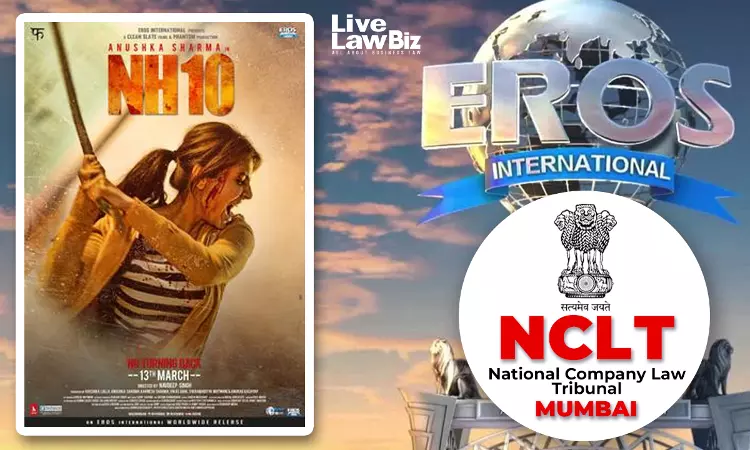
The Mumbai Bench of the National Company Law Tribunal (NCLT) has dismissed an insolvency plea filed by Phantom Studios India Pvt Ltd against Eros International Media Ltd.
The Tribunal held that Phantom Studios' claim for ₹1.48 crore arising from the parties' co-production arrangement for the film NH10 did not qualify as an operational debt under the Insolvency and Bankruptcy Code.
A bench of Judicial Member Lakshmi Gurung and Technical Member Hariharan Neelakanta Iyer rejected Phantom Studios' petition seeking initiation of the corporate insolvency resolution process against Eros over an alleged default of Rs 1.48 crore.
“As in the facts and circumstances of present case the dues claimed by Petitioner do not constitute an operational debt within the meaning of Section 5(21) of the Code, as discussed above, this Tribunal does not deem it necessary to examine other aspects of this case.”
The dispute arose from a term sheet executed in February 2013 and a Film Co-Production Agreement signed in December 2013 for the Hindi film NH10. Under the arrangement, Phantom's predecessor entity was responsible for producing the film. Eros financed, distributed and exploited the film.
Following a series of assignments and a deed of novation executed in January 2022, Phantom Studios stepped into the shoes of the original producer. The company relied on a letter dated March 14, 2024, under which Eros agreed to pay Rs 1.25 crore by June 30, 2024. Phantom claimed that the amount remained unpaid.
The Tribunal examined the co-production agreement and noted that the parties had agreed to share profits from the film equally after recoupment of production costs. It also recorded that actor Anushka Sharma's fee of Rs 1.25 crore was to be borne equally by the parties. Each side was to contribute Rs 62.50 lakh, which would later be recouped from revenues generated through exploitation of the film.
The bench noted that the invoices raised by Phantom were for recoupment from revenues generated through exploitation of the film's rights. They were not invoices for the supply of goods or services.
“A perusal of the aforesaid arrangement demonstrates that the nature of the transactions entered into between the parties were not that of a Vendor and Vendee.”
The tribunal found that the arrangement reflected a common commercial venture. It observed that the parties exercised joint control over key aspects of the project. They had also agreed to share profits equally and contribute equally towards the lead actor's fee.
“These features are indicative of a joint venture arrangement between the parties.”
Having concluded that the relationship between the parties was in the nature of a joint venture, the Tribunal held that any amount due under that arrangement could not be treated as an operational debt.
“Further, the judgements submitted by the Petitioner do not aid the case of the Petitioner as the facts and circumstances in those cases are distinguishable from the facts of the present case. The Petitioner via this petition is seeking recovery of amount in default. IBC cannot be used as a tool for recovery or as a lever to coerce payment.”
For Petitioner: Advocates Shyam Kapadia, Shamant Satiya, Nishi Doshi,Janaki Garde instructed by Rashmikant & Partners.
For Corporate Debtor: Advocates Ali Ibrahim, Prashant Leo, Tarun Singla, Adv. Mayank Sharma, Ayush Jindal, Ashu Goyal, Arunim Sharma