
Market Integrity Prevails Over Investor Gains; Profits Can't Excuse Regulatory Breach: Supreme Court
Kirit Singhania
14 July 2026 9:29 AM IST
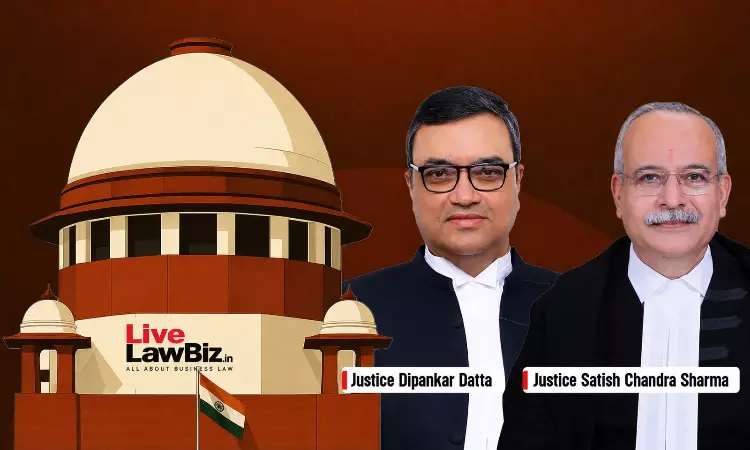
The Supreme Court on Monday held that market integrity and regulatory compliance cannot be compromised merely because investors ultimately earned profits. It ruled that a regulatory breach cannot be excused simply because investors suffered no loss.
A bench of Justices Dipankar Datta and Satish Chandra Sharma dismissed appeals filed by Kotak Mahindra Asset Management Company (Kotak AMC), Kotak Mahindra Trustee Company Ltd. and their senior executives. The appeals challenged SEBI's action over investments in Essel Group debt securities under six close-ended mutual fund schemes. The court left intact the Securities Appellate Tribunal's judgment affirming SEBI's findings.
"Market integrity being the paramount consideration, profit or loss to investors is immaterial to determine whether a regulatory infraction has occurred. A wrongdoer cannot be allowed to use the plea of the investors having gained, notwithstanding the violation, as a shield for evading penalty. The 1996 Regulations operate in a specific field: to ensure compliance. Variable scenarios of violation is not contemplated," the court held.
It also upheld the penalties imposed by SEBI and directed Kotak AMC and Kotak Mahindra Trustee Company Ltd. to pay costs of ₹30 lakh and ₹20 lakh, respectively, within two months.
"Market integrity being the paramount consideration, profit or loss to investors is immaterial to determine whether a regulatory infraction has occurred. A wrongdoer cannot be allowed to use the plea of the investors having gained, notwithstanding the violation, as a shield for evading penalty. The 1996 Regulations operate in a specific field: to ensure compliance. Variable scenarios of violation is not contemplated," the court held.
The dispute arose from Kotak AMC's investments in Essel Group debt securities under six close-ended fixed maturity plans. After the value of pledged Zee Entertainment shares declined, Kotak AMC extended the maturity of the debt securities and delayed full redemption of the schemes.
Kotak AMC argued that extending the maturity of the securities protected investors from losses and ultimately benefited them. It maintained that it had exercised due diligence while making the investments and pointed out that other mutual funds had also invested in similar Essel Group securities. SEBI, however, maintained that the issue was one of regulatory compliance, not investment outcomes. It contended that the fact that investors eventually gained could not justify a departure from the statutory framework.
The court rejected those submissions. It held that the regulatory framework requires strict compliance and due diligence, and that investor gains cannot serve as a defence once a regulatory breach is established.
It ruled that once a regulatory breach is established, the fact that investors eventually benefited cannot be treated as a defence. The bench also upheld the Whole Time Member's finding, affirmed by the tribunal, that Kotak AMC had failed to exercise due diligence.
"Additionally, regulation 25(16) read with the Fifth Schedule of the 1996 Regulations demands due diligence. The focus should, therefore, have been on diligence, not dividends. Having faltered, the appellants have to bear the consequences. We, therefore, see no reason to agree with the contention that there was no lack of due diligence. The WTM's order, since affirmed by the TRIBUNAL, is cogent and commends itself for acceptance. The contentions of KOTAK AMC, thus, stand rejected," the court observed.
The bench also rejected Kotak AMC's argument that similar conduct by other market participants justified its actions. It held that one regulatory violation cannot be defended by pointing to another. The principle of negative equality, the court ruled, has no application in such cases.
"The contention that no loss was caused to the investors/unitholders and, on the contrary, they gained and, hence, action should not have been taken is no defence at all. The 1996 Regulations make no distinction between a breach resulting in profit and a violation resulting in loss. Neither do we. Breaches of the regulatory framework, fortuitously, could ultimately result in gain but excusing a breach which led to profit is likely to incentivize the next breach. Progression from profit to greed, from greed to regulatory breach and from breach to systemic failure is not too unfamiliar," the court held.
The court further ruled that Kotak AMC had not followed the mandatory procedure for rolling over the close-ended schemes. The required disclosures to investors and SEBI were not made, and mandatory investor consent was never obtained. In the absence of a valid roll-over, the resulting breach was "brazen and indefensible."
Addressing Kotak AMC's submission that it had acted to protect investors, the bench held that mutual fund investments are made subject to statutory risk disclosures. Those disclosures, it ruled, cannot justify a departure from the regulatory framework or absolve liability for regulatory violations.
"The 'Risk Disclosure Statement' and the 'Due Diligence Advisory', as has been noticed at the beginning of this judgment, comprise the 'Statutory Disclaimer'. Those willing to invest in mutual funds despite such disclaimer do so at their own risk and peril. Committing a breach to save such investors is no justification for deviation from the regulatory mandate and does not absolve liability. The course adopted by KOTAK AMC was wholly unknown to, and irreconcilable with, the legislative scheme enacted under the SEBI Act," the court observed.
Finding no ground to interfere with the tribunal's judgment or the penalties imposed by SEBI, the court dismissed all the appeals. It additionally directed Kotak AMC and Kotak Mahindra Trustee Company Ltd. to deposit costs of ₹30 lakh and ₹20 lakh, respectively, within two months.
For Appellants: Shyam Divan, Mukul Rohatgi, Senior Advocates, Advocates Mahesh Agarwal, Ankur Saigal, Ashwath Rau, S. Lakshmi Iyer, Deepsikha Mishra, Kashish Bhatia, Anushree Kapooria, Aditi Shukla, Ritish Desai, Dishti Kaji, Ankur Singhal, Anshula L Bakhru, E. C. Agrawala, AOR, Mahesh Agarwal, Ankur Saigal, Ashwath Rau, S. Lakshmi Iyer
For Respondent: N. Venkataraman, A.S.G., Amarjit Singh Bedi, Advocates Surekha Raman, Sidharth Nair, Harshit Singh, Yashwant Sanjenbam, M/S. K J John And Co, AOR