
Profitable Companies Can Face Insolvency Proceedings If They Default On Loans: Supreme Court
Kirit Singhania
15 Oct 2026 7:24 PM IST
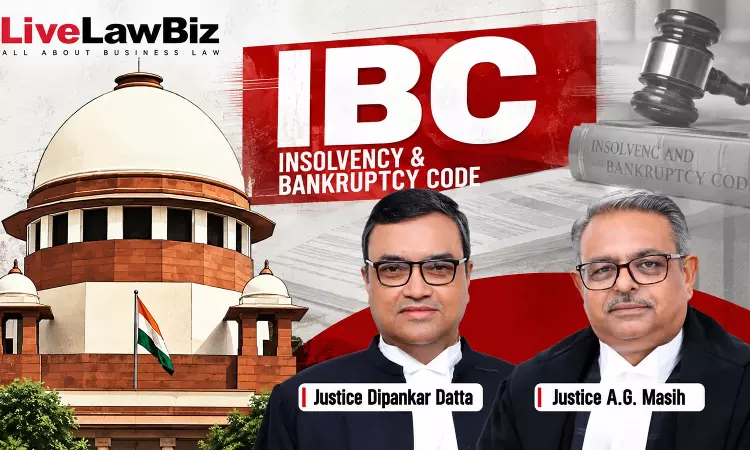
The Supreme Court on Thursday held that a company's profitability does not prevent insolvency proceedings under the Insolvency and Bankruptcy Code (IBC).
A financial default, rather than commercial or balance-sheet insolvency, triggers the Corporate Insolvency Resolution Process (CIRP).
“Profitability is neither legally relevant to, nor economically probative of, the capacity to service debt. The Code proceeds upon the principle of timely intervention rather than terminal insolvency, and adopts 'default' under Section 3(12) of the Code, not commercial or balance-sheet insolvency, as the jurisdictional trigger,” a bench of Justices Dipankar Datta and Augustine George Masih observed.
The court dismissed appeals filed by Deepak Raheja and another appellant challenging the National Company Law Appellate Tribunal's August 19, 2025 order. The tribunal had upheld the admission of insolvency proceedings against GSTAAD Hotels Pvt Ltd and Neo Capricorn Plaza Pvt Ltd.
The dispute arose from loan facilities worth ₹600 crore extended by Piramal Finance to the two companies as co-borrowers under an agreement dated December 26, 2017.
The lenders assigned the loans to Omkara Asset Reconstruction in December 2022. After issuing recall notices, Omkara moved the NCLT in March 2023. The tribunal admitted the insolvency petitions in 2024, and the appellate tribunal upheld the orders in August 2025 after a fresh hearing.
Before the apex court, the companies argued that they were profitable and had positive EBITDA. The court rejected this, holding that Section 7 proceedings require proof of financial debt and default, not a detailed audit of every account entry. Disputes over the exact amount owed do not negate default if the statutory threshold is met.
The court also laid down a hierarchy for assessing documentary evidence. An authenticated record of default issued by an Information Utility carries high evidentiary value and is sufficient to establish default at the prima facie stage.
Such a record can be displaced only by clear, cogent, credible and compelling material, not by a bare denial or bookkeeping disagreement.
“The documentary evidence upon which the Adjudicating Authority may record its satisfaction admits of a hierarchy. At the first tier stands a record of default issued by an Information Utility, which is by itself sufficient and which creates a presumption of high evidentiary value, displaceable only by clear, cogent, credible and compelling material and not by bare denial or bookkeeping disagreement.”. the court ruled.
Other documents, including loan agreements, statements of account, balance confirmations, acknowledgements of liability and contemporaneous correspondence, may collectively establish default. They do not individually carry the same evidentiary status as an authenticated Information Utility record.
The court further held that a corporate debtor that allows an Information Utility record to go unchallenged through authentication cannot subsequently deny the default in Section 7 proceedings where the circumstances attract the principle of estoppel.
The court found defaults of ₹17.16 crore at GSTAAD Hotels and at least ₹2.64 crore at Neo Capricorn Plaza, both above the IBC's threshold. Company correspondence showed that rising interest costs had affected repayments, hotel revenues had fallen by over 90% during the pandemic, and around 400 employees had been retrenched.
Rejecting the companies' reliance on positive EBITDA, the court pointed to GSTAAD Hotels' debt service coverage ratio of 0.12 in 2022–23, meaning internal accruals covered only 12% of its debt obligations.
The court also held that the 2026 IBC amendments clarified the law on admitting insolvency petitions. It dismissed both appeals, allowing the proceedings to continue.
For the Appellants: Arunabh Chaudhry, Sr. Adv., Farrukh Rasheed- 1993, AOR, Khalid Israr, Khalid Israr, Harshita Singhal, Shakil Ahmed, Zahid Hussain, Mohd Zahid Hussain, Advocates
For the Respondents: Abhishek Anand, Mandeep Kalra- 3242, AOR, Chitrangada Singh, Yashas J, Vaibhav Yadav, Paras Mohan Sharma, Karan Kohli, Palak Kalra, Ridhima Mehrotra, Vanshika Dhoot, Ira S. Mahajan, Varad Kohle, Saumitr Kumar, Radhika Narula, Anushna Satapathy, Advocates