
How A Nation Taxes Its People Reflects Who Deserves Liberty, Right To Love: Same-Sex Partners Tell Karnataka HC In Tax Exemption Case
Kirit Singhania
12 Oct 2026 5:42 PM IST
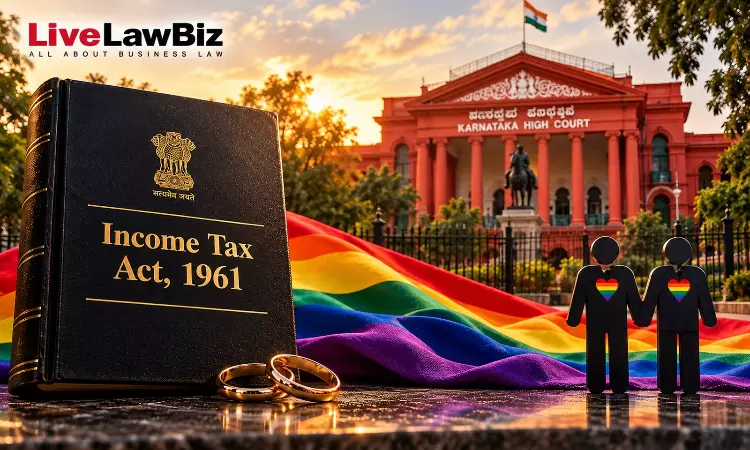
A same-sex couple has argued before the Karnataka High Court that the Income Tax law effectively makes them pay tax for expressing love for their partners, while married couples can exchange gifts without the same tax burden.
Arguing that a nation's tax laws reflect the values it upholds, Advocate Dr. Dhruv Janssen Sanghvi, in a rejoinder, appearing for Anurag Kalia and Akhilesh Godi, a same-sex couple, submitted that excluding same-sex partners from the gift-tax exemption available to spouses raises questions about whose relationships receive equal treatment under the law.
“Also how a nation taxes its people reflects the values it holds. Distinguishing between its people, in how it taxes them, reflects who it thinks deserves liberty and who it does not. And in the instant case, it translates to who deserves to express their love for their life partners, and who must pay taxes for expressing,” Sanghvi submitted.
A Single Judge Bench of Justice B.M. Shyam Prasad was hearing a petition challenging the exclusion of same-sex partners from the exemption under the fifth proviso to Section 56(2)(x) of the Income Tax Act, 1961.
The petition arose after Godi gifted Kalia a 22-karat gold bracelet, described as a family heirloom. The petitioners challenged the tax treatment of the gift, arguing that the exemption available to spouses should also extend to same-sex partners.
Sanghvi submitted that although marriage could constitute a reasonable basis for classification in certain contexts, it could not automatically justify excluding same-sex couples from the tax exemption. He argued that the classification must be examined in the context of the specific provision and the constitutional rights it affects.
He submitted that marriage could be a reasonable ground for classification when it concerned access to religious and social institutions protected under Article 25 of the Constitution or the protection of women and children under Article 15(3). However, he argued that neither consideration justified the exclusion in the present case.
Sanghvi pointed out that a gift made by one spouse to another was excluded from the recipient's taxable income. He argued that denying the same treatment to same-sex partners could not be justified merely by relying on marital status.
“A gift made by a wife to her husband is equally excluded from the scope of his income as it is vice versa,” Sanghvi submitted.
Sanghvi relied on the Supreme Court Constitution Bench's judgment in Supriyo v. Union of India, which dealt with the legal recognition of same-sex marriages. He argued that the judgment addressed the question of the right to marry and its associated legal consequences, whereas the present case concerned a distinct issue under the Income Tax Act.
Referring to the discussion in Supriyo concerning adoption by same-sex couples, Sanghvi submitted that the Court's concerns arose from the absence of a legislative framework governing matters such as child custody and maintenance in the event of separation. He argued that the gift-tax exemption in the present case did not involve comparable concerns relating to children, religious practices or cultural rights.
Sanghvi then addressed the respondents' reliance on the concept of under-inclusion to defend the classification. He argued that where a law extends a benefit to some members of a class but excludes others, the exclusion cannot automatically be treated as constitutionally permissible.
“I'm trying to put the concept of under-inclusion, which can be justified or it cannot, it is unjustified discrimination,” he submitted.
Referring to State of Gujarat v. Ambica Mills, Sanghvi argued that the judgment recognised that courts could potentially consider whether an under-inclusive classification should be remedied by extending a statutory benefit to an excluded class.
He relied on paragraph 76 of the judgment, which left open whether a court could address an unreasonable classification by extending the legislation to cover an omitted class or by applying the doctrine of severability.
Reading from the judgment, he submitted:
“Whether a court can remove the unreasonableness of a classification when it is under inclusive, by extending the ambit of the legislation, to cover the class omitted to be included or by applying the doctrine of severability, to delete a clause which makes the classification over inclusive, are matters on which it is not necessary to express any final opinion.”
Sanghvi argued that although the Supreme Court had not conclusively decided the issue in Ambica Mills, the passage supported the proposition that under-inclusion was not necessarily beyond judicial scrutiny. He distinguished the case, arguing that the petitioners' position was the inverse of the situation discussed there.
“Our case is the exact inverse of it. We are the underincluded class and we are saying these extend the benefit of the provision to us,” Sanghvi argued.
The petitioners' counsel also addressed the respondents' reliance on Venu Gopala Ravi Varma Raja v. Union of India, which concerned the constitutional validity of provisions of the Expenditure Tax Act, 1957, as applied to Hindu undivided families. He submitted that the case involved an Article 14 challenge concerning the classification of taxpayers and the application of an exemption threshold, rather than a challenge based on the grounds of discrimination raised in the present petition.
He further relied on Tukkin Roy Rymbai, concerning the tax exemption available to members of Scheduled Tribes in specified areas under Section 10(26A) of the Income Tax Act. Sanghvi submitted that the decision had to be considered alongside Lawrence Singh Indi v. State of Assam, in which a distinction affecting government employees was held unconstitutional and the benefit was extended to the excluded assessee.
He argued that these decisions demonstrated that an under-inclusive classification did not automatically insulate a law from judicial review. The constitutional validity of the exclusion, he submitted, depended on the justification for the distinction and the rights affected.
“Just the use of the terminology under inclusion does not automatically mean that the discrimination is beyond judicial review,” Sanghvi submitted.
He added that under-inclusion could be constitutionally valid in some circumstances but not in others. In the present case, he argued, the exclusion of same-sex partners was not justified by Article 15(3), Article 25 or any other constitutional provision identified by the respondents.
Sanghvi then distinguished under-inclusion from indirect discrimination. Relying on the Supreme Court's decision in Lt. Col. Nitisha v. Union of India and its discussion in Supriyo, he argued that constitutional scrutiny must consider the effect of a law on the affected group rather than merely the legislature's stated intention.
Concluding his submissions, Sanghvi argued that excluding same-sex partners from the gift-tax exemption imposed a different tax consequence on their relationships despite the comparable nature of gifts exchanged between spouses. He urged the Court to examine whether the classification could withstand constitutional scrutiny in the context of the tax provision.
The court has fixed November 2 as the next date to seek clarification on certain documents filed in the case, after which it is expected to reserve its verdict.