
Forensic Audit Of Fortis Share Transactions Involving 17 Banks Can't Be A 'Fishing And Roving Inquiry': Supreme Court
Kirit Singhania
29 Sept 2026 1:39 PM IST
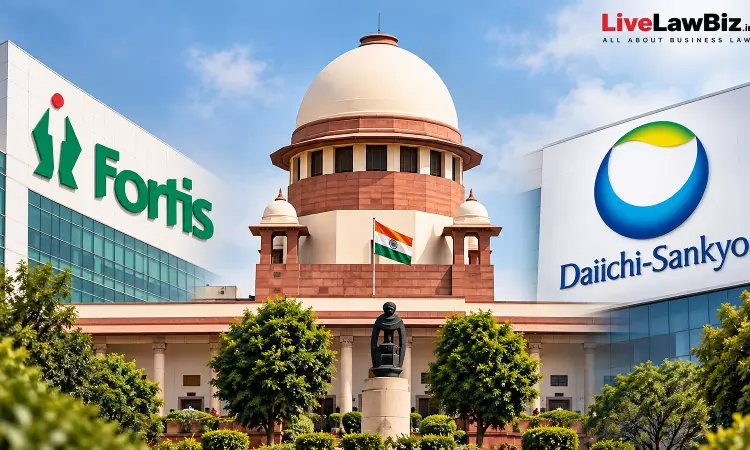
The Supreme Court on Tuesday clarified that the forensic audit ordered by the Delhi High Court into the alleged dissipation of Fortis Healthcare Ltd (FHL) shares cannot become a “fishing and roving inquiry” into the affairs of 17 banks and financial institutions.
The audit, ordered in the enforcement proceedings arising from Daiichi Sankyo's ₹2,562 crore arbitral award against the Singh brothers, requires the banks to be examined only in relation to their commercial transactions with FHL, Fortis Healthcare Holdings Pvt Ltd (FHHPL), and the judgment debtors.
The Delhi High Court had directed the forensic auditor to examine the banks' role in loans secured by FHL shares. This includes the creation and variation of security, maintenance of security margins, contractual top-up mechanisms, invocation and sale of pledged shares, release of security and the outstanding liability corresponding to each transaction.
The auditor was also directed to prepare a bank-wise statement detailing the facilities, value of each facility, FHL shares pledged, fresh securities, top-up transfers, invocation, sale and release of securities, outstanding exposure and the judicial orders applicable to each transaction.
The banks from which the judgment debtors had taken loans were directed to assist the forensic auditor. They are required to provide the information and documents sought by the auditor, including any additional material subsequently requisitioned.
The clarification came while the Supreme Court was hearing pleas filed by Yes Bank and Axis Bank against the Delhi High Court's forensic audit directions.
A Bench of Chief Justice of India Surya Kant and Justices Joymalya Bagchi and V. Mohana while making it clear that the directions do not authorise any “fishing and roving inquiry” into the affairs of the banks beyond such transactions, said:
“We have heard learned senior counsel for the parties at a considerable length. The relevant records have also been perused with their able assistance. In sum and substance, it seems to us that the directions to conduct a forensic audit are primarily directed with respect to the transactions between FHL, FHHPL and the judgment debtors. The directions issued by the High Court in paragraph 274 of the impugned judgment regarding the forensic audit qua 17 banks, therefore, ought to be read and construed in that context. In other words, these directions pertain to the commercial transactions/ relationships between the judgment debtors, FHL, FHHPL and the banks. Clauses x and xi of Paragraph 274 of the impugned judgment need not be misconstrued as if there is a direction for a fishing and roving enquiry into the entire affairs of the banks other than their transactions with FHL, FHHPL and the judgment debtors. With this clarification, these Special Leave Petitions stand disposed of, with pending application(s), if any."
The clarification consequently leaves the forensic audit in place but limits its scope. The 17 banks may have their records and involvement examined to the extent relevant to their commercial transactions with FHL, FHHPL and the judgment debtors, but the High Court's directions cannot be read as authorising a general investigation into the affairs of the banks.
Senior Advocate Shyam Divan, appearing for Yes Bank, submitted that the execution application had initially sought a forensic audit concerning 17 noticee banks and financial institutions, but Daiichi had subsequently stated that it was not pressing for a forensic audit of the banks. He argued that the banks could not be subjected to an expansive forensic exercise without being put to notice.
Divan submitted:
“It would be grossly inequitable to pursue a forensic audit into banks and financial institutions, and result in a wastage of precious judicial time.”
He also submitted that Yes Bank was not a judgment debtor or garnishee and was itself seeking recovery of substantial outstanding amounts.
He submitted that Daiichi had specifically told the High Court that it was not pressing the prayer for a forensic audit of the banks and was instead seeking an audit concerning FHL and the judgment debtors.
He emphasised that Yes Bank was a regulated banking institution subject to extensive regulatory oversight.
“A bank is very important. I have got huge regulatory oversight. The Reserve Bank of India is my primary regulator. I have all sorts of audits and compliances which have to be completed.”
Divan also disputed any suggestion that Yes Bank was a judgment debtor or garnishee in the proceedings.
Senior Advocate Naveen Pahwa, appearing for DCB Bank, submitted that the facts concerning his client were entirely different. He pointed out that the loan had been completely repaid on August 8, 2017 and the pledge had been released. DCB Bank, he said, had never invoked the pledge.
“I never invoked the pledge. Entire loan is repaid and shares released. I am completely out. I never invoked the pledge.”
Pahwa argued that there was no allegation against DCB Bank which justified subjecting it to the forensic exercise.
Senior Advocate Arvind Datar, appearing for a Japanese company, submitted that Daiichi had initially sought examination of the banks but had subsequently not pressed for a separate forensic audit of the banks after prolonged litigation.
He nevertheless submitted that examination of the transactions was necessary to determine what happened to the FHL shares and whether the Supreme Court's earlier directions concerning those shares had been complied with.
Senior Advocate Abhishek Manu Singhvi, appearing for Fortis Healthcare, supported the forensic audit. He submitted that the earlier proceedings had not conclusively established what happened to the FHL shares and that examination of the relevant records was necessary to unravel the transactions.
During the hearing, the Bench also indicated that the relevant bank records could be examined insofar as they related to the transactions involving FHL/FHHPL and the judgment debtors. The Court sought to ensure that the forensic exercise remained contextualised and did not become an unrestricted audit of the banking institutions.
Separately, the Supreme Court on September 25, 2026 dismissed Fortis Healthcare Ltd.'s plea challenging the Delhi High Court's order directing a comprehensive forensic audit of transactions involving FHL shares.
For Petitioners: Shyam Divan, Sr. Adv. Mr. Ritin Rai, Sr. Adv. Ms. Shally Bhasin, Adv. Mr. Prateek Yadav, Adv. Ms. Jyotsna Punshi, Adv. Ms. Sonsie Khatri, Adv. Mr. Adith Deshmukh, Adv. Mr. Apoorva Nangia, Adv. Mr. S. S. Shroff, AOR Mr. Shyam Divan, Sr. Adv. Mr. Malak Manish Bhatt, AOR Ms. Samridhi, Adv. Mr. Adith Deshmukh, Adv. Ms. Tashi Saraf, Adv.
For Respondent: Aditya Dewan, Adv. Ms. Himangi Kapoor, Adv. Mr. Naman Tandon, AOR, Himangi Kapoor, Adv. Mr. Naman Tandon, AOR Mr. Navin Kumar Pahwa, Sr. Adv. Mr. Abhishek Singh, Adv. M/S. K Ashar & Co., AOR Mr. Amit Rawal, Sr. Adv. Mr. Mukul Rohatgi, Sr. Adv. Mr. Arvind Datar, Sr. Adv. Mr. Arvind Nigam, Sr. Adv. Mr. Anand Swarup Pathak, Adv. Mr. Giriraj Subramanium, Adv. Mr. Nabik Syam, Adv. Mr. Pawan Bhushan, Adv. Ms. Anandita Barman, Adv. Mr. Shashank Kumar Anand, Adv. Mr. Chirag Gupta, Adv. Mr. Sai Srijan Neti, Adv. Mr. Rahul Krishan Sharma, Adv. Mr. Jaisal Baath, Adv. Mr. Kunal Chatterji, AOR Ms. Bijaharini G, Adv. Mr. Sushant Bontha, Adv. Mr. Kunal Chatterji, AOR Ms. Saman Ahsan, Adv. Ms. Srijata Majumdar, Adv. Mr. Rahul Sangwan, Adv.