
FERA Opportunity Notice Mandatory Before Instituting Complaint, Taking Cognizance: Supreme Court
Kirit Singhania
21 July 2026 5:56 PM IST
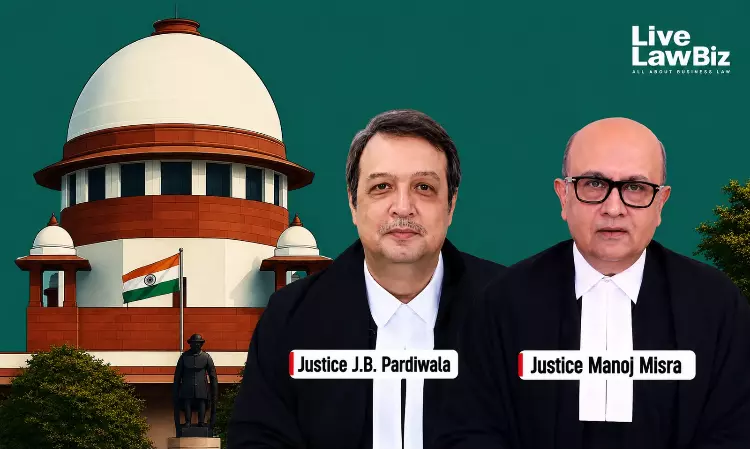
The Supreme Court on Tuesday held that no criminal complaint under the Foreign Exchange Regulation Act (FERA) can be instituted unless the proposed accused is first given a meaningful opportunity to show it had the requisite permission, ruling that the requirement is mandatory and not a mere procedural formality.
A bench of Justices J.B. Pardiwala and Manoj Misra, relying on the Delhi High Court's decisions in Devashis Bharracharya, Sanjay Malviya, United India Airways Ltd., and Shilpi Modes, held:
"Thus, the conspectus of the above discussion is that the service of an opportunity notice under the proviso to Section 61(2) of FERA is a mandatory requirement, without compliance of which no complaint under Section 56 or 57 of FERA respectively, can validly be instituted, and no Magistrate can validly take cognizance of the offence alleged therein. This opportunity must be meaningful and adequate, and not a mere technical or notional compliance, given the drastic penal consequences that follow from proceedings under FERA."
The ruling came while allowing appeals filed by Standard Chartered Bank and its official, B. McHugh, against criminal proceedings initiated by the Enforcement Directorate over alleged FERA violations relating to foreign exchange remittances. The court set aside the Bombay High Court's March 22, 2012 judgment and quashed the trial court's cognizance and summoning orders.
The case arose from alleged FERA violations in 1992 involving foreign exchange remittances routed through Standard Chartered Bank's Vostro account. According to the prosecution, the bank credited remittances for the benefit of a person resident outside India without the requisite permission. Criminal complaints were filed in May 2002, following which the trial court took cognizance and issued summonses.
The bank challenged the proceedings, contending that it had never been served with the mandatory opportunity notice before the complaints were filed. It also argued that the prolonged proceedings had violated its fundamental right to a speedy trial.
The Enforcement Directorate argued that the Bombay High Court had rejected the bank's petitions on merits. It contended that the High Court's observations regarding the availability of an alternate remedy were not determinative.
The court, however, held that the High Court's judgment was fundamentally premised on the view that the appellants ought to have first exhausted the alternate remedy before invoking the High Court's inherent jurisdiction. It held that the availability of such a remedy did not bar the High Court from exercising its inherent powers.
Turning to the issue of the opportunity notice, the court found that the Enforcement Directorate had neither disclosed the date of the alleged notice nor produced a copy of it or any proof of its service. It also noted that despite being given an opportunity by the Supreme Court to place additional documents on record, the Enforcement Directorate failed to produce the alleged notice.
The court observed that the Magistrate had taken cognizance without recording satisfaction that the mandatory requirement had been complied with, as no opportunity notice was placed on record before it. It also noted that the High Court had failed to address the issue.
"In such circumstances, applying the principles laid down in the decisions discussed above, we are of the considered opinion that the mandatory requirement of the proviso to Section 61(2) of FERA has not been complied with in the present case, giving rise to violation of principle of natural justice, and therefore, the order of the Magistrate taking cognizance of the complaints and issuing summons to the appellants, having been passed without satisfaction of this mandatory pre-condition, cannot be sustained in law.", the top court ruled.
The court also examined the bank's contention that the proceedings had violated its right to a speedy trial. While reiterating the settled principles governing such claims, it found that the respondent-complainant was responsible for the prolonged delay in the proceedings.
It noted that although the High Court had initially granted one month to conclude the trial, and later extended the time by another six months, the Enforcement Directorate failed to diligently pursue the proceedings.
"Given a clear window of one-month to conclude the trial, the respondent – complainant's response was to refuse to even collect the notices meant for service upon the accused. This compelled the trial court to seek an extension, which the High Court granted, allowing a further 6-months. Yet the record shows that the respondent - complainant continued to remain absent right through thisextended period, and indeed, right up to the filing of the present appeals before us.", the court noted
Accordingly, the court set aside the Bombay High Court's March 22, 2012 judgment, quashed the cognizance and summoning orders, and allowed the appeals.
For Appellants: Senior Advocate: Shyam Divan; AORs: Gagan Gupta, Ananta Prasad Mishra; Advocates: Ateev Mathur, Ajay Monga, Sanjay Gupta.
For Respondents: Senior Advocate: Ruchi Kohli; AORs: B. Krishna Prasad, Aaditya Aniruddha Pande; Advocates: Srishti Mishra, A.K. Sharma, Vatsal Singh, Anuj Srinivas Udupa, Sarthak Karol, Arvind Kumar Sharma, Siddharth Dharmadhikari, Shrirang B. Varma, Bharat Bagla, Sourav Singh, Aditya Krishna, Preet S. Phanse, Adarsh Dubey.