
Challenge To Arbitral Award Can Be Heard By District Court Where No Commercial Court Exists: Supreme Court
Kirit Singhania
23 Sept 2026 7:16 PM IST
The Supreme Court has ruled that a petition challenging an arbitral award under Section 34 of the Arbitration and Conciliation Act can be filed before a Commercial Court.
Where no Commercial Court has been established, it can be filed before a District Court within the territorial jurisdiction of the concerned High Court.
This is unless the parties have agreed otherwise or a specific arbitral seat has been determined.
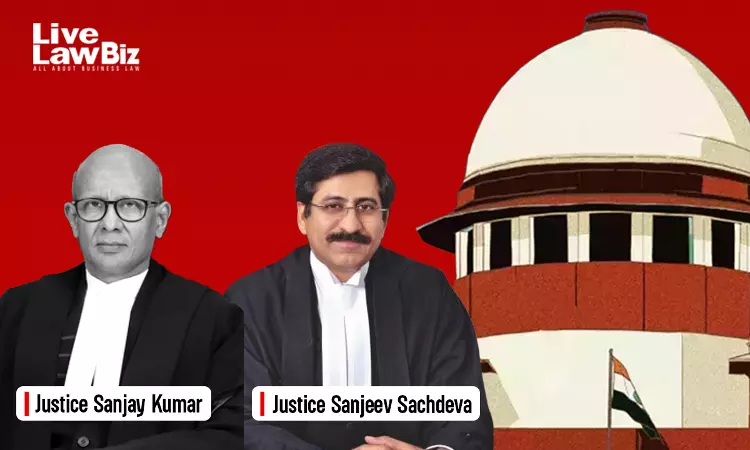
A bench of Justice Sanjay Kumar and Justice Sanjeev Sachdeva made the observation while allowing Mahanadi Coalfields Ltd's appeal against an Orissa High Court order. The High Court had held that MCL's Section 34 petitions before the District Judge, Sundargarh were not maintainable for want of jurisdiction and were also time barred.
The Supreme Court set aside the June 20, 2025 order and restored the petitions before the Sundargarh court.
“A High Court of a State exercises jurisdiction over the entire State and as such all the Commercial Courts/District Courts (where no commercial Court has been set up) within the territorial jurisdiction of the High Court would have jurisdiction to entertain a petition under section 34 of the Act,” the court ruled.
It added that this would not apply where the parties had agreed otherwise or a specific seat had been determined.
The dispute arose from a 2012 contract between Mahanadi Coalfields and GSCO Infrastructure Pvt Ltd for hiring heavy earth-moving machinery. The work concerned MCL's Kulda Open Cast Project and other specified areas in Sundargarh, Odisha.
After disputes arose over the contract, the Orissa High Court appointed Justice M.M. Das (Retd.) as the sole arbitrator on March 25, 2019. The arbitration proceedings were held at Cuttack. The arbitrator passed an award on October 25, 2021.
MCL filed three petitions under Section 34 before the District Court, Sundargarh on December 8, 2021. It sought to set aside the arbitral award.
GSCO objected to the petitions. It contended that Cuttack was the seat of the arbitration and that the Sundargarh court therefore lacked territorial jurisdiction. It also argued that the petitions were filed beyond the limitation period.
The High Court accepted both objections. It held that Cuttack was the seat because the arbitrator had been appointed by the High Court at Cuttack under Section 11(6) and because the High Court was situated there. It also held that the Section 34 petitions were time barred.
The Supreme Court disagreed with the finding on jurisdiction. It drew a distinction between the “seat” and “venue” of arbitration. The seat determines which courts exercise supervisory jurisdiction over the arbitration. The venue is the physical location where the arbitration sittings are held.
“There is a distinction between 'seat' and 'venue' of arbitration,” the court observed.
It held that the March 25, 2019, order referring the disputes to the sole arbitrator did not specify any seat or venue. There was also no agreement between the parties designating Cuttack as the seat.
The court further ruled that the fact that the arbitrator was appointed by the High Court at Cuttack did not make Cuttack the juridical seat of the arbitration. The mere conduct of the proceedings at Cuttack also could not, by itself, determine the seat.
The court also noted that the contract contained clauses providing for disputes to be dealt with before the District Court where the work was executed. The subject work was executed in Sundargarh. No Commercial Court had been established for the district at the relevant time.
The Supreme Court therefore held that the Section 34 petitions could be presented before the District Judge, Sundargarh.
It rejected the High Court's view that the Section 11 proceedings before the High Court at Cuttack gave courts there exclusive jurisdiction.
On limitation, GSCO's senior counsel conceded before the Supreme Court that the High Court's finding was erroneous. MCL had filed the Section 34 petitions on December 8, 2021. This was within three months of the October 25, 2021 arbitral award.
The apex court accordingly allowed the appeal. It set aside the High Court's order and restored the Section 34 petitions before the District Judge, Sundargarh. The district court was directed to decide them expeditiously in accordance with law.
For Petitioner: R. Venkataramani, A.G., Advocates Soumyajit Pani, Aishwary Bajpai, Varun, Siddharth Jain, AOR
For Respondent: Ashok Panigrahi, Sr. Advocate, Advocates Avijit Patnaik, Shuvra Mohapatra, Raja Kumar Pati, Shreyan Das, Aditya Narayan Das, Mohini Priya, AOR