
Bombay High Court Quashes Centre's Retrospective One-Time Spectrum Charge On Airtel, Vodafone Idea
Kirit Singhania
8 Jun 2026 7:32 PM IST
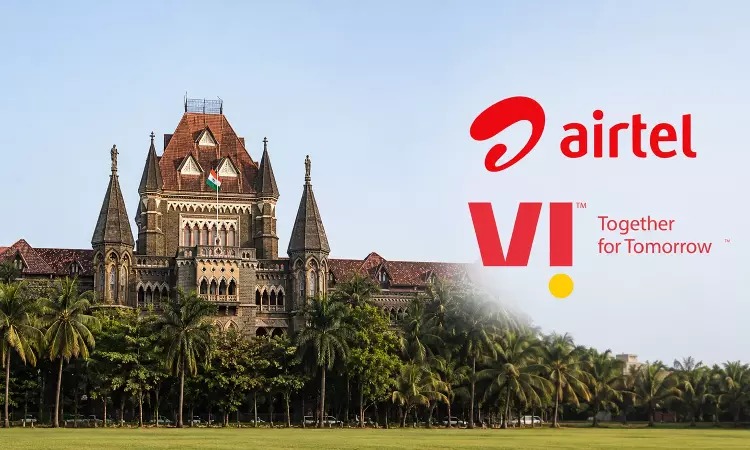
The Bombay High Court on Monday quashed the Centre's decision imposing one-time spectrum charges retrospectively on Bharti Airtel and Vodafone Idea under the National Telecom Policy, 1999 (NTP-99) regime.
The court held that the Union Government lacked authority under Section 4 of the Indian Telegraph Act, 1885, or the telecom licence agreements to levy such charges for spectrum held beyond 6.2 MHz from July 2008 onwards.
A Division Bench of Justices Manish Pitale and Shriram V. Shirsat held that telecom licences are contracts requiring definite consideration. It said the Union Government's power to impose charges must flow from the terms of the licence itself. The Court held that Section 4 of the Telegraph Act could not be invoked to unilaterally impose liabilities contrary to the contractual framework agreed between the parties.
“Such a contract in the form of license, must have a definite price and clearly discernible consideration in terms of the position of law noted hereinabove. The terms of contract are the determining factors and the source of power for the respondent – Union of India to justify its impugned decisions, must have its source in the terms of contract. The respondent obviously cannot claim statutory power under Section 4 of the Telegraph Act to act as per its own whim, notwithstanding the terms of contract/license executed as per the power available under the said provision,” the Court observed.
The Court further held that the 2012 decisions retrospectively imposed liability from 2008 despite the absence of any statutory or contractual source of power. It said the impugned decisions effectively amounted to executive orders unsupported by law.
“We find that in the present case, the impugned decisions have the effect of placing liability on the petitioners retrospectively for a period starting from the year 2008, while the decisions were taken in the year 2012. Since we have already found that there was lack of power in the respondent Union of India either under the Statute or under the terms of the contract to impose such a retrospective liability, the impugned decisions become nothing but executive orders without any source of power, seeking to impose liability retrospectively,” the Court held.
The dispute arose from the National Telecom Policy, 1999, which replaced the fixed licence fee regime with a revenue-sharing model. Following a Union Cabinet decision dated November 8, 2012, and a Department of Telecommunications order dated December 28, 2012, telecom operators were directed to pay a one-time spectrum charge for spectrum held beyond 6.2 MHz during the period from July 1, 2008, to December 31, 2012.
Bharti Airtel and Vodafone Idea challenged the levy. They contended that they had already paid consideration for spectrum through licence fees, revenue-sharing payments, and spectrum usage charges under their licence agreements.
The Court held that the objectives of NTP-99 included efficient utilisation of spectrum and expansion of affordable telecom services. It noted that revenue maximisation was not one of the policy's stated objectives. The Court further held that public interest under NTP-99 had to be understood in the context of those objectives and could not be justified solely on the basis of increasing government revenue.
“The objectives also included efficient utilization of spectrum. Revenue maximisation was clearly not an objective or target of NTP-99. The policy was formulated by the respondent itself and 'public interest' or common good would have to be construed in the context of the objectives and targets of NTP-99. As already noted hereinabove, the Constitution Bench of the Supreme Court has laid down that the concept of 'common good' has to be interpreted and appreciated in a holistic manner and that revenue maximisation is not the only way in which the common good can be subserved,” the Court observed.
The Court further found that the government had not modified the licence terms before imposing the levy. It noted that whenever additional spectrum was allotted, operators were already paying enhanced revenue-share charges and spectrum usage charges under the contractual framework.
“The respondent did not propose any modification of the terms of contract and issued the impugned decisions abruptly and unilaterally, imposing one-time spectrum charge retrospectively from the year 2008 on the petitioners. The consideration for grant of license, as per revenue sharing regime introduced under NTP-99, and manifested in the amended license agreements, was specific and as noted hereinabove, at each stage when additional spectrum was allocated, additional charge as percentage point of the AGR was imposed and the same was paid by the petitioners,” the Court noted.
The court emphasised that a telecom licence is a contract with definite consideration and that the Union Government was bound by the contractual framework governing the parties. It held that the impugned levy could not be imposed in the absence of authority under either the statute or the licence terms.
Accordingly, the court quashed the impugned decisions and demand notices. It also set aside consequential actions arising from them.
For Petitioners: Senior advocates Harish Salve, Darius Khambata. Aspi Chinoy, Advocates Fereshte Sethna, Anuradha Dutt, Suman Yadav, Nikhita Suri, Prakalathan Bathey, Mohit Tiwari, Naira Jejeebhoy, Payal Nayak, Gurudas Khurana, A. Das, Sushmita Singh Chauhan, Sneha Jaisingh, Jaidhara Shah, Manan Parekh, i/b. DMD Advocates, Bharucha & Partners
For the Union of India: Additional Solicitor General Anil Singh. Advocates Aditya Thakkar, Gauraj Shah, D.P. Singh, Adarsh Vyas, Yugandhara Khanwilkar, Simantini Mohite, Siddha Pamecha, Krishnakant Deshmukh, Rama Gupta, Chaitanya Chavan, PSM Tripathi