
Bank Receiving Cheques Acts As Agent Of Customer, Liable Under Consumer Law For Delay In Presentation: Supreme Court
Kirit Singhania
16 April 2026 3:02 PM IST
The Supreme Court on Wednesday held that a bank receiving cheques for collection acts as an agent of the customer and must exercise due diligence in presenting them within the prescribed validity period, failing which it would amount to negligence and deficiency in service under consumer protection law.
The top court upheld the finding of deficiency in service against Canara Bank but reduced the compensation awarded by the National Consumer Disputes Redressal Commission to Kavita Chowdhary from 10% to 6% of the cheque amount of ₹1.06 crore along with interest, holding that the earlier award was excessive.
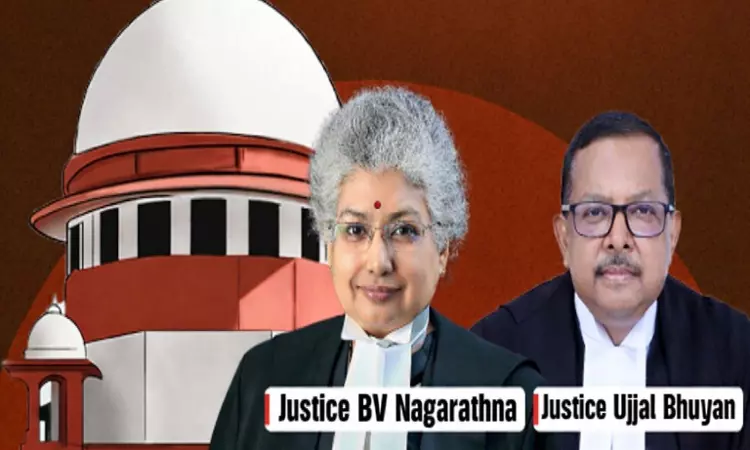
A bench of Justices B.V. Nagarathna and Ujjal Bhuyan, while partly allowing the appeal filed by Canara Bank, observed:
“A bank receiving cheques for collection acts as an agent of the customer and is under an obligation to exercise due diligence in presenting the instruments within the prescribed validity period. Failure to do so resulting in the instrument becoming stale, in the absence of any reasonable explanation, would result in negligence in the discharge of banking duties which would constitute deficiency in rendering service within the meaning of the consumer protection law..”
Agreeing with the Commission's view, the court held that there was negligence on the part of the bank in not presenting the cheques within the validity period, leading to deficiency in service.
It said, “That being the position, we are in agreement with the view taken by the Commission that there was negligence on the part of the appellant in presentation of the two cheques of the respondent within the validity period of the cheques leading to deficiency in service on the part of the appellant qua the respondent..”
The dispute arose between Canara Bank and Kavita Chowdhary, who had deposited two cheques totalling about Rs.1.06 crore issued by Assotech Ltd on May 29, 2018.
The cheques were returned during a bank strike on May 30–31, 2018, but the bank failed to re-present them within the validity period after the strike ended, resulting in the cheques becoming stale and depriving her of legal remedies, including action under Section 138 of the Negotiable Instruments Act.
Addressing the bank's defence based on delay caused by the strike, the court clarified that while Section 75A of the Negotiable Instruments Act permits delay in presentment due to circumstances beyond the holder's control, such as a strike, the cheque must be presented within a reasonable time once the cause of delay ceases. The court observed:
“If there is a delay in presentment for acceptance or payment of the cheque, such a delay would be excused under Section 75A if it is caused by circumstances beyond the control of the holder and not imputable to his default, misconduct or negligence. But the moment the cause of delay ceases to operate, presentment must be made within a reasonable time.”
The court further relied on Lucknow Development Authority v. M.K. Gupta to reiterate that the expressions “service” and “deficiency” under consumer law have a wide ambit and extend to banking services.
Accordingly, while upholding the finding of deficiency in service, the court held that compensation at 10% of the cheque amount was excessive and reduced it to 6% of Rs 1.06 crore along with interest, holding that the loss suffered was indeterminate and required moderation.
For Appellant: Advocates Brijesh Kumar Tamber, AOR with Advocates Vinay Singh Bist, Arani Mukherjee, Sahas Bhasin, Yashu Rustagi
For Respondent: Advocate Vinod Agarwal, Ashish Pandey, AOR