
IBC Time-Bound Resolution “Impossible To Achieve” Amid NCLT Delays; Supreme Court Takes Suo Motu Cognisance
Shilpa Soman
29 April 2026 4:20 PM IST
The Supreme Court of India on Wednesday took suo motu cognisance of delays in approval of resolution plans pending before various benches of the National Company Law Tribunal (NCLT), stating that the objective of time-bound resolution under the Insolvency and Bankruptcy Code, 2016 is “impossible to achieve” in the present situation.
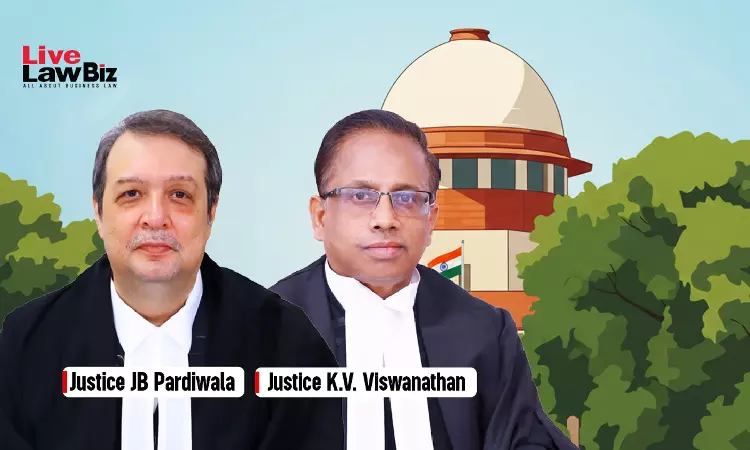
A bench of Justice J.B. Pardiwala and Justice K.V. Viswanathan was hearing the matter pursuant to its order dated April 16, 2026. By that order, the Court had sought data from the Registrar of the NCLT Principal Bench, New Delhi, and from the parties on (i) (i) the number of applications pending for approval of resolution plans, (ii) how long such applications have been pending, and (iii) the reasons for delay.
It had also directed the Registrar to submit a report answering these queries and impleaded the Insolvency and Bankruptcy Board of India (IBBI), asking it to place on record figures and statistics from across the country. Senior advocates Gopal Jain and Navin Pahwa were requested to assist as amicus.
On Wednesday, after examining the material placed on record, the Court said the picture was “extremely grim and dismal.” It recorded that 363 applications for approval of resolution plans are pending, with delays ranging from 48 days to 738 days, and in some cases extending up to four years.
The court noted that the reasons cited include lack of adequate infrastructure, half-day sittings due to changes in Bench composition, and a large number of objections filed by stakeholders.
It also recorded a shortage of members in the NCLT. Against a sanctioned strength of 63, only 28 judicial and 26 technical members are in position.
Recording submissions of amicus Navin Pahwa, the court noted that several posts, including that of Registrar, are being filled on a contractual basis. It also recorded that benches do not have full-time staff. Issues of non-payment of salaries and lack of support staff were also placed before the Court.
Referring to the recent insertion of Section 31(2A) of the Insolvency and Bankruptcy Code, which prescribes a 30-day timeline for deciding approval applications, the Court expressed doubt over its implementation.
“Of course, this amendment has not yet come into force. But the day it comes into force, we have our own doubts whether true effect could be given to this particular amendment in light of the deficiencies which we have highlighted about,” the Bench observed.
The Court stated that the Insolvency and Bankruptcy Code is a crucial economic legislation. It added:
“In the state of affairs that presently prevail, the objective of a time bound resolution is impossible to achieve.”
Taking suo motu cognisance in larger public interest, the Court directed its Registry to place the matter before the Chief Justice of India for further orders.
"...we take suo motu cognisance of the aforesaid in larger public interest. The issues need to addressed on war footing. Otherwise, the purpose of enacting IBC would stand frustrated. As we have taken suo motu cognisance let the matter be placed before CJI for further orders", it said.
For Appellant: AORs Udita Singh, Zeeshan Diwan with Advocate Shashank Agarwal
For Respondent: Senior Advocates Neeraj Kishan Kaul, Nakul Dewan with Advocates Nikhil Mehndiratta, Toyesh Tewari, Agastya Sen, Nidhisha Chokshi, Danya Krishnan, Dhanya Krishnan, Mani Gupta, Dua Associates, AOR