
Supreme Court Refers To Larger Bench Whether IBC Moratorium Applies To Entire Cheque Bounce Proceedings Or Only Compensatory Aspect
Shilpa Soman
28 May 2026 12:26 PM IST
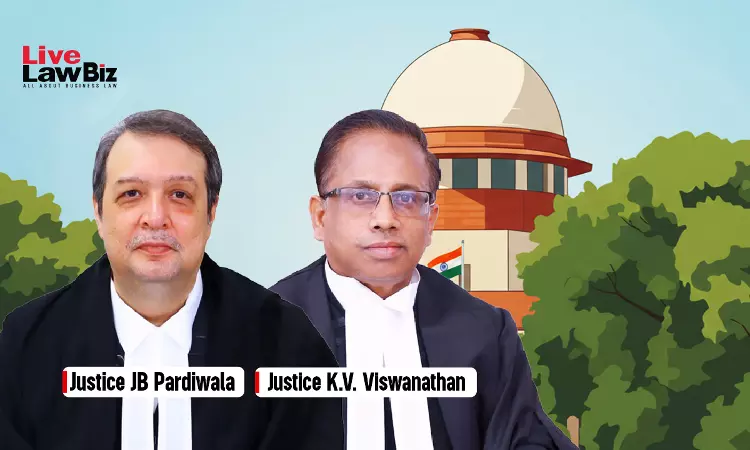
The Supreme Court on Wednesday referred to a larger bench the question of whether insolvency moratorium protections under the Insolvency and Bankruptcy Code apply to cheque dishonor prosecutions, while expressing the view that the criminal component of such proceedings should not be halted during personal insolvency and bankruptcy proceedings.
A bench of Justices J.B. Pardiwala and K.V. Viswanathan observed that the issue requires an “authoritative pronouncement” by a three-judge bench after noting conflicting strands in earlier Supreme Court rulings on whether check bounce proceedings are predominantly criminal in nature or quasi-criminal proceedings with substantial compensatory and recovery elements.
“However, in our considered view, to make moratorium provisions under the IBC applicable on proceedings under Section 138 of the NI Act, solely because of the civil nature of the injury is untenable in light of the objective sought to be achieved by the enactment of Section 138. We may even go so far as to say that the applicability of moratorium provisions on Section 138 proceedings makes the same equivalent to a debt recovery mechanism, which could never have been the intention of the legislature,” the Court observed.
The bench noted that while an earlier three-judge bench ruling in P. Mohanraj v. Shah Bros. Ispat Pvt. Ltd. had described cheque dishonour proceedings as a “civil sheep in a criminal wolf's clothing”, later decisions including Ajay Kumar Radheyshyam Goenka and Rakesh Bhanot emphasised the penal and deterrent character of cheque bounce prosecutions and distinguished them from ordinary recovery proceedings.
The case arose from cheque dishonour proceedings initiated by UCO Bank against Dineshchand Surana, former Managing Director of Surana Power Ltd., after a cheque issued towards discharge of dues was dishonoured for “Funds Insufficient”.
During the pendency of the prosecution, Surana underwent personal insolvency and bankruptcy proceedings under the IBC and sought stay of the cheque bounce case on the ground that moratorium protections barred legal proceedings in respect of debt.
Appearing for Surana, Senior Advocate Shreeyash Lalit argued that cheque dishonour proceedings are quasi-criminal in nature and substantially aimed at recovery of money.
Relying on the Supreme Court's ruling in P. Mohanraj, he contended that moratorium protections available during personal insolvency proceedings should extend to prosecutions under the Negotiable Instruments Act as well.
UCO Bank opposed the plea, arguing that cheque dishonour cases are criminal proceedings intended to preserve the credibility of commercial transactions and cannot be equated with ordinary debt recovery actions.
The bench expressed agreement with the bank insofar as the criminal consequences arising from cheque dishonour are concerned. It observed that the offence under the law is centred on the dishonour of the cheque itself and not merely the underlying debt.
“The offence is the act of cheque dishonour which has been saddled with criminal consequences. The non-payment of the debt to the extent of the cheque amount is the injury caused due to commission of the offence,” the bench observed.
It further observed, “The principal object of Section 138 is to deter persons from using cheques when they have insufficient balance. The provision of punishment is a measure of deterrence. Therefore, the provision was not intended to be used as a recovery of debt mechanism.”
Explaining why it was of the view that insolvency protections should not extend to the criminal component of cheque dishonour proceedings, the Court observed, “If the protection of moratorium is granted to the persons accused of cheque dishonour, it would tantamount to allowing evasion of criminal liability.”
The bench also observed that, in its view, criminal prosecution under the law may continue despite insolvency proceedings.
“The same may be initiated and taken to it its logical conclusion. The drawer of the cheque, if convicted must discharge his personal criminal liability by serving the sentence of imprisonment or paying the fine imposed,” the court observed.
At the same time, the Court distinguished the compensatory aspect of cheque dishonour proceedings from the criminal prosecution itself. It observed that recovery of compensation awarded in such proceedings may attract moratorium protection because of its underlying civil character.
“Therefore, once the criminal court exercising jurisdiction over a complaint under Section 138, orders compensation under Section 395 of the BNSS, then the moratorium would be made applicable if the recovery of compensation remains pending,” the Court observed.
Referring the matter to a larger bench, the Court observed that a three-judge bench would now examine whether cheque dishonour proceedings are quasi-criminal “with a tilt towards the criminal side” and whether moratorium protections under the IBC apply to the entire proceedings or only to the compensatory aspect thereof.
"The three-Judge Bench constituted may refer to the following questions:
(i) Whether the provisions of Section 138 of the NI Act and the objective underlying the enactment thereof indicate that it is quasicriminal in nature with a tilt towards the criminal side?
(ii) Whether the moratorium provisions under Part III of the IBC should be made applicable on the entire proceedings under Section 138 of the NI Act or only to the compensatory aspect thereof?"
For Petitioners: Advocate Ishaan George
For Respondent: Advocate Brijesh Kumar Tamber