
NSE Clearing's Settlement Committee Cannot Order Restitution Of Liquidated Client Securities: Supreme Court
Shilpa Soman
3 Sept 2026 12:23 PM IST
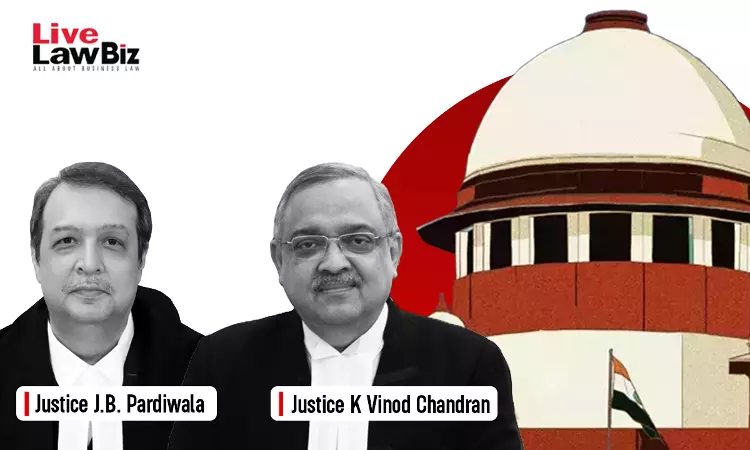
The Supreme Court on Wednesday ruled that the Member and Core Settlement Guarantee Fund Committee constituted by NSE Clearing Corporation had no statutory or bye-law power to direct Professional Clearing Members to restore securities liquidated after Trading Members defaulted.
A Bench of Justice J.B. Pardiwala and Justice K. Vinod Chandran held:
“This is in stark violation of the power conferred by the statute and the byelaws also do not speak of any such power being conferred of disgorgement or payment of money in the nature of restitution of securities on the NCL, which alone could empower the Committee constituted by the NCL to impose such penalty.”
The bench allowed the appeals filed by the Professional Clearing Members and set aside the restitution directions issued by the committee and the orders of the Securities Appellate Tribunal that had upheld them.
The dispute arose from the liquidation of securities provided as collateral by clients of certain Trading Members operating in the Futures and Options segment of the National Stock Exchange.
Trading Members act as intermediaries through whom investors place trades, while Professional Clearing Members handle clearing and settlement obligations.
Under the system in place at the time, clients provided securities to Trading Members as collateral. The Trading Members could then provide their own or clients' collateral to Professional Clearing Members, which could provide collateral to the NSE Clearing Corporation.
Certain Trading Members later defaulted on their obligations. The Professional Clearing Members liquidated the collateral provided by the defaulting Trading Members to recover the amounts due.
Some investors alleged that securities belonging to clients with no outstanding debit balances had also been sold. The affected clients approached various forums seeking compensation before proceedings eventually reached the committee constituted by NSE Clearing Corporation.
The committee found that the Professional Clearing Members had failed to exercise adequate due diligence before liquidating the securities. In one case, securities worth about ₹460 crore at the time of liquidation were involved.
It directed the concerned Professional Clearing Member to restore the securities and imposed a penalty of ₹1 lakh. Similar restitution directions were issued in other cases, and the Securities Appellate Tribunal upheld them.
The Professional Clearing Members challenged those decisions before the Supreme Court. They argued that the committee had no legal authority to order restitution of securities.
They contended that the law conferred specific powers on the Securities and Exchange Board of India, or SEBI, to order disgorgement in appropriate cases but did not give NSE Clearing Corporation or its committee a similar power.
Disgorgement, in this context, means requiring a person to give up money or assets obtained through wrongful conduct.
The Professional Clearing Members also argued that they had no direct contractual relationship with the individual clients of the Trading Members. They maintained that the regulatory framework then in force did not require them to verify every client's debit or credit position before liquidating collateral following a Trading Member's default.
The Bench accepted this contention.
It held, “We are of the definite opinion that there was no statutory violation committed by the PCM and their plea of having no privity of contract with the constituents of the TM as also no statutory obligation to verify the debit/credit positions of the individual clients of the TM is perfectly in order.”
After examining the applicable regulations, agreements, and SEBI circulars, the court found that the Professional Clearing Members had committed no statutory violation.
The bench also considered the rules governing the handling of client securities. It noted that a new pledge and repledge system was introduced to create a clear trail showing how an individual client's securities moved through the clearing chain.
Under this system, which took effect on June 1, 2020, a client pledged securities with the Trading Member. The Trading Member then repledged them with the Clearing Member, which in turn repledged them with NSE Clearing Corporation.
The court also noted that the earlier consolidated accounts used to hold client margin or collateral had to be closed by June 30, 2020. After that, the new framework ensured that the pledge and repledge trail could be reflected in the individual investor's demat account.
Before this transition, Trading Members collected collateral from clients on a gross basis. The collateral provided by each Trading Member was maintained in a consolidated account tagged as client margin or collateral.
The court found that the regulatory framework applicable at the time did not impose a statutory duty on Professional Clearing Members to verify the individual debit or credit positions of clients before liquidating collateral.
The Bench also examined whether the committee had the power to order restitution. It found that neither the law nor the bye-laws gave NSE Clearing Corporation or the committee the power to order disgorgement or restitution requiring the restoration of securities or payment of their value.
The court noted that the Trading Member involved had offered an assured-return arrangement to investors and used their securities in connection with its activities. It found the arrangement to be illegal.
The Bench observed that the investors had willingly participated in the scheme, furnished their securities, and executed undertakings. It further noted that the illegality of the arrangement was known to both the Trading Member and its clients.
In these circumstances, the court held that no claim could be laid against the Professional Clearing Members for the Trading Members' defaults.
It also found that the losses recouped by the Professional Clearing Members through the liquidation of collateral were permissible under the regulatory framework then in force.
The top court accordingly allowed the appeals filed by the Professional Clearing Members and set aside the restitution directions issued by the committee and the orders of the Securities Appellate Tribunal upholding them.
For Appellants: Senior Advocates Shyam Divan, Niranjan Reddy; Advocates Rameshwar Prasad Goyal, AOR, Mahesh Agarwal, Anshuman Srivastava, Abhinabh Garg, Rishi Agrawala, Sanjivani Pattjoshi, Yashvardhan Singh, E. C. Agrawala, AOR, Sanjivani Pattjosh, Divyam Agarwal, AOR, Pulkit Sukhramani, Pallavi Kumar, Aniket Aggarwal, Priya Chauhan, Yashvardhan Singh, Juan D Souza, Shreyas Jain, Manish Kumar, AOR
For Respondents: Senior Advocates R. Verdrajan, Neeraj Malhotra, Meenakshi Arora, Advocates Amrita Panda, AOR, Dinesh Kumar Mudgal, Anupam Kumar, Akhileshwar Jha, Hitesh Kumar Sharma, Satvik Sharma, Mudit Gupta, AOR, Mahfooz Ahsan Nazki, AOR, Ashish Prasad, Mukta Dutta, Pruthvi Dhinoja, Siddhi Jain, Pranjal Kishore, AOR, Ishan Agrawal, Anshit Aggarwal, Ashutosh Mishra, Nagarjun Sahu, Shreya Kak, Dr. Yusuf Iqbal Yusuf, Bhavya Sethi, Zubin Sheth, Bhavya Sethhi, Kailash Uday Kapoor, Neelam Singh, AOR, Apurva Ambasth, Shiven Khurana, Sameer Singh, P. V. Yogeswaran, AOR, Sonali Jaitley Bakhshi, Jaiyesh Bakhshi, Ravi Tyagi, AOR, Mayank Mishra, Gaurav Mishra, Daman Popli, Sudiksha Saini, Abhijay Basu, Anuj Kumar, Sudhanshu Prakash, AOR, Kausik Chatterjee, Soumya Dutta, AOR, Samriddhi, Siddhant Upmanyu, Nisstha Balodia, Dr. Dinesh Rattan Bhardwaj, AOR, Ravichandra Hegde, Mahesh Singh, Mitravinda Chunduru, Kandarp Trivedi, Parinaz Bharucha, Pankaj Kumar Sharma, Rudra Pratap Dhananjay, Shailesh S. Sharma, Sujeet Swami, Sameer Rawal