
Banks Can Use SARFAESI To Recover Dues Under Loans Acquired From Non-Notified Institutions: Supreme Court
Shilpa Soman
3 Sept 2026 4:53 PM IST
The Supreme Court has ruled that a bank can use the Securitisation and Reconstruction of Financial Assets and Enforcement of Security Interest Act, 2002, commonly known as the SARFAESI Act, to recover a secured loan it acquired from an entity not covered by the law.
This applies even if the original lender was not covered by the Act when the loan was granted.
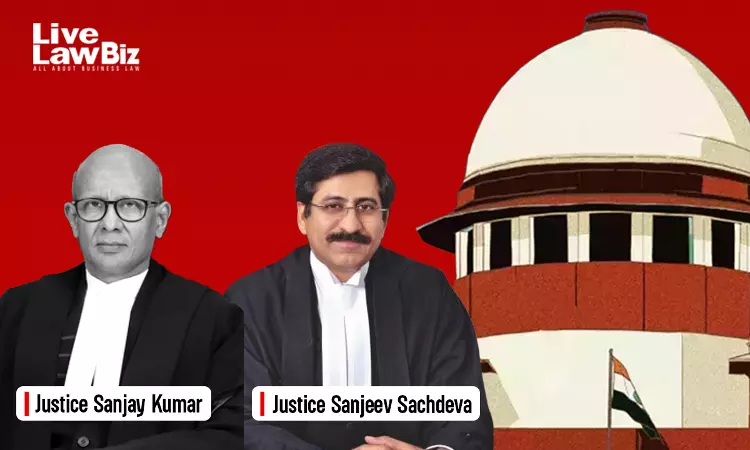
Justices Sanjay Kumar and Sanjeev Sachdeva ruled,
“When the institution is one to which the SARFAESI Act is already applicable, acquisition of a non-performing secured loan account by such institution from an entity, that does not come within the ambit of the SARFAESI Act, would immediately clothe the said loan account with the attributes of a 'secured debt' covered by the provisions of the SARFAESI Act.”
The ruling came in appeals arising from action taken by Kotak Mahindra Bank after it acquired loan accounts from City Financial Consumer Finance Limited. City Financial is a non-banking financial company.
When these loans were granted, City Financial was not among the financial institutions covered by the SARFAESI Act.
The Act gives banks and certain notified financial institutions a special mechanism to enforce security created for loans. It allows them to take recovery measures against secured assets without having to first pursue the usual civil court process.
The dispute before the Supreme Court was whether a loan originally granted by an entity outside the SARFAESI framework could later be subjected to recovery measures under the Act. The question arose after the loan was acquired by a bank already covered by the law.
One of the cases concerned a home loan of about ₹69.60 lakh taken by Amit Bipin Shah from City Financial. The loan was used to acquire a residential flat from Trupti Sanjay Mehta and her husband.
Shah defaulted. An arbitral award later directed him to pay about ₹75.31 lakh with interest.
Kotak Mahindra Bank took over the loan account in July 2012. It later invoked the SARFAESI Act and initiated steps to take possession of the flat.
The Mehtas remained in possession of the property and challenged the action. They argued that Kotak Mahindra Bank could not use the SARFAESI Act because City Financial was not covered by the law when the loan was granted.
The debt recovery tribunal accepted their argument. The appellate tribunal and the Bombay High Court later upheld that view.
Similar questions arose in two other matters.
In one case, Kotak Mahindra Bank had acquired two housing loans from City Financial. The loans were for about ₹28.50 lakh and ₹13.36 lakh. The bank later invoked the SARFAESI Act after the borrowers defaulted.
The third case involved a loan of about ₹2.98 crore taken by Poorti Rent A Car and Logistics Private Limited and its directors. The loan had been granted by City Financial.
Kotak Mahindra Bank subsequently acquired the loan. It then initiated recovery action against the secured property.
City Financial was notified as a financial institution covered by the SARFAESI Act only on August 27, 2018. The central question was therefore whether Kotak Mahindra Bank could use the Act because it was already covered by the law. This was despite City Financial not being covered when the loans were created.
The Supreme Court examined its earlier rulings in M.D. Frozen Foods Exports Private Limited v. Hero Fincorp Limited and Indiabulls Housing Finance Limited v. Deccan Chronicle Holdings Limited.
In M.D. Frozen Foods, the Supreme Court considered a situation where a non-banking financial company later became covered by the SARFAESI Act through a government notification. It held that the Act could apply to claims that were still “live and owing” when the law became applicable to that institution.
The court also held that the date on which the loan account became a non-performing asset did not affect this position.
In Indiabulls, the earlier ruling concerned loans that had originally been granted by an entity not covered by the SARFAESI Act. The loans later came into the hands of a successor entity that was covered by the Act.
The Supreme Court had held that the successor could invoke the Act's recovery mechanism.
The Reserve Bank of India also told the Supreme Court that it had no objection to banks purchasing non-performing assets from financial institutions and non-banking financial companies. It submitted that a restrictive interpretation would prevent an assignee bank from using the SARFAESI Act to enforce the security attached to an acquired loan.
The Bench observed that the Act was enacted to help banks and financial institutions deal with non-performing assets and bad debts. It also noted that the law aims to facilitate the recovery of such debts and supports the larger economy.
The borrowers' argument, if accepted, would mean that those who took loans from institutions not covered by the Act would have greater freedom to default. Their lenders would have to rely on ordinary and time-consuming recovery processes. Borrowers who took loans from institutions already covered by the Act, on the other hand, could face quicker recovery measures.
“Irrespective of whether a financial institution comes under the SARFAESI Act or not, the failure on the part of borrowers to repay their loans to such institution invariably sets off a chain reaction resulting in an adverse impact on the whole economy,” the Bench observed.
The Supreme Court noted that its earlier ruling in M.D. Frozen Foods had established that once a claim is “live and owing” when the SARFAESI Act becomes applicable to the institution holding the loan account, the Act would be available for recovery.
Applying that reasoning, the Bench held that a non-performing secured loan account acquires the attributes of a secured debt under the Act when it is acquired by a bank already covered by the law. The fact that the original lender was not covered by SARFAESI when the loan was created would not prevent the bank from invoking the Act.
The Supreme Court also rejected the borrowers' attempt to rely on individual definitions in the Act. They had argued that their loans could not be subjected to recovery measures under SARFAESI.
In the Mehtas' case, the Supreme Court set aside the Bombay High Court's judgment. It also set aside the decisions that preceded it.
Their challenge was restored before the debt recovery tribunal. The other factual and legal issues raised by them can now be considered on their merits.
The Bench also required the Mehtas to deposit a further ₹25 lakh with Kotak Mahindra Bank within eight weeks. The deposit will remain subject to the final outcome of their challenge.
As for the Sables, the Supreme Court ruled that Kotak Mahindra Bank was legally entitled to seek the assistance of the relevant authority for taking physical possession of the secured property under the SARFAESI Act.
Their earlier challenge had been dismissed on the ground of delay.
In the Poorti Rent A Car matter, the Supreme Court found that the Bombay High Court had correctly treated the issue as covered by its earlier rulings in M.D. Frozen Foods and Indiabulls. The secured property had already been sold in 2023.
The top court accordingly allowed Kotak Mahindra Bank's appeal in the Mehtas' case. It dismissed the other two appeals.
For Appellants: Senior Advocate Amar Dave, Advocates Satyajit A. Desai, Sachin Patil, Sachin Singh, Pratik Kumar Singh, Shashank Upadhyay, Anagha S. Desai, AOR, Mahesh Agarwal, Rishi Agrawala, Ankur Saigal, S. Lakshmi Iyer, Sukriti Bhatnagar, Anukanksha Singh, E.C. Agrawala, AOR, Rohit Sharma, Nishanth Patil, AOR, Arijit Dey, Nikhil Purohit, Jatin Lalwani, Bhumi Agrawal, Abhishek Gupta, Awanish Gupta, Harshita Jain
For Respondents: Senior Advocate Umesh Shetty, Ramesh Babu, Advocates S. Lakshmi Iyer, Mahesh Agarwal, Rishi Agrawala, Ankur Saigal, Sukriti Bhatnagar, E.C. Agrawala, AOR Anukanksha Singh, Nitin Tambwekar, Pranita, Hina Mody, Seshatalpa Sai Bandaru, AOR, Sanjay Kumar, Chanchal Kumar Ganguli, AOR, Nisha Sharma, Tanya Chowdhary, Mukti Chowdhary, AOR, Khushi Jain, H.S. Parihar, AOR, Kuldeep S. Parihar, Ikshita Parihar, Rukhmini Bobde, Siddharth Dharmadhikari, Aaditya Aniruddha Pande, AOR, Shrirang B. Varma, Vinayak Aren, Jatin Dhamija, Aishwarya Nigam, Mudit Sharma, AOR, Anup Jain, AOR, Jasmine Damkewala, AOR