
Only Civil Court Can Extend Arbitration Time Even When Arbitrator Is Appointed By High Court: Supreme Court
Shilpa Soman
30 Jan 2026 10:19 AM IST
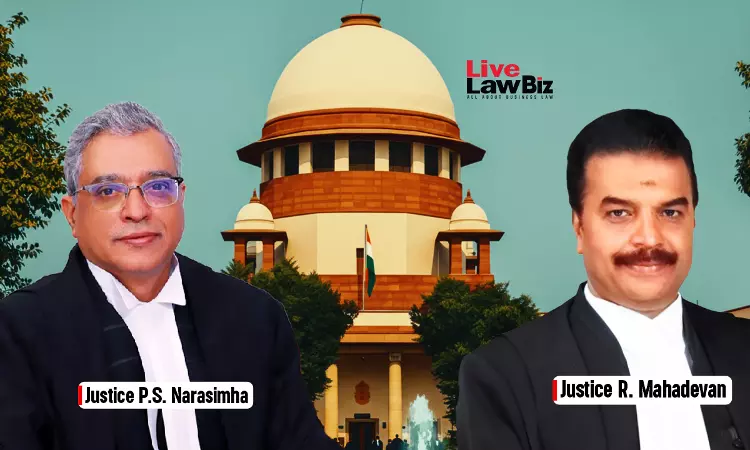
The Supreme Court has held that an application seeking extension of time for an arbitral tribunal under Section 29A of the Arbitration and Conciliation Act lies before the civil court, even in cases where the High Court has appointed the arbitrator.
The court clarified that the High Court's role ends with the appointment of the arbitrator and does not continue during the arbitration.
A Bench of Justice Pamidighantam Sri Narasimha and Justice R. Mahadevan said the jurisdiction exercised by a High Court under Section 11 is limited in scope and comes to an end once the arbitral tribunal is constituted.
Relying on its own ruling in Kamal Gupta v. L.R. Builder (2025), the court held, "Exercise of jurisdiction under Section 11 stands exhausted upon the constitution of the arbitral tribunal. There is no residual supervisory or controlling power left with the High Court or the Supreme Court over the arbitral proceedings after appointment is made. To read Section 11 as conferring such enduring control would be to conflate appointment with supervision, a conflation which the Act as well as the precedents on the subject prohibit,”
It rejected the assumption that courts continue to oversee arbitral proceedings after appointing the tribunal. “It is a misconception to assume that the Supreme Court or the High Court keeps a watch on the conduct of arbitral proceedings or on making of the arbitral award like the Orwell's 'Big Brother is watching you.'”
The dispute involved members of the Chowgule family and a family settlement signed in January 2021. Arbitration was invoked in May that year. As the proceedings did not conclude within the prescribed time, one of the parties approached the Commercial Court seeking an extension under Section 29A.
Around the same time, the presiding arbitrator resigned. This was followed by a separate application before the Bombay High Court at Goa seeking appointment of an arbitrator, which the court allowed in October 2023. In January 2024, the Commercial Court allowed the request to extend the arbitration period.
That order was challenged before the High Court on the ground that once an arbitrator had been appointed by the High Court, only the High Court could extend the time. A single judge referred the issue to a Division Bench due to conflicting rulings on the point.
The Division Bench held that the Section 29A application was not maintainable before the Commercial Court. Acting on that view, the Single Judge set aside the Commercial Court's order and allowed the parties to approach the High Court instead. This led to the appeal before the Supreme Court.
Disagreeing with the High Court, the Supreme Court held that the expression “court” under Section 29A must be understood in the same manner as under Section 2(1)(e) of the Act.
“The 'Court' under Section 29A shall be the Civil Court of ordinary original jurisdiction in a district and includes the High Court in exercise of its original civil jurisdiction under Section 2(1)(e), and shall not be the High Court or the Supreme Court under Section 11(6) of the Act. Equally, Section 42 of the Act relating to jurisdiction for application will not apply to Section 11 of the Act.3,” the bench said.
It further clarified that Section 42 of the Act does not apply, since applications under Section 11 are not made to a “court” as defined under the Act.
The bench rejected the argument that allowing civil courts to extend the mandate of arbitrators appointed by high courts would create any conflict of authority. It said jurisdiction flows from statute, not from perceptions of hierarchy.
"For the reasons stated above, we are of the opinion that the conclusion on the ground that there will be hierarchical difficulties, conflict of power or jurisdictional anomaly if a Civil Court entertains application under Section 29A for extension of time of an arbitral tribunal if the High Court under Section 11(6) of the Act has appointed the arbitrator(s) is untenable. This approach is hereby rejected."
On that basis, the court set aside the Bombay High Court's orders and restored the Commercial Court's decision, granting liberty to the parties to seek further extension of time before the Commercial Court.
For Appellants: Advocate Surbhi Kapoor
For Respondents: Advocates Omkar Jayant Deshpande, Salvador Santosh Rebello, Vivek Jain and Cyril Amarchand Mangaldas AOR