
Supreme Court
Supreme Court Upholds NCLAT Order Entrusting NBCC To Complete Stalled Supertech Housing Projects
The Supreme Court recently dismissed a batch of appeals challenging directions issued by the National Company Law Appellate Tribunal (NCLAT) to involve NBCC (India) Ltd for completion of stalled housing projects of Supertech Ltd, declining to interfere with the appellate tribunal's approach. A bench of Chief Justice Surya Kant and Justice Joymalya Bagchi held that the NCLAT's decision in evolving a mechanism to protect the interests of homebuyers and ensure completion of long-delayed projects...
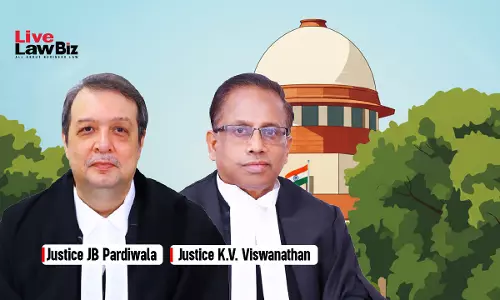
High Courts Cannot Nullify Prior Arbitral Proceedings While Substituting Arbitrator: Supreme Court
The Supreme Court of India has recently observed hat while appointing a substitute arbitrator under Section 15(2) of the Arbitration and Conciliation Act, 1996, High Courts cannot invalidate prior arbitral proceedings or orders. A Bench of Justices J.B. Pardiwala and K.V. Viswanathan set aside a portion of an order passed by the Bombay High Court, which, while appointing a substitute arbitrator, had declared arbitral proceedings conducted on seven dates between March 17, 2022 and August 25,...
Supreme Court Issues Notice In Plea Challenging Punjab and Haryana HC Ruling Against AO Consulting Superiors Before IT Assessment
The Supreme Court on Monday issued notice on an appeal by the Income Tax Department against a Punjab and Haryana High Court judgment that held that an Assessing Officer abdicated his quasi-judicial function by repeatedly consulting superior officers before passing an assessment order. A bench of Justice Pamidighantam Sri Narasimha and Justice Alok Aradhe issued notice on both the application seeking condonation of delay and the Special Leave Petition. The matter is listed next on March 16,...

Supreme Court To Hear On Friday Ustad's Plea In 'Veera Raja Veera' Copyright Case Against A R Rahman
The Supreme Court will hear on Friday an appeal filed by renowned Dhrupad vocalist Ustad Faiyaz Wasifuddin Dagar challenging the Delhi High Court's decision to vacate and dilute interim relief granted in his copyright suit over the song “Veera Raja Veera” from the film Ponniyin Selvan II, composed by A. R. Rahman. A bench comprising Chief Justice Surya Kant and Justices Joymalya Bagchi and N.V. Anjaria will hear the matter.BackgroundThe case arose from the use of a classical Dhrupad composition...

Supreme Court Upholds Delhi High Court Ruling On Duty Drawback For Unlocked Mobile Phones
The Supreme Court has recently dismissed a Special Leave Petition filed by Customs, thereby letting stand a Delhi High Court ruling that unlocking or activating mobile phones prior to export does not disentitle exporters from claiming duty drawback. By an order dated January 30, 2026, a Bench of Justices J.B. Pardiwala and Joymalya Bagchi declined to interfere with the Delhi High Court's judgment, observing that it found “no good ground to interfere with the impugned order passed by the High...
Supreme Court Issues Notice On Challenge To Delhi HC View That Customs Need Not Communicate Adjudication Time Extension
The Supreme Court recently (February 6) issued notice in a challenge to a Delhi High Court ruling that held that customs authorities were not required to communicate an extension granted for completing adjudication proceedings and directed that the matter be heard along with a pending appeal. A bench comprising Justices P.S. Narasimha and Alok Aradhe issued notice in the special leave petition filed by Pranij Heights India Pvt. Ltd. and directed that it be listed along with the pending SLP in...
Supreme Court Cuts Compensation Order Against ITC Maurya From ₹2 Crore to ₹25 Lakh In Botched Haircut Case
The Supreme Court on Friday clarified that compensation running into crores of rupees cannot be awarded on “presumptions or whims and fancies” of a complainant and must be founded on “trustworthy and reliable evidence”. The clarification came while the court was examining a consumer dispute arising from services rendered at the ITC Maurya hotel in New Delhi, where the complainant had alleged deficiency in service relating to a haircut and sought compensation running into crores of rupees. A...
Confiscation Under PMLA Cannot Proceed While Appeal Against Attachment Is Pending: Supreme Court
The Supreme Court on Friday (February 6) held that confiscation proceedings under the Prevention of Money Laundering Act (PMLA) cannot be taken forward while an appeal against the confirmation of attachment is pending before the Appellate Tribunal. The Court clarified that once an attachment order passed under Section 8(3) of the PMLA is challenged under Section 26, a “deemed embargo” operates, preventing the Special Court from deciding confiscation proceedings under Section 8(7) until the...
Supreme Court Lets LG Electronics Withdraw Challenge To Rajasthan HC Entry Tax Ruling
The Supreme Court on Wednesday permitted LG Electronics India Pvt. Ltd. to withdraw its Special Leave Petitions challenging a Rajasthan High Court ruling on entry tax, granting it liberty to seek a review before the High Court as the constitutional validity of the provision remains pending. A Bench of Justices Pamidighantam Sri Narasimha and Alok Aradhe recorded the submission that the vires of the provision had not been examined in the proceedings leading to the impugned judgment, since...

Supreme Court Records Justice Abhay Oka–Mediated Settlement In Transcon–Anchor Point Insolvency Dispute
The Supreme Court of India has recently recorded a comprehensive settlement between Transcon Skycity Pvt. Ltd. and Anchor Point Developers Pvt. Ltd., bringing to an end a prolonged insolvency dispute arising out of a stalled real estate project. A bench of Justices J.B. Pardiwala and K.V. Viswanathan noted that the mediation conducted by former Supreme Court judge Justice Abhay S. Oka was successful and that a comprehensive mediation report had been submitted and taken on record. “We had...
Supreme Court Issues Notice On Vedanta's Appeal Against Denial Of Interest On Delayed Export Duty Refund
The Supreme Court of India on Monday issued notice in a civil appeal filed by Vedanta Limited challenging a judgment of the Calcutta High Court, which denied interest on a delayed refund of export duty, holding that statutory interest under the Customs Act becomes payable only after a valid refund application is filed. A Bench of Justices Manoj Misra and Manmohan condoned the delay. It directed issuance of notice, returnable in six weeks. The order records: “Delay condoned. Issue notice,...
Mere Renting Of Residential Flat Does Not Take Away Buyer's Consumer Rights: Supreme Court
The Supreme Court of India has clarified that the mere act of leasing or renting out a residential flat does not by itself take a homebuyer outside the protection of consumer law. The Court ruled that a buyer can be excluded from the definition of “consumer” only if it is established that the dominant purpose of purchasing the flat was commercial in nature. The ruling arose from a dispute relating to a residential project in Gurugram. A Bench of Justices Prashant Kumar Mishra and N.V....