
Supreme Court
Supreme Court Dismisses Plea Against Allahabad HC Ruling Upholding DRT Registrar's Power to Issue Notice Under SARFAESI
The Supreme Court on Tuesday dismissed a special leave petition challenging an Allahabad High Court ruling that upheld the authority of the Registrar of the Debts Recovery Tribunal to issue notice in a securitisation application under the SARFAESI Act. A Bench of Justices Dipankar Datta and Satish Chandra Sharma declined to interfere with the High Court's decision, observing, “We are not inclined to interfere with the impugned judgment and order of the High Court; hence, the special leave...
Supreme Court Dismisses Aspek Media Plea Against Delhi HC Order Impleading Directors In Arbitral Award Execution
The Supreme Court has recently dismissed a special leave petition filed by Aspek Media Pvt. Ltd. and others against Entertainment City Limited, declining to interfere with a Delhi High Court order in an arbitration matter. A Bench of Justices J.K. Maheshwari and Atul S. Chandurkar said: “After hearing learned counsel, we see no reason and ground to interfere with the order impugned. Accordingly, the special leave petition is dismissed.” The SLP arose from execution proceedings before the...

Decrees Cannot Be Turned into “Paper Tigers” by Permitting Post-Award Property Transfers: Supreme Court
The Supreme Court has reaffirmed that a person who purchases disputed property after the passing of an arbitral award cannot obstruct its attachment in execution proceedings. A Bench of Justice Pankaj Mithal and Justice S.V.N. Bhatti warned that permitting such objections would derail the execution process, causing proceedings to get trapped “in an infinite loop and practically never get completed,” and reducing decrees to mere “paper tigers.” The court emphasised its ruling in Jini...
Supreme Court Grants Bail In Alleged Online Investment Fraud Case
The Supreme Court on Monday granted bail to Paramjit Kharb in a case arising out of an alleged online investment fraud involving the use of bank accounts opened in the name of “R.S. Trading,” holding that “the case for bail is made out.” A Bench of Justice B.V. Nagarathna and Justice Ujjal Bhuyan allowed the appeal challenging the Delhi High Court's order refusing regular bail. The Court observed, “Considering the facts on record, in our view, the case for bail is made out,” and directed that...
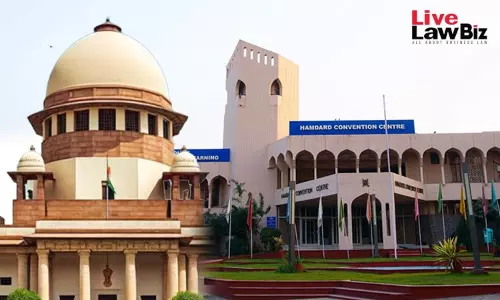
Supreme Court Deems Jamia Hamdard's Consent Of Affiliation Granted To HIMSR, Protects 49 PG Admissions
The top court said the direction was being issued in the peculiar facts of the arbitration dispute between two branches of the Hamdard family.

Byju's Parent Moves Supreme Court To Stall Second Tranche Of Aakash ₹240 Crore Rights Issue
Think & Learn Pvt. Ltd., which owns edtech major Byju's, has moved the Supreme Court against a National Company Law Appellate Tribunal (NCLAT) order that allowed Aakash Educational Services Ltd. to proceed with the second tranche of its Rs. 240 crore rights issue. The NCLAT permitted Think & Learn to apply for shares up to its original 25.75% entitlement. It also restrained Aakash from taking up any matter requiring a special resolution until the dispute is decided. A bench of Justices...

LiveLawBiz Arbitration Cases Weekly Digest : February 9 - February 15, 2026
Nominal Index A2Z Infraservices Ltd & Anr vs Quippo Infrastructure Ltd & Ors 2026 LLBiz SC 60Ankhim Holdings Pvt. Ltd. & Anr. versus Zaveri Construction Pvt. Ltd. 2026 LLBiz SC 53Aggarwal Sons v. Union of India and Others 2026 LLBiz HC (PNH) 8Airports Authority of India v. URC Construction (P) Ltd 2026 LLBiz HC (DEL) 146E-City Real Estates Pvt Ltd & ANR vs IMAX Corporation & Ors 2026 LLBiz SC 22Fresh and Healthy Enterprise Ltd v. Global AgriSystem Pvt Ltd & connected...

Mere Accounting Treatment Of Spectrum As 'Asset' Does Not Bring It Within IBC Framework: Supreme Court
The Supreme Court on Friday held that mere treatment of telecom spectrum as an “intangible asset” in the financial statements of telecom service providers (TSPs) does not bring it within the sweep of the Insolvency and Bankruptcy Code (IBC), observing that spectrum remains a natural resource held by the Union of India in public trust. “Merely because spectrum can be treated as an 'asset' on the basis of certain attributes, such as possession and usage, lease and assignment, claim and liability...
Bank's Classification Of Debt As NPA For Balance Sheet Purposes Not Decisive For Limitation Under IBC: Supreme Court
The Supreme Court on Thursday observed that the manner in which a bank classifies a loan as a non-performing asset for accounting or provisioning purposes does not determine the starting point of limitation under the Insolvency and Bankruptcy Code, particularly where the debt has been restructured and acknowledged in fresh agreements. “In our view, how a bank classifies its debt for managing its balance sheet is not a factor determining the starting point of limitation more so, when the debt...
IBC Cannot Override Telecom Laws Governing Spectrum Trading and Licence Dues: Supreme Court
The Supreme Court of India on Friday held that the Insolvency and Bankruptcy Code cannot be invoked to override the statutory framework governing telecom spectrum, ruling that spectrum trading conditions and licence dues mandated under telecom laws must be honoured notwithstanding insolvency proceedings. A bench of Justices PS Narasimha and Atul S. Chandurkar framing the key issue observed, “The question for our consideration is whether telecom service providers (TSPs), called upon to pay the...
DEEC Licence Must Be Valid On Date Of Warehouse Clearance To Claim Customs Exemption: Supreme Court
The Supreme Court of India has recently reiterated that in the case of warehoused goods, customs duty liability arises on the date of actual clearance from the warehouse, and an importer cannot claim exemption under a DEEC advance licence if the licence has expired by then.Upholding the High Court's decision, a bench of Justices Manmohan and Vipul M. Pancholi ruled that entitlement to exemption must subsist on the date duty is assessed. “From the aforesaid provisions, it is evident that the...

Supreme Court Says IBC Cannot Determine Ownership Of Telecom Spectrum, Calls It Material Resource Of Community
The Supreme Court on Friday held that the ownership and control of telecom spectrum cannot be determined by the Insolvency and Bankruptcy Code since it is a common good.A bench of Justices PS Narasimha and Atul S. Chandurkar held that the spectrum is a material resource of the community in the constitutional sense. It said the spectrum must benefit the common good, so its control has to be secured for the citizens.“IBC cannot be the guiding principle for restructuring the ownership and control...