
Supreme Court

Supreme Court Refuses To Frame Guidelines On Parallel Insolvency Against Borrower and Guarantor
The Supreme Court on Thursday observed that while simultaneous Corporate Insolvency Resolution Processes (CIRPs) against principal borrowers and corporate guarantors are legally permissible, it will not frame additional judicial guidelines regulating such proceedings, leaving any reform to Parliament and the Insolvency and Bankruptcy Board of India (IBBI). “We, however, decline to lay down guidelines as proposed; and for good reason. IBC is a product of a well-thought, deliberated, and...
Supreme Court Issues Notice In Zoomcar Plea Over Denial Of Appeal Against GST Order By Rajasthan High Court
The Supreme Court on Wednesday issued notice on a special leave petition filed by Zoomcar India Pvt. Ltd., a self-drive car rental platform, challenging a Rajasthan High Court order that disposed of its writ petition without granting liberty to pursue a statutory appeal under the GST law. A bench of Justice J.B. Pardiwala and Justice K.V. Viswanathan heard the matter and directed the issuance of notice. Zoomcar had approached the High Court of Judicature for Rajasthan challenging...
Voluntary Statements To Customs Officers Can Sustain Conviction: Supreme Court
The Supreme Court has recently reiterated that statements recorded by Customs officers under Section 108 of the Customs Act, 1962, constitute substantive evidence and can sustain a conviction if shown to be voluntary. A bench of Justice Vikram Nath and Justice Sandeep Mehta reaffirmed the Gujarat High Court's judgment holding that, “Statements recorded under Section 108 of the Customs Act, 1962 by duly authorized Customs Officers are admissible in evidence and do not attract the bar...

Defunct Scheme Of Arrangement Under Companies Act Cannot Stall IBC Proceedings: Supreme Court
The Supreme Court on Tuesday held that insolvency proceedings under the IBC cannot be kept in abeyance on the basis of a Scheme of Arrangement that has become redundant and inoperative for non-compliance with statutory requirements.The court reiterated that once the statutory requirements of Section 7 are met, insolvency must proceed notwithstanding any parallel company law proceedings.A bench of Justices Sanjay Kumar and K. Vinod Chandran framed the core issue as whether pendency of proceedings...

NCLT, NCLAT Cannot Nullify Benami Act Confiscation In IBC Proceedings: Supreme Court
The Supreme Court on Tuesday held that insolvency tribunals cannot nullify confiscation of property under the Prohibition of Benami Property Transactions Act, ruling that once property is confiscated under Section 27, it vests absolutely in the Central Government and falls outside the liquidation estate under the Insolvency and Bankruptcy Code. A Bench of Justices Pamidighantam Sri Narasimha and Atul S. Chandurkar dismissed appeals filed by liquidators who had sought to challenge attachment...
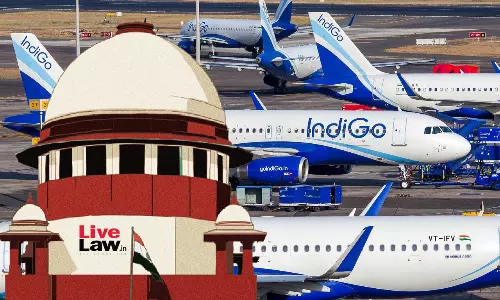
Supreme Court Dismisses Customs Review Plea Against IndiGo, SpiceJet In IGST Exemption Case On Reimported Aircraft Parts
The Supreme Court has recently dismissed review petitions filed by the Customs Department against its earlier judgment affirming relief granted to InterGlobe Aviation Limited, which operates IndiGo, in a dispute concerning the levy of Integrated Goods and Services Tax (IGST) on re-import of aircraft and parts sent abroad for repairs.A bench of Justice B.V. Nagarathna and Justice K.V. Viswanathan condoned the delay but declined to interfere with its earlier decision. The court held: ...

Supreme Court Dismisses Appeal Against NCLAT Order Rejecting Insolvency Plea Against Voltas
The Supreme Court has recently refused to interfere with the National Company Law Appellate Tribunal's decision dismissing the insolvency plea filed by Air Wave Technocrafts Pvt. Ltd against Voltas Ltd, a Tata Group company engaged in air-conditioning and engineering services. A bench of Justices Sanjay Kumar and K. Vinod Chandran dismissed the civil appeal arising out of the NCLAT judgment of November 27, 2025, which had refused to admit insolvency against Voltas for for an operational...

Meta, WhatsApp Undertakes To Comply With NCLAT Order Extending CCI's Privacy Safeguards To Advertising Data By March 16
WhatsApp and Meta on Monday told the Supreme Court that they will comply with the National Company Law Appellate Tribunal's directions extending CCI's privacy and consent safeguards initially applicable to non-advertising data to advertising-related data sharing. They did not press their plea seeking a stay. Senior Advocate Kapil Sibal, appearing for the platforms, said an affidavit has been filed explaining what data is shared and what is not. He told the court the companies will comply with...
CBIC's 2024 Policy Barring Govt Appeals Below ₹2 Crore Covers Pending Cases, Not Merely Future Filings: Supreme Court
Holding that the Centre's 2024 litigation policy applies even to pending appeals, the Supreme Court on February 5, 2026 dismissed appeals filed by the Commissioner of Commercial Tax against Vikaram Cement, ruling that the Rs. 25.47 lakh tax demand involved fell well below the Rs. 2 crore monetary limit fixed under the June 26, 2024 circular issued by the Central Board of Indirect Taxes and Customs. Rejecting the State's contention that the circular would not apply to appeals already filed under...

Supreme Court Dismisses BWL Plea, Upholds Delhi High Court Ruling That BSNL Has Satisfied 2000 Arbitral Award
The Supreme Court on Friday refused to interfere with a Delhi High Court ruling declaring that a 2000 arbitral award in favour of BWL Limited against Bharat Sanchar Nigam Limited stands satisfied, concluding the dispute between the parties over the computation of post-award interest. Dismissing a Special Leave Petition, a bench of Justice Pamidighantam Sri Narasimha and Justice Alok Aradhe observed, “We are not inclined to interfere with the impugned judgment and order passed by the High...
LiveLawBiz Arbitration Cases Weekly Digest : February 16 - February 22, 2026
Nominal Index Asad Mueed & Ors. vs Jamia Hamdard Deemed to Be University, 2026 LLBiz SC 65Talwandi Sabo Power Ltd vs Punjab State Power Corporation, 2026 LLBiz SC 72R. Savithri Naidu v. The Cotton Corporation of India Ltd. & Anr., 2026 LLBiz SC 66Aspek Media Pvt Ltd & Ors. vs Entertainment City Ltd, 2026 LLBiz SC 68Rashtriya Chemicals & Fertilisers Ltd vs Thermax Ltd, 2026 LLBiz SC 70Ansal Housing Limited v. SS Infrastructures Pvt. Ltd. & Anr., 2026 LLBiz HC (DEL)...
Supreme Court Sets Aside High Court Order Quashing ₹2.27 Crore RERA Penalty
The Supreme Court has recently set aside a Madhya Pradesh High Court order that had quashed a Rs. 2.27 crore penalty imposed by the Madhya Pradesh Real Estate Regulatory Authority (MPRERA) on an industrial project developer for non-registration of its project. A bench of Justice Pamidighantam Sri Narasimha and Justice Alok Aradhe held that “the approach adopted by the High Court is impermissible in law.” The court noted that the High Court was exercising judicial review in the context of...