
Supreme Court
Supreme Court Sets Aside HC Ruling Granting Electricity Duty Relief To Reliance, Other Captive Power Industries
The Supreme Court on Wednesday set aside the Bombay High Court's 2009 rulings that had granted electricity duty relief on captive power generation to industries, including Reliance Industries Ltd., for the period between 2000 and 2005.The appeals challenged the Bombay High Court judgments dated October 5, 2009, and November 7, 2009, which had quashed state notifications withdrawing exemption and allowed full electricity duty relief to industries for the intervening period. A bench of Justices...

State Cannot Appoint Arbitrator Under Maharashtra Municipal Councils Act Without Arbitration Agreement: Supreme Court
The Supreme Court on Tuesday dismissed a special leave petition filed by Bharat Udyog Ltd, holding that the State Government had no authority under Section 143-A(3) of the Maharashtra Municipal Councils, Nagar Panchayats and Industrial Townships Act, 1965, which deals with issuance of policy directions regarding the levy and collection of octroi, to appoint an arbitrator between a Municipal Council and its agent.The court held that the government's exercise of such power could not be equated...

Supreme Court Refuses To Interfere In Harpic-Spic Bottle Dispute Between Reckitt And Godrej
The Supreme Court on Monday refused to interfere in the Harpic toilet cleaner bottle disparagement and trademark dispute between Reckitt Benckiser (India) Pvt Ltd and Godrej Consumer Products Ltd, noting that the Calcutta High Court had clarified that its observations while setting aside an injunction were only prima facie and that the matter would be decided finally after completion of pleadings. A bench of Justices Sanjay Kumar and K. Vinod Chandran disposed of the special leave petitions...
Supreme Court Calls Govt. Contractual Clause Foreclosing Redressal Before Courts "Shocking"; Restores Award For ABS Marine
The Supreme Court on Monday expressed shock at the stand taken by the Andaman and Nicobar Administration that a contractual clause made its decision final and beyond challenge, holding that such a term offended the rule of law.The court made the observationwhile setting aside a July 11, 2018 judgment of the Calcutta High Court and restoring an arbitral award of Rs 2.87 crore in favour of ABS Marine Services. The ruling came in a dispute where the Andaman and Nicobar Administration relied on...
Supreme Court Rejects Recall Plea In Disposed SLP, Says Court Cannot Compare Rival Offers Before CoC Under IBC
The Supreme Court on Monday dismissed a miscellaneous application seeking recall of its February 25, 2025 order dismissing an SLP in a dispute over an agreement to sell a property of a corporate debtor, holding that a disposed Special Leave Petition cannot be reopened on the basis of subsequent developments in insolvency proceedings or rival financial offers before the Committee of Creditors.A bench of Justices Vikram Nath and Sandeep Mehta emphasized that the court cannot sit in appeal over the...

Supreme Court Dismisses Riddhi Siddhi Appeal Against SAT Order In SEBI Delisting, MPS Norm Violations Case
The Supreme Court recently dismissed appeals filed by Riddhi Siddhi Gluco Biols Limited against the Securities Appellate Tribunal's order upholding SEBI's findings of violation of minimum public shareholding norms, non-disclosure of promoter group entities, and fraudulent trading in the company's scrip during a proposed delisting process, holding that no substantial question of law arises for consideration.A division bench of Justice Sanjay Kumar and Justice K. Vinod Chandran refused to...
After Disputed Arbitrator Steps Down, Supreme Court Restores MSA Global–EPIL Arbitration Dispute To Delhi HC
The Supreme Court has held that the primary ground for restraining MSA Global LLC (Oman) from continuing arbitration proceedings against Engineering Projects (India) Limited ceased to exist after arbitral tribunal member Andre Yeap resigned, whose alleged non-disclosure had formed the basis of the anti-arbitration injunction.Accordingly, setting aside the Delhi High Court's decision dated December 12, 2025, the Supreme Court restored the appeal to the Division Bench for fresh...
Supreme Court Refuses To Interfere With Arbitrator Appointment In Gini & Jony–Benetton Dispute
The Supreme Court on Monday dismissed a Special Leave Petition filed by Gini & Jony Ltd. challenging the Delhi High Court's order appointing an arbitrator in its dispute with Benetton India Pvt. Ltd. arising from a distribution agreement for sale of United Colors of Benetton apparel products, involving an unpaid amount of about Rs 91 lakh.After hearing the parties, Justices J.K. Maheshwari and Atul S. Chandurkar dismissed the special leave petition and said: “After hearing the learned...
Supreme Court Allows Set-Off Defence Against Ujaas Energy Though Counterclaim Extinguished Under IBC
The Supreme Court on Friday allowed West Bengal Power Development Corporation Ltd. to raise a plea of set-off as a defence in arbitration proceedings against Ujaas Energy Ltd., even though its counterclaim stood extinguished after approval of the resolution plan under the Insolvency and Bankruptcy Code. A bench of Justices Dipankar Datta and Augustine George Masih while granting the relief observed: “Upon a cumulative consideration of all relevant factors, we hold that the...
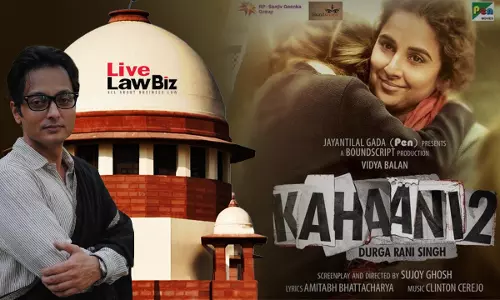
Supreme Court Quashes Criminal Proceedings Against Filmmaker Sujoy Ghosh In 'Kahani 2' Copyright Case
The Supreme Court on Friday quashed criminal proceedings against filmmaker Sujoy Ghosh in a copyright infringement case relating to the film “Kahani 2," setting aside the summoning order issued against him by the CJM Hazaribagh and the subsequent refusal of the Jharkhand High Court to quash the case.A bench of Justices Pamidighantam Sri Narasimha and Alok Aradhe, while allowing Ghosh's petition, said:“In the result, the summoning order dated 07.06.2018 passed by the CJM and order dated...
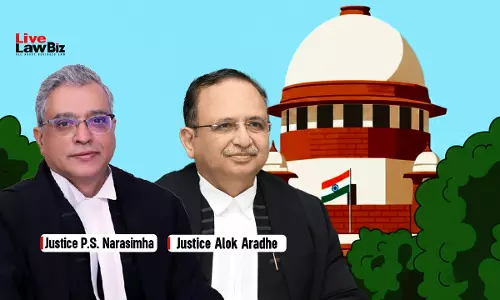
Supreme Court Dismisses Centre's SLP Against Gujarat HC Order Granting IGST Refund Despite GST Return Error
The Supreme Court has recently dismissed a Special Leave Petition filed by the Union of India challenging a Gujarat High Court judgment that directed the grant of an IGST refund to an exporter despite errors in GST returns. A bench of Justice Pamidighantam Sri Narasimha and Justice Alok Aradhe, while hearing the matter, refused to interfere with the High Court's decision but kept open the question regarding the applicability of the proviso to Rule 96 of the CGST Rules for consideration in an...
Diversion Of Preferential Issue Funds For Undisclosed Purpose Amounts To Fraud Under PFUTP Regulations: Supreme Court
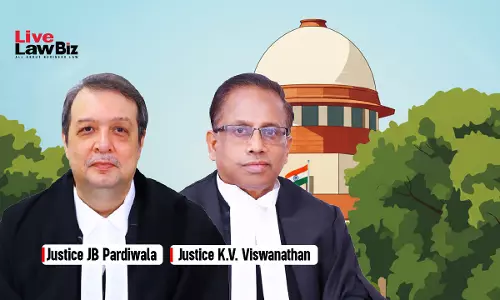
The Supreme Court on Tuesday held that diversion of funds raised through a preferential issue for purposes not disclosed in the notice of the Extraordinary General Meeting (EoGM) convened to approve the allotment amounts to a violation of securities law and constitutes fraudulent conduct under the SEBI (Prohibition of Fraudulent and Unfair Trade Practices) Regulations (PFUTP). A bench of Justices J.B. Pardiwala and K.V. Viswanathan made the ruling while allowing appeals filed by the Securities...