
Revenue Cannot Levy Service Tax Through Notional Apportionment Of Indivisible Turnkey Contracts: Supreme Court
Rajnandini Dutta
13 Aug 2026 1:30 PM IST
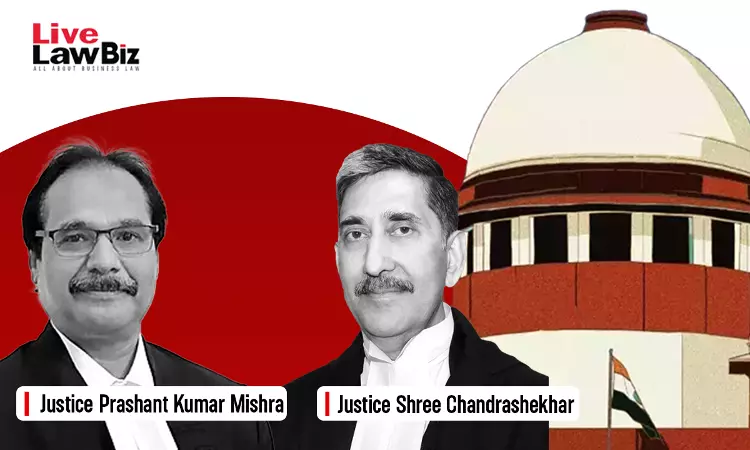
The Supreme Court has held that the Revenue cannot artificially split an indivisible turnkey contract and levy service tax on a notional portion of the total consideration towards installation and commissioning.
Such segregation was not permitted under the law during the relevant period, from July 2003 to April 2006.
A Bench of Justice Prashant Kumar Mishra and Justice Shree Chandrashekhar made the observation while upholding a CESTAT order that had set aside service tax demands against Diebold Systems (P) Ltd. The top court dismissed the appeals filed by the Commissioner of Service Tax, Chennai.
The court found no statutory basis for the Revenue's decision to attribute 33% of Diebold's gross contractual consideration to installation and commissioning.
It held, “We are, therefore, of the considered view that the contracts executed by the respondent-assessee cannot be artificially disintegrated so as to subject a notional portion of the composite consideration to service tax under the taxable category of "commissioning or installation". During the period from July 2003 to April 2006, the Finance Act, 1994 did not authorise the vivisection of such indivisible turnkey contracts, nor did it provide the machinery necessary for identifying and assessing the service element embedded therein. Such authorisation came to be only introduced on 01.06.2007 (via Finance Act, 2007) in form of Section 65(105)(zzzza).”
"In the absence of an express legislative mandate permitting such segregation under the Finance Act, 1994, the Revenue could not, by a process of administrative attribution or notional apportionment, create a taxable event where none existed under the charging provisions of the Act during the relevant period.", the top court added.
Diebold was engaged in supplying Automated Teller Machines (ATMs) to various banks. Under its contracts, it was responsible for supplying, installing, and commissioning the machines at sites identified by the banks. The contracts were executed on a turnkey basis and provided for a composite consideration.
The dispute concerned the period from July 2003 to April 2006. The Revenue took the view that 33% of the gross consideration received by Diebold represented consideration for installation and commissioning. It therefore sought to levy service tax on that amount under the taxable category of "commissioning or installation" under the Finance Act, 1994.
Diebold maintained that the contracts were indivisible turnkey contracts involving the supply of ATMs along with incidental installation and commissioning. It argued that the contracts could not be artificially split for taxation.
The CESTAT accepted Diebold's case. It found that the dominant object of the contracts was the supply of ATMs, while installation and commissioning were incidental obligations. The contracts provided for a single composite consideration and did not contemplate separate consideration for installation or commissioning.
Agreeing with the Tribunal's ultimate conclusion, the Supreme Court said that a tax liability must flow from the charging statute itself. A machinery or valuation provision cannot be used to create or enlarge a tax liability which the charging provision does not impose.
The court held that the Finance Act, 1994, as it stood during the relevant period, contained no express provision authorising the dissection of an indivisible composite turnkey contract. The revenue, therefore, could not extract and separately tax one constituent element of such a contract.
The Court also rejected the use of a notional percentage to determine the taxable component. It said the existence of a valid charging provision must precede the determination of value, and a valuation exercise cannot itself create the power to levy tax.
Examining Diebold's contracts, the court found that their single commercial objective was to deliver fully functional ATMs at the banks' designated sites. Procurement, supply, transportation, installation, testing and commissioning were integral components of that obligation.
There was neither a separate bargain nor separate consideration for installation or commissioning. The consideration was composite and payable for execution of the turnkey project as a whole.
The Court relied on its earlier ruling in Commissioner, Central Excise and Customs, Kerala v. Larsen and Toubro Limited. It had held that before the introduction of "works contract service" from June 1, 2007, the Finance Act, 1994 did not contain the charging provision or machinery necessary to levy service tax on indivisible composite works contracts.
The Bench further observed that Parliament's introduction of a separate taxable entry for "works contract service" from June 1, 2007, along with a mechanism to determine the service component, was a substantive legislative measure. It reinforced the conclusion that the existing service-tax provisions did not permit such composite contracts to be split and taxed.
Rejecting the Revenue's contention that Diebold's installation and commissioning activities themselves attracted service tax, the Court said the legal character of the transaction had to be considered as a whole. One aspect of a composite commercial transaction could not be isolated from the rest of the contract.
The court held, “The mere circumstance that one of the obligations undertaken under a composite contract answers the description of an existing taxable service cannot, in the absence of statutory authority, justify the fragmentation of the contract and the taxation of that obligation in isolation.”
The apex court accordingly held that Diebold's turnkey contracts could not be artificially disintegrated to subject a notional portion of the composite consideration to service tax.
It affirmed the CESTAT's order and dismissed the Revenue's appeals.
For Petitioner: Gurmeet Singh Makker (AOR)
For Respondent: Advocate Charanya Lakshmikumaran; Advocate Nitum Jain; Advocate Neha Choudhary; Advocate Medha Sinha; Advocate Swastik Mishra; Advocate Yashovardhan Singh; Advocate Adithya Nair; Advocate L Badri Narayanan; AOR M. P. Devanath; Advocate Ananya Gupta.