
RERA Orders Not Civil Decrees, Recoverable As Arrears Of Land Revenue: Kerala High Court
Shivani PS
20 April 2026 4:00 PM IST
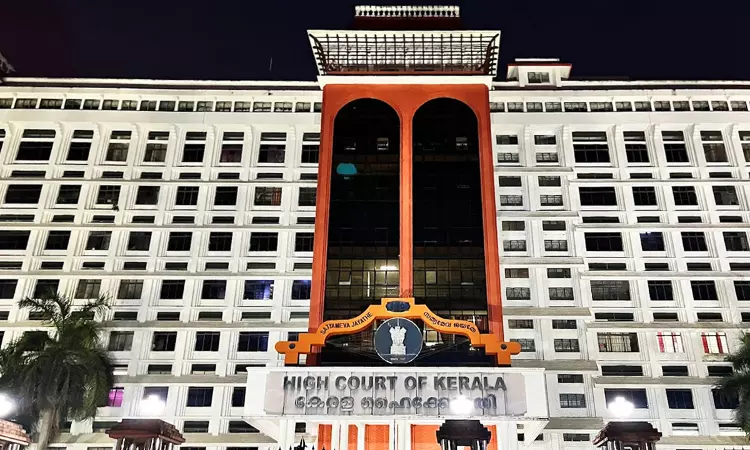
The Kerala High Court has held that amounts awarded by the Real Estate Regulatory Authority (RERA) can be recovered as arrears of land revenue under the Real Estate (Regulation and Development) Act, 2016, and that such orders do not amount to “decrees” requiring execution through civil courts.
By dismissing an appeal moved by Sanroyal Builders and Contractors Pvt. Ltd. and its managing director against homebuyer Divya Balu, the Court has effectively allowed the recovery process under the RERA order to go ahead.
What came up for consideration was a mismatch between the RERA Act and the Rules framed under it. The statute allows amounts such as interest, penalty and compensation to be recovered as arrears of land revenue. The Kerala RERA Rules, however, say such orders can be enforced in the same manner as a civil court decree.
The builder relied on this provision to contend that recovery ought to be pursued through civil court execution.
The Court, however, found that this resulted in a direct conflict between the Act and the Rules.
“Thus, it is clear that the when Section 79 of the Act of 2016 is read with Rule 27 of the Kerala Real Estate (Regulation & Development) Rules, 2018, there is a clear conflict and necessarily, the Section of the Act of 2016 will have to prevail over the Rules of 2018,” the court observed.
A Bench of Justice Easwaran S held that subordinate legislation cannot override the Act. Referring to the statutory bar on civil court jurisdiction, the Court noted that matters falling within the domain of RERA authorities cannot be entertained by civil courts. It further emphasised that proceedings before RERA are complaint-based and not in the nature of civil suits.
Clarifying the nature of RERA orders, the Court said they do not meet the definition of a “decree” under the Code of Civil Procedure, 1908, which arises from adjudication in a civil suit.
“Admittedly, the proceedings before the R.E.R.A. are not in the nature of a suit rather on a complaint. Hence, the decision or order of R.E.R.A. or by the Appellate Tribunal in an appeal arising out of such proceedings would not be a decree within the meaning of Section 2(2) CPC, 1908,” it said.
The court also rejected the contention that recovery proceedings could be initiated only upon issuance of a State Government notification under the Kerala Revenue Recovery Act. It held that such a notification is not a mandatory precondition and that the statutory power of RERA to recover dues as arrears of land revenue operates independently.
“The notification dated 28.12.2020 issued under Section 71 of the Act of 1968 is concerned, the notification can at the best be interpreted in such a manner conferring the power on the RERA to independently proceed with the revenue recovery measures of any amount due to it," the court held.
The dispute arose from proceedings initiated by the homebuyer before the Kerala Real Estate Regulatory Authority, which culminated in an order directing the builder to discharge a quantified liability towards the allottee. The order was later affirmed by the Appellate Tribunal.
With no further appeal against that decision, the builder approached the High Court seeking to restrain recovery through revenue recovery proceedings and to confine enforcement of the order to civil court execution.
Rejecting these submissions, the Court turned to the Supreme Court's ruling in Newtech Promoters and Developers Pvt Ltd v. State of Uttar Pradesh, which makes it clear that amounts determined by RERA can be recovered as arrears of land revenue under the statutory framework.
It said the Rules or the State notification cannot be used to cut down or sidestep this recovery mechanism laid down in the Act.
Since the liability fixed by RERA had already been upheld by the Appellate Tribunal and was no longer under challenge, the Court found there was nothing left to examine as a substantial question of law. The appeal was dismissed, leaving the recovery process to continue through the jurisdictional Collector
For Appellant (Sanroyal Builders and Contractors Pvt Ltd & Anr): Advocates Legith T. Kottakkal, P. R. Banerji.