
Non-Production Of One Legal Notice In Cheque Bounce Case Is Curable Defect: Karnataka High Court
Shilpa Soman
23 Nov 2026 7:09 PM IST
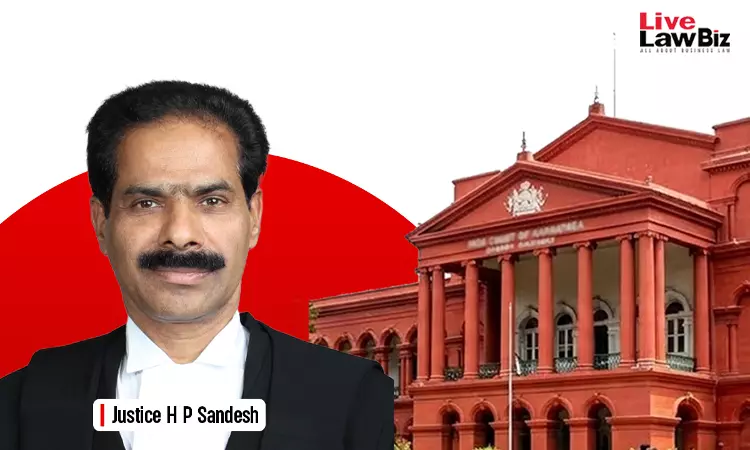
The Karnataka High Court has held that non-production of one of two statutory demand notices in a complaint under Section 138 of the Negotiable Instruments Act is a curable defect and not a ground to quash the proceedings, particularly when issuance and service of both notices are undisputed.
“There was a bouncing of cheque and there was an issuance of notice and reply was also given. Only because one of the notice was not produced, it is not a fundamental defect as contended by the learned counsel for the respondent and document can be produced at a later stage also,” Justice H.P. Sandesh ruled
The case arose from a complaint filed by B. Lingappa against Prasad A. over the dishonour of two cheques worth ₹50 lakh each, aggregating to ₹1 crore.
The trial court took cognizance of the complaint after recording Lingappa's sworn statement. Prasad then approached the High Court, seeking to quash the cognizance order and the consequential proceedings.
His counsel argued that although separate legal notices had been issued for the two dishonoured cheques, only one was produced before the trial court. He contended that the omission was a fundamental defect and that the trial court had erred in taking cognizance despite the missing notice.
Prasad also accused Lingappa of suppressing an earlier legal notice dated June 19, 2019. He pointed out that the notice described the transaction as a loan of ₹50 lakh, whereas a subsequent notice dated June 24, 2019, referred to the transaction involving both cheques as a real estate transaction. He argued that the complainant had taken contradictory positions and deliberately withheld the earlier notice.
Opposing the petition, Lingappa's counsel argued that issuance and service of both notices were undisputed and that Prasad had replied to both. He explained that one of the notices was inadvertently not produced when the sworn statement was recorded. The omission was curable, and the missing document could be produced before conclusion of the trial, he submitted.
The court noted that neither the issuance of the two cheques nor the separate legal notices issued in respect of them was disputed. Prasad had also replied to both notices.
The court rejected the argument that non-production of one notice was a fundamental defect, noting that both notices had been issued and served and that replies had been sent.
Distinguishing the Supreme Court's ruling in H.N. Jagadeesh v. R. Rajeshwari, Justice Sandesh observed that the statutory notice in that case had not been placed on record even though the accused had specifically denied its issuance or receipt. In the present case, however, both notices had been served and Prasad had replied to them. The trial had also not concluded, leaving the complainant an opportunity to produce the missing document.
The court also distinguished the Supreme Court's ruling in Kaveri Plastics v. Mahdoom Bawa Bahrudeen Noorul. That case concerned a notice demanding ₹2 lakh against a cheque for ₹1 lakh. Here, separate notices had been issued for the two cheques, each demanding ₹50 lakh, and the complaint sought the same aggregate amount of ₹1 crore.
Prasad had also relied on a Madras High Court ruling to argue that proceedings could be challenged under Section 482 of the CrPC even after commencement of trial. However, Justice Sandesh observed that the High Court could not examine the deposition of prosecution witness PW1 or assess the alleged admissions while exercising its inherent jurisdiction.
Such evidence had to be examined by the trial court on merits, the judge held. The missing notice could also be produced during the pendency of the proceedings.
The court further clarified that the non-production of the notice was a curable defect and that the complainant could produce the document at a later stage, provided the omission was explained.
“But in the case on hand, non-production of legal notice is a curable defect. Hence, the contention of the learned counsel for the petitioner that this Court can quash the proceedings under Section 482 of Cr.P.C. even after commencement of trial, cannot be accepted and the relevant document can be produced even at the later stage, if it is explained by the complainant,” the court held.
Referring to a Madhya Pradesh High Court ruling, the court noted that the notice ought to have been filed along with the complaint, but there was no bar on producing it at a later stage. The MP High Court had held that such an omission was curable.
On the allegation that Lingappa had deliberately suppressed material facts, the court observed that the issue could be considered while deciding the case on merits.
Accordingly, the court dismissed Prasad's petition.
For Petitioner: Advocate Sridhar Chakravarthi M.V