
DEBT RECOVERY LAWS
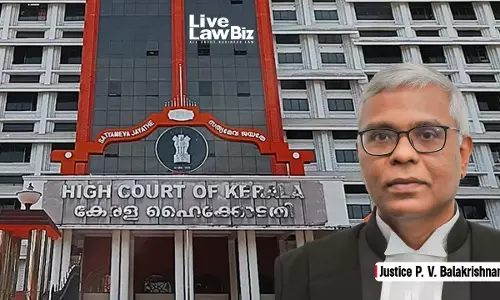
Magistrate Cannot Refer Parties To Mediation In SARFAESI Proceedings Under Section 14: Kerala High Court
The Kerala High Court has set aside an order referring a SARFAESI proceeding to mediation, holding that the role performed by a Magistrate in such proceedings is purely ministerial and does not involve any adjudicatory process. Justice P.V. Balakrishnan observed that a Chief Judicial Magistrate or Additional Chief Judicial Magistrate exercising powers under the SARFAESI Act does not perform any quasi-judicial function and has no discretion in the matter. “It cannot be disputed that the power...
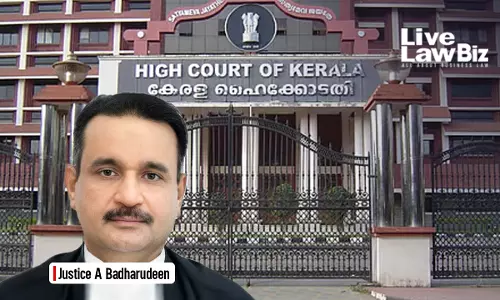
Unauthenticated Alteration In Cheque Date Renders It Void: Kerala High Court
The Kerala High Court has recently held that an alteration in the date of a cheque that is not authenticated by the drawer's full signature amounts to a material alteration and renders the cheque void, while upholding an acquittal in a cheque dishonour case. Justice A. Badharudeen held: “When there is alteration of the date in the cheque which is not authenticated by putting the full signature of the drawer on the place of alteration, the same operates as a material alteration and the same...

Madras High Court Issues Statewide Directions For Timely Disposal Of SARFAESI Pleas Seeking Aid In Taking Possession
The Madras High Court on Friday issued a comprehensive set of statewide directions governing applications under Section 14 of the SARFAESI Act. The Court observed that delays by designated authorities defeat the legislation's objective of enabling expeditious recovery of secured assets and reducing non-performing assets (NPAs). Section 14 of the SARFAESI Act enables banks and other secured creditors to seek the assistance of a Chief Metropolitan Magistrate, Chief Judicial Magistrate or...

Madras High Court Upholds Forfeiture of 25% Bid Amount in SARFAESI Auction Case
On 4 June, the Madras High Court dismissed a writ petition and held that a defaulting auction purchaser cannot claim refund of the 25% deposit when he repeatedly fails to pay the balance sale consideration despite extensions, and the rules permit forfeiture of the amount in such circumstances. A Division Bench comprising Chief Justice Sushrut Arvind Dharmadhikari and Justice G. Arul Murugan rejected Kamal's challenge to the order of the DRAT Chennai, which had upheld the dismissal of his...

Delhi High Court Refuses To Restore LOC Against SSK Trading Directors In Bank Fraud Case
On 4 June, the Delhi High Court dismissed Bank of Baroda's appeal and upheld a 21 January 2026 order of a Single Judge that had quashed a Look Out Circular (LOC) issued against Surender Kumar Bansal and another director of SSK Trading Pvt. Ltd. in a bank fraud and loan default case, subject to conditions requiring them to cooperate with the criminal trial and obtain prior permission before travelling abroad. A Division Bench of Chief Justice Devendra Kumar Upadhyaya and Justice Tejas Karia...

S.138 NI Act Case Cannot Fail For Non-Examination Of Authorised Representative: Calcutta High Court
The Calcutta High Court on 20 May held that a complaint under Section 138 of the Negotiable Instruments Act, 1881 cannot be rejected solely on the ground that the complainant's original authorised representative was not examined, where the court could have exercised powers under Section 311 CrPC to summon the witness and ensure a just decision. Justice Ajoy Kumar Mukherjee allowed the appeal filed by Shriram Transport Finance Co. Ltd. and set aside the judgment dated 27 August 2021 passed by...

DRT Competent To Order Release Of Title Documents After Loan Settlement: Allahabad High Court
On 4 June, the Allahabad High Court held that the Debts Recovery Tribunal (DRT) can decide applications seeking release of title documents from a bank after full repayment of a loan. Borrowers cannot invoke writ jurisdiction for release of such documents when an effective remedy is available before the DRT. A Division Bench of Justices Shekhar B. Saraf and Abdhesh Kumar Chaudhary dismissed a writ petition filed by R.S. Contractors and Engineers against Canara Bank, holding that the petitioners...
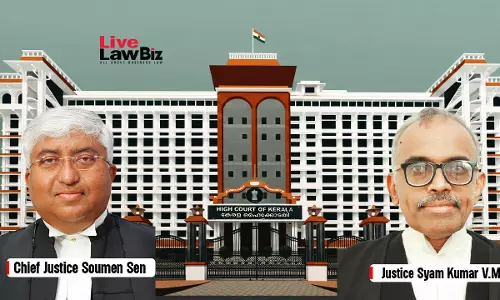
Pre-Deposit Under SARFAESI Can Be Based On Creditor's Claim If DRT Has Not Determined Debt: Kerala HC
On 2 June, the Kerala High Court held that where the Debts Recovery Tribunal (DRT) has not determined the debt due from a borrower, the pre-deposit required for maintaining an appeal under Section 18 of the SARFAESI Act can be computed on the basis of the amount claimed by the secured creditor. A Division Bench comprising Chief Justice Soumen Sen and Justice Syam Kumar V.M. allowed Canara Bank's appeal in part against a Single Judge's order on the computation of pre-deposit for a SARFAESI...
Failed Auctions, Litigation Concerns Cannot Depress Secured Asset Value Under SARFAESI: DRAT Chennai
The Debts Recovery Appellate Tribunal (DRAT), Chennai, on 13 May held that a mere apprehension of litigation and the failure of earlier auctions cannot, by themselves, justify a substantial reduction in the market value of a secured asset. A Bench presided over by Justice G. Chandrasekharan allowed the appeal filed by ITG Energy Ltd. and others and set aside a SARFAESI auction conducted by CSB Bank after finding that the borrower's property had been grossly undervalued and sold through a flawed...

Writ Petition Not Maintainable Against Private ARC Enforcing Security Interest: Madras High Court
On 2 June, the Madras High Court dismissed a writ petition challenging a pre-sale auction notice issued under the Securitisation and Reconstruction of Financial Assets and Enforcement of Security Interest Act, 2002, and held that Article 226 jurisdiction does not extend to a private Asset Reconstruction Company (ARC) enforcing contractual rights, and that the borrower must approach the Debts Recovery Tribunal (DRT). The Division Bench comprising Chief Justice Sushrut Arvind Dharmadhikari and...
Cheque Dishonour Notice Must Specify Amount Demanded, Else No Valid Notice In Eye Of Law: Kerala High Court
The Kerala High Court has held that a statutory demand notice issued in a cheque dishonour case must specifically mention the amount demanded, failing which there would be no legal notice in the eye of law. “Only when the notice is specific about the amount, it is possible for the recipient of the notice to pay the amount which was specifically asked for to avoid penal consequences,” the Court observed. Justice A Badharudeen made the observation while dismissing an appeal filed against the...
Technical Glitch Could Have Misled Bidder; Kerala High Court Directs Central Bank To Refund Auction Deposit
The Kerala High Court has upheld a direction requiring the Central Bank of India to refund money deposited by an auction participant after finding that an admitted technical glitch could have led her to believe that her bid had not been accepted. A Division Bench of Chief Justice Soumen Sen and Justice Syam Kumar V.M. passed the order while partly allowing an appeal filed by the Bank against a Single Judge's decision directing a refund of the amount deposited by the auction participant and...