
Judicial Member Must Be Part Of PMLA Bench Deciding Property Attachment, Not Needed For Issuing SCN: Supreme Court
Kirit Singhania
26 Nov 2026 12:20 PM IST
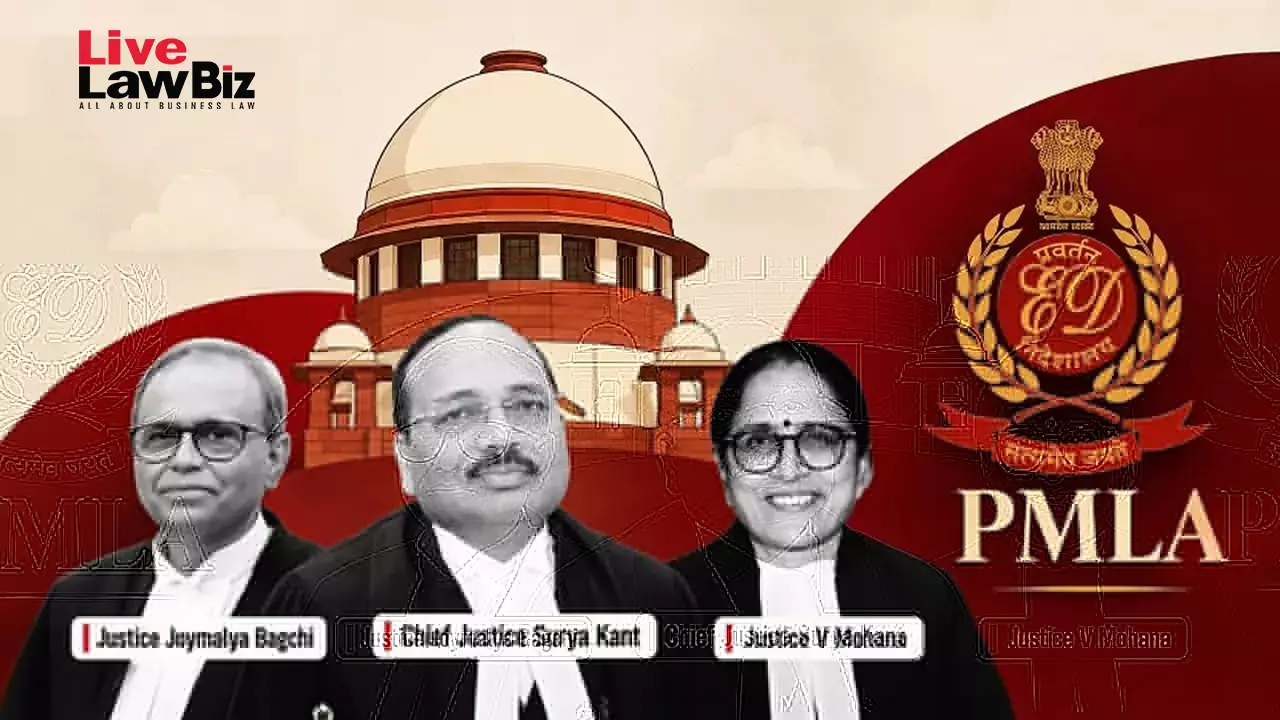
The Supreme Court has on Thursday held that a judicial member must be part of the bench of the Adjudicating Authority constituted under the Prevention of Money Laundering Act (PMLA) when it determines whether a property is involved in money laundering and decides whether to confirm its attachment.
However, the Court clarified that a judicial member's participation is not necessary when the Authority issues a show-cause notice under Section 8(1) of the PMLA. The requirement applies only when the Authority conducts the hearing and final adjudication under Sections 8(2) and 8(3).
A Bench of Chief Justice Surya Kant and Justices Joymalya Bagchi and V. Mohana clarified that although the Adjudicating Authority can function through a single-member bench, the bench undertaking adjudication under Sections 8(2) and 8(3) must include a judicial member.
The Court concluded its judgment by issuing the following directions:
1. There is no legal mandate that only a judicial member be appointed as Chairperson of the Adjudicating Authority.
2. Sections 6(5)(b) and 6(7) of the PMLA are valid and provide that a bench of the Adjudicating Authority shall consist of one or two members, which may or may not include a judicial member. Subject to clauses three and four below, such a bench may discharge any or all of the functions of the Adjudicating Authority.
3. The adjudication under Section 8(2) and 8(3) of the PMLA involves the interpretation of key statutory provisions and the appreciation of evidentiary material and shall be undertaken only by a bench of the Adjudicating Authority which consists of or includes a judicial member.
4. Determinations under Sections 20(4) and 21(4) of the PMLA are ancillary to the adjudication under Sections 8(2) and 8(3) and shall likewise be assigned to a bench competent to undertake adjudication in terms of clause three above.
Why Judicial Member's Presence Is Necessary
The court examined the functions entrusted to the Adjudicating Authority under the PMLA and classified them into two categories.
The first involves receiving and preserving the reasons recorded and material relied upon by Enforcement Directorate (ED) officers when attaching properties under Sections 5 and 17 of the Act.
The second involves adjudicating complaints and applications filed by the ED and determining whether the property in question is involved in money laundering.
Explaining the distinction, the Court observed:
"In the first, the Adjudicating Authority receives and preserves the reasons recorded and the material relied upon by the officers of the ED when they attach property under Sections 5 and 17. These are searches or arrest powers."
On the second category, the Court said:
"In the second, the Adjudicating Authority adjudicates upon the complaints and applications filed by the ED and determines whether the property in question is involved in money laundering, with consequential orders flowing upon that determination. In our considered opinion, the Adjudicating Authority performs, in this role, a function not unlike that of a regular court at the stage of confiscation or a similar determination made by the Special Court after the trial, on the basis of evidence led in the course of the criminal trial."
The Court reasoned that these adjudicatory functions involve interpreting statutory provisions and appreciating evidence, with serious consequences for the property rights of affected persons. It held that the presence of a judicial member was necessary to ensure legal objectivity.
"Consequently, to the above extent, we are satisfied that a member drawn from the field of law must comprise or be a part of the bench of the Adjudicating Authority for a determination under Section 8(2) or issuance of an order under Section 8(3) of the PMLA."
The Court separately addressed the requirement of judicial participation at different stages of proceedings under Section 8.
It held that while the issuance of a show-cause notice under Section 8(1) does not require the participation of a judicial member, the bench conducting the hearing and final adjudication under Sections 8(2) and 8(3) must necessarily include one.
"Consequently, we hold that while the issuance of a show cause notice under Section 8(1) does not require the participation of a judicial member of the Adjudicating Authority, the bench that undertakes the hearing and final adjudication under Sections 8(2) and 8(3) must necessarily include a judicial member."
To implement this requirement, the Court directed the Chairperson to issue an administrative circular under Section 6 of the PMLA.
Single-Member Benches Can Continue
The court also considered whether Sections 6(5)(b) and 6(7) permitted the Adjudicating Authority to function through a single-member bench and whether every bench had to include a judicial member.
It accepted the construction advanced by the Union Government on the statutory composition of benches:
"We thus find greater force in the construction advanced by the Union of India, namely, that the bench may consist of one member, being either the Chairperson or one of the other members, or of two members, being either the Chairperson and one other member or two members other than the Chairperson."
However, the Court clarified that the statutory provisions permitting single-member benches did not conclude the separate question of whether the nature of the Authority's adjudicatory functions required judicial participation.
"That, however, does not conclude the inquiry. The private appellants submit, in the alternative, that the functions entrusted to the Adjudicating Authority themselves demand the participation of a judicial member and that such a requirement must be read into the statute."
The court made clear that its ruling did not require every adjudication under Section 8 to be conducted by a bench of at least two members. A single-member bench could undertake such adjudication, provided the member was a judicial member duly authorised by the Chairperson.
"We are satisfied to clarify that our findings do not mandate that adjudication under Section 8 of the PMLA be undertaken only by benches of at least two members."
The court also rejected the contention that the Chairperson must necessarily be a judicial member, holding that there was no such mandate under the PMLA.
Supreme Court Recommends Restoring Multiple Adjudicating Authorities
The court also recommended that the Union Government consider repealing the 2009 amendment to the PMLA and restoring the original framework of multiple Adjudicating Authorities.
The 2009 amendment substituted the words "one or more Adjudicating Authorities" in Section 6(1) with "an Adjudicating Authority", replacing the framework permitting multiple authorities with a single Authority comprising a Chairperson and two other members.
The Court observed,
"That being so, we recommend to the Union of India that it appropriately consider the suitability and desirability of repealing the 2009 amendment and reverting to the original framework of multiple Adjudicating Authorities and take necessary steps for the same."
Background
The Supreme Court was hearing a batch of matters concerning the constitutional validity of the second proviso to Section 5(1) of the PMLA and whether proceedings are vitiated by non-compliance with Section 5(1) or Section 8(1), particularly the requirement to furnish "reasons to believe".
The matters arose from appeals against decisions of different High Courts.
One of the issues arose from a Delhi High Court Division Bench judgment which upheld the constitutional validity of the second proviso to Section 5(1) of the PMLA.
On whether a single-member bench of the Adjudicating Authority could exercise powers and conduct proceedings under Section 8 of the Act, the High Court held that both the Adjudicating Authority and the Appellate Tribunal could comprise single-member benches. It further held that such benches need not necessarily include a judicial member and could also comprise an Administrative Member.
In one of the special leave petitions filed by the ED, the Supreme Court had stayed the High Court judgment, which had also held that the writ petitions challenging the proceedings were maintainable.
A detailed copy of the judgment is awaited.