
Politicians Must Tolerate AI Satire, But Not Vulgar Deepfakes: Delhi High Court In Raghav Chadha Case
Riya Rathore
1 July 2026 2:01 PM IST
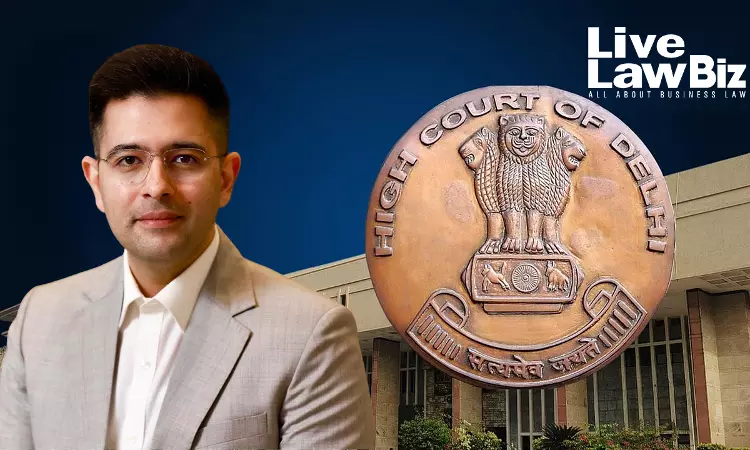
The Delhi High Court on Tuesday partly allowed Rajya Sabha MP Raghav Chadha's plea for interim relief against AI-generated deepfake content.
It directed Meta Platforms and another platform arrayed as a defendant to take down URLs corresponding to six of the 52 impugned posts after finding them to contain "explicit content" that was "profane and vulgar in nature."
The court declined to restrain the remaining content, holding that most of it amounted to political satire rather than defamation.
Justice Subramonium Prasad, hearing Chadha's interim injunction application, observed that public figures are expected to tolerate criticism and satire arising from their political decisions.
The court observed, "this Court observes that humor about change in political party alliances, governance, policies, etc. are a part and parcel of politics. Any action by a politician belonging to any political party will, in most, if not all circumstances, invite criticism from, upset, or create turmoil amongst, the general public or members from rival political parties, which may at times be expressed in the form of satirical humor. However, that does not automatically make such content offensive or defamatory. At the cost of repetition, public figures assuming such positions of power must accept being at the receiving end of the satirical humor as a necessary and inevitable aspect of their profession, though unpleasant."
Chadha, who previously served as an AAP MLA from Rajinder Nagar and as Vice-Chairman of the Delhi Jal Board, approached the court alleging that unknown persons had used artificial intelligence to create deepfake videos and morphed images portraying him in a negative light.
According to the plaint, the campaign commenced after he, along with several other Aam Aadmi Party MPs, defected to the Bharatiya Janata Party in 2026.
The suit sought a permanent injunction against the alleged misuse of his personality and publicity rights. It also sought restraint on impersonation and voice cloning, removal of the impugned content, and damages.
At the outset, the court observed that the plaint did not, in substance, concern personality rights. It explained that personality rights protect an individual's control over the unauthorised exploitation of their identity and likeness. The grievance before it, however, was essentially one of alleged defamation.
When the court asked whether Chadha was pressing his personality rights claim, Senior Advocate Rajiv Nayar, appearing for him, confirmed that he would not press those arguments and would instead confine the case to defamation. The court therefore declined to consider the prayers relating to personality rights. It restricted its consideration to the 52 documents that had earlier been argued before it.
While examining the claim, the court referred to a series of Supreme Court and Delhi High Court decisions emphasising that those holding public office are expected to display a greater degree of tolerance towards criticism.
The court also made it clear that it was not endorsing the use of artificial intelligence to create deepfakes that harm an individual's dignity.
It observed, "this Court in no way or manner endorses the use of AI to produce deepfake videos, morphed images, etc., when employed to harm the dignity of an individual which would strike at the very root of their fundamental rights guaranteed under the Constitution of India."
The court further observed that, until AI-generated content is regulated by a stringent legislation, it has a judicial duty to examine whether such material crosses the threshold of infringing an individual's right to dignity. It added that this exercise must be balanced against the constitutional guarantee of free speech.
After reviewing the material placed before it, the court found that the majority of the impugned posts appeared to be satirical expressions concerning Chadha's political decisions. It held that such content did not automatically become defamatory merely because it criticised his political choices.
The court observed that political decisions are likely to attract "both bouquets and brickbats." It added that public figures must accept being at the receiving end of satirical humor as an inevitable aspect of political life.
However, it held that six of the 52 impugned posts contained content that was "profane and vulgar in nature" and fell "outside the purview of harmless satirical humor.
Accordingly, the court directed Meta to take down the URLs corresponding to those six posts within two weeks. It also directed them to furnish Chadha with the Basic Subscriber Information and IP logs associated with those accounts within the same period.
The matter has been listed for further hearing on August 18, 2026.
For Raghav Chadha: Senior Advocate Rajiv Nayar with Sataya Anand, Nikhil Aradhe, Amber Chaturvedi, Manjira Das Gupta and Naman Maheshwari
For Defendants: Advocates Varun Pathak, Radhika Roy and Prasidhi Agrawal for Meta Platforms Inc; Advocates Mamta Rani Jha, Rohan Ahuja, Shruttima Ehersa, Sanya Sehgal and Aiswarya for Defendant No. 4; Dimple S Arora (SPC) and Vanshul Pali (GP) along with Advocate Ayushika Mishra for the government.