
Patent Revocation Can Be Sought Independently Or By Counter Claim, Cannot Be Curtailed: Madras High Court
Riya Rathore
3 Oct 2026 4:31 PM IST
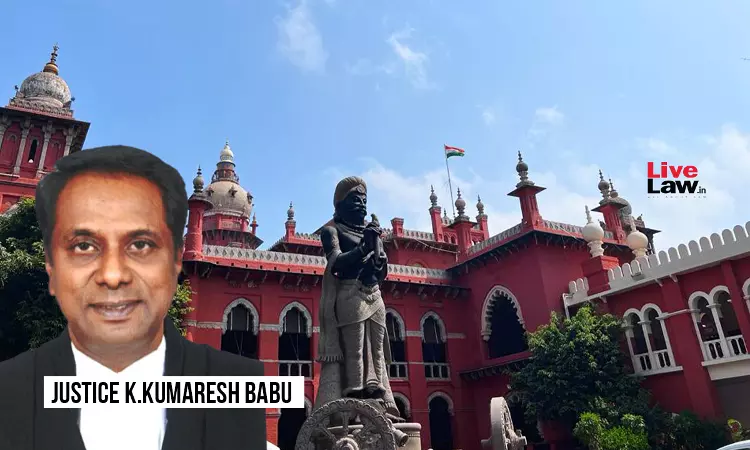
The Madras High court has ruled that a party facing a patent infringement suit can seek revocation of the patent either through a separate revocation petition or by filing a counterclaim in the infringement suit. It cannot be forced to pursue only the counter claim.
“This statutory right cannot be whittled down by forcing the litigant to choose a remedy by only filing a counter claim,” Justice K. Kumaresh Babu observed.
“Such statutory rights available to the litigant cannot be curtailed to the litigant in choosing the mode of revocation.” the court added.
The court was dealing with a review petition filed by Arunachalaa Enterprises challenging an earlier order transferring an infringement suit from the District Court to the High court. The suit was transferred to be dealt with along with a separate patent revocation petition pending before the High court.
The court closed the connected application seeking a stay of further proceedings.
Arunachalaa Enterprises argued that once the infringement suit had been filed, the only way to seek revocation was through a counter claim in that suit. Since no such counter claim had been filed, it argued that the District Court continued to have jurisdiction over the infringement suit.
The court rejected that interpretation.
It relied on Section 64 of the Patents Act, which permits revocation to be sought independently or by way of a counter claim in an infringement suit.
The court held that the statutory choice under Section 64 could not be curtailed by requiring the litigant to pursue revocation only through a counter claim.
The court also considered Section 104 of the Patents Act. It noted that an infringement suit could be filed before the District Court, but if a claim for revocation is made in that suit, the District Court is ousted of jurisdiction and the suit has to be transferred to the jurisdictional High court.
This is because the High court alone has jurisdiction to decide the revocation claim.
In the present case, the revocation proceeding had been filed separately while the infringement suit was pending before the District Court. The court held that this did not prevent it from transferring the infringement suit to the High court.
It noted that otherwise, the District Court dealing with the suit would have to wait for the High court to decide the revocation petition.
The court also referred to the object of Order VIII of the Code of Civil Procedure of “not to drive the litigant to different forum”. It observed that transferring the infringement suit to the High court to be dealt with along with the revocation petition fulfils that object.
The court added that the power to transfer was available not only under the proviso to Section 104 but also under Clause 13 of the Letters Patent, which applies to the High court.
The court found no material error apparent on the record requiring review and dismissed the petition. The connected application seeking a stay of further proceedings was also closed
For Arunachalaa Enterprises: Advocate V. Natarajan, assisted by G.V. Subramanian
For Respondents: Advocate A.K.Rajaraman for Kamalesh Kannan; Advocate J.Madanagopal Rao