
Delhi High Court Revives University Of North Texas' Patent Bid For Marijuana Detection Breathalyser
Riya Rathore
25 May 2026 12:39 PM IST
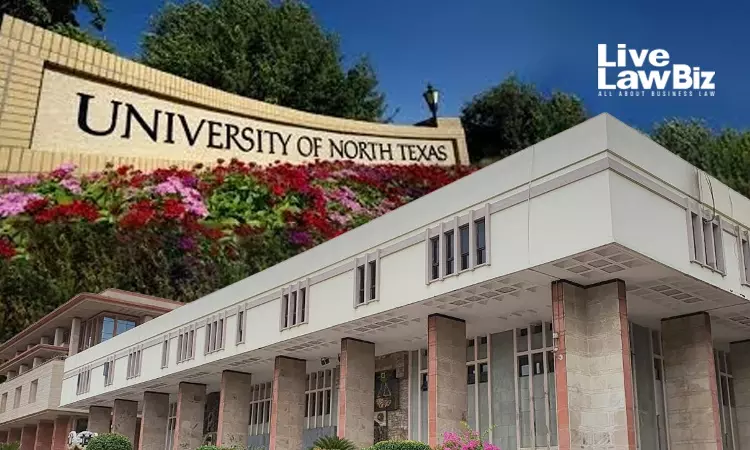
The Delhi High Court has recently set aside the Indian Patent Office's refusal of a patent application filed by the University of North Texas for a breathalyser technology intended to detect cannabinoids, including THC, from breath samples.
Justice Jyoti Singh, who heard the appeal, held that the rejection order could not be sustained as it failed to properly assess the claimed invention's patentability.
“The conclusion is thus cryptic and unreasoned on as to how the use of a heating element and a THz spectrometer does not provide a technical advancement over the SERS-based detection system described in D1, when both the features are not disclosed in D1. The only similarity that exists between the two is that both analyse breath samples, which was not enough to refuse the application," the court observed.
The invention, titled Technologies for Rapid Detection and Quantitation of Volatile Organic Compounds (VOCs) Using Breath Samples, was filed before the Indian Patent Office in February 2021 as a national phase application. The technology relates to a portable breathalyser system designed for rapid field detection of cannabinoids in breath samples, including for use by law enforcement agencies to identify drivers suspected of being under the influence of marijuana.
The Patent Office had rejected the application in January 2025 citing lack of inventive step, non-patentability as a diagnostic method, lack of clarity and conciseness, and insufficient disclosure.
On the question of inventive step, the court found that the Controller had failed to follow the settled five-step test for determining obviousness and had not even identified the ordinary person skilled in the art.
“In the present case, Respondent has not followed the first step of identifying an ordinary person skilled in the art and this is enough to vitiate the impugned order,” the court said.
The court also found that the Patent Office had incorrectly identified the key technical features of the invention, which affected its ultimate conclusion.
On the objection that the invention was a diagnostic method, the court held that the Controller had neither analysed the claims nor applied any test to determine whether the invention fell within that exclusion.
“Respondent has neither analysed the claims nor applied any test for making an assessment whether the claimed invention falls within the ambit of 'diagnostic method',” the court observed.
Finding multiple flaws in the refusal order, the court quashed the January 2025 decision and remanded the matter to the Patent Office for fresh consideration within four months after granting the applicants an opportunity of hearing.
The court directed that the fresh decision “will be a detailed, speaking and a reasoned order” and must be taken uninfluenced by observations in either the impugned order or the present judgment
For University Of North Texas: Advocates Vaishali Joshi, Vineet Rohilla and Ankush Verma
For Assistant Controller: CGSC Nidhi Raman with Advocates Arnav Mittal and Nikita Singh