
Delhi High Court Orders Itel, Infinix, Tecno Phones' Maker to Deposit Pro Tem Security In InterDigital Patent Suit
Riya Rathore
6 July 2026 9:50 AM IST
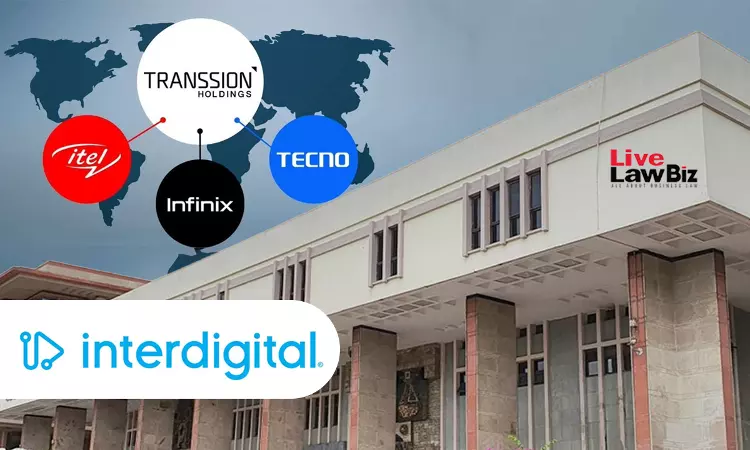
The Delhi High Court has directed Shenzhen Transsion Holdings, which sells smartphones under the Itel, Infinix and Tecno brands, to deposit pro tem security with the Registrar General in patent infringement suits filed by InterDigital Patent Holdings over Standard Essential Patents (SEPs) covering 3G, 4G, 5G and HEVC video coding technologies.
Justice Tushar Rao Gedela passed the order on July 1 while deciding InterDigital's applications seeking an interim pro tem security deposit pending adjudication of its plea for interim injunction.
InterDigital has filed two suits against Transsion and its group companies relying on five patents. Four relate to cellular technologies used in 3G, 4G and 5G standards, while one concerns HEVC video coding technology. The company claimed Transsion had been using its SEPs without a licence since at least April 2016 despite licensing negotiations that began in 2019.
InterDigital argued that it had shared more than 100 claim charts with Transsion during the negotiations, held at least 12 meetings between the parties, including four full-day technical meetings in China, and proposed arbitration to resolve the licensing dispute. According to InterDigital, Transsion declined arbitration and continued using the technology without obtaining a licence.
Transsion opposed the applications, contending that the validity and essentiality of the asserted patents had not been established even on a prima facie basis. It also argued that the court could not determine any security amount without comparable third-party licence agreements being placed on record.
Rejecting that contention, the court relied on earlier Division Bench rulings and noted that non-production of comparable licence agreements was not a bar at this stage.
The court also examined foreign decisions concerning corresponding patents. It noted that Chinese authorities had invalidated counterparts of some asserted patents, while courts in jurisdictions including the United Kingdom and Brazil had upheld the validity or essentiality of corresponding patents. Looking at those decisions together, the court held there was no basis at this stage to conclude that the asserted patents were invalid or non-essential.
"It cannot be concluded with conviction that the suit patents are invalid or not essential to the standards," the court held, adding that InterDigital had prima facie established the validity and essentiality of the suit patents for deciding the present applications.
Examining the negotiations between the parties, the court found that a pro tem security order was necessary to balance the parties' positions while the dispute remained pending.
"A pro-tem security order does not confer any advantage upon" the SEP holder but "only balances the asymmetric advantage that an implementer has over a Standard Essential Patent holder," the court observed.
The court also rejected Transsion's contention that the pro tem security should be computed by considering only Indian patents in isolation. It held that 3G, 4G and 5G technologies are "so well enmeshed, entrenched, interwoven, intertwined and interdependent" that the SEP portfolio could not be artificially compartmentalised for this purpose.
While determining the amount, the court noted that comparable third-party licence agreements were not before it and ultimately treated Transsion's own last counter-offer during the negotiations as the fairest basis for quantifying the security.
It directed Transsion to deposit one-fifth of the cumulative value of that counter-offer, calculated for the licence period sought by InterDigital, with the Registrar General within eight weeks.
In the alternative, the court permitted the company to furnish an unconditional bank guarantee for an equivalent amount.
The court clarified that its findings were confined to the present applications and would not influence the pending interim injunction proceedings.
For Plaintiffs : Advocates Pravin Anand, Vaishali R. Mitttal, Gitanjali Sharma, Siddhant Chamola, Pallavi Bhatnagar and Prachi Sharma.
For Defendants : Advocates Saikrishna Rajagopal, Julien George, Vivek Ayyagari, Arjun Gadhoke, Ayush Saxena, Christo Sabu, Devanjan Chakravarty, Sanskar Dua, Soumya Singh, Priyam Lizmary Cherian and Vedam Anand Kumar.