
Calcutta High Court Quashes Property Tax Hike Based On Undisclosed Policy, Says It Lacks Statutory Basis
Mehak Dhiman
2 July 2026 4:54 PM IST
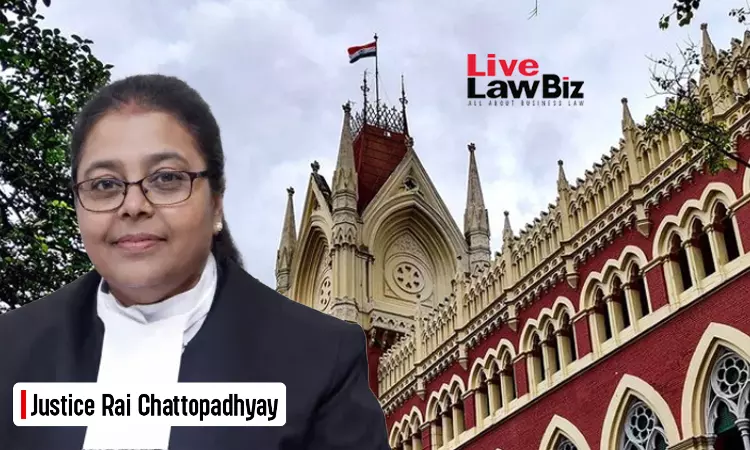
The Calcutta High Court on 15 June held that municipal authorities cannot enhance property tax liability through undisclosed administrative policies lacking statutory backing, and set aside the enhancement of annual valuation imposed on Popat and Kotecha Property along with consequential tax demands.
Justice Rai Chattopadhyay observed that fiscal measures must rest on clear statutory authority and cannot be justified through internal administrative arrangements. He said:
“The respondent has not placed before this Court any rule, regulation, notification, circular having statutory force, or delegated legislative instrument authorising application of predetermined percentage increases in the manner alleged. In absence thereof, the purported policy remains merely an internal administrative arrangement. Such an arrangement cannot acquire legal efficacy merely because it has been implemented through a centralised computer system or applied uniformly across a large number of properties.”
The dispute arose after the Kolkata Municipal Corporation enhanced the annual valuation of the petitioners' property from Rs. 20.13 lakh to Rs. 22.15 lakh with retrospective effect from the fourth quarter of 2016–17, resulting in additional tax demands.
Petitioners challenged the enhancement, contending that it was based on an undisclosed computer-generated policy applying standardised percentage increases and was issued without statutory authority or notice.
The Court held that taxation measures must have explicit statutory backing and cannot be sustained through executive instructions or internal administrative mechanisms. It noted:
“The explanation offered by the respondent is wholly unsatisfactory. Instead of identifying any clear statutory source authorising the enhancement, the respondent attempts to explain the controversy by attributing it to a misunderstanding concerning whether the relevant cut-off was the year 2011 or the 4th quarter of 2011-12.”
The Bench observed that the Corporation failed to produce records justifying the basis for fixed percentage increases or explaining the classification criteria adopted for different properties. It also found a clear violation of principles of natural justice, noting that the enhancement was carried out without issuing notice, inviting objections, or granting a hearing to the petitioners, who became aware of the change only through the Corporation's website. It held:
“The admitted position remains that the petitioner came to know of the enhancement only from the Corporation's website. Such a state of affairs is wholly incompatible with the statutory scheme and fundamentally destructive of procedural fairness.”
Further, the Court held that the impugned enhancement suffered from multiple legal infirmities, including absence of statutory authority, lack of individualised assessment under statutory criteria, reliance on an undisclosed policy, and violation of mandatory procedural safeguards. It observed:
“The impugned enhancement, therefore, suffers from multiple incurable defects. It lacks a demonstrated statutory foundation. It is not based on an individual assessment undertaken in accordance with statutory criteria. It proceeds upon an undisclosed policy. It is sought to be justified through inconsistent explanations. It ignores the implications of the amended statutory regime. Most importantly, it has been affected in complete violation of mandatory procedural safeguards and principles of natural justice.”
Accordingly, the High Court quashed the enhanced valuation and consequential demands, directed restoration of the earlier valuation, and ordered refund or adjustment of Rs. 1.97 lakh collected pursuant to the impugned action. However, it granted liberty to the Corporation to undertake a fresh assessment in accordance with law after following due procedure.
For Petitioner: Senior Advocate, Mainak Bose, Shankarshan Sarkar, Magnath Dutta, Tanmoy Sett and Sucheta Das, Advocates
For Respondent: Alak Kumar Ghosh, Fazlul Haque and Piyali Sengupta, Advocates