
Madhya Pradesh High Court Upholds State Power To Levy ₹1,000 Per Seat For Permit Violations
Mehak Dhiman
7 Sept 2026 1:43 PM IST
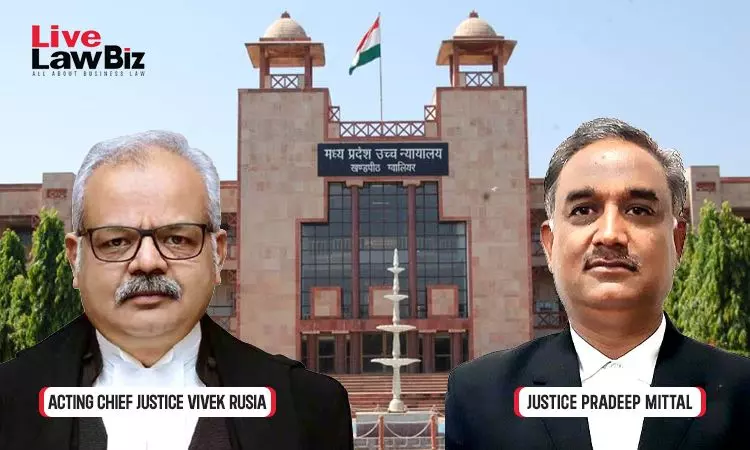
The Madhya Pradesh High Court on 25 August upheld the State Legislature's power to impose an additional levy on vehicles plying without a valid permit or in violation of permit conditions, holding that the levy is regulatory and compensatory rather than punitive.
A Division Bench comprising Acting Chief Justice Vivek Rusia and Justice Pradeep Mittal dismissed a challenge to Section 13(2)(a) of the Madhya Pradesh Motoryan Karadhan Adhiniyam, 1991, as substituted by the 2025 amendment. The provision imposes an additional levy of Rs. 1,000 per seat on specified passenger vehicles found operating without a valid permit or for a purpose contrary to the permit. The judges held:
“...Section 13(2)(a) of the 1991 Act, as substituted by Act No. 22 of 2025, does not alter the charging section, does not amend the First Schedule, and does not convert a valid permit into a legal fiction of "no permit" for the purpose of tax calculation, unlike the mechanism which was struck down in Hardev Motor Transport…”
Smt. Nayaju Pote, the petitioner, claiming to be the registered owner of a vehicle bearing registration No. MP-48-P-2211, challenged the constitutional validity of the amended provision.
She argued that the provision was repugnant to the Motor Vehicles Act, which requires permits for specified vehicles and prescribes punishment for using a vehicle without a permit or in violation of permit conditions. The petitioner relied on the Supreme Court's judgment in Hardev Motor Transport v. State of Madhya Pradesh.
The State contended that the levy formed part of fiscal and regulatory legislation within the State Legislature's competence and was distinct from the criminal punishment imposed under the Motor Vehicles Act.
The Court noted that the Supreme Court had subsequently considered a similar issue in State of H.P. v. Goel Bus Service and held that an additional State fiscal levy arising from the same conduct of operating a vehicle without a permit does not become unconstitutional merely because the Motor Vehicles Act also prescribes punishment for that conduct.
Applying this principle, the Bench held that Section 13(2)(a) creates an independent fiscal liability in addition to the tax payable. It noted that the provision neither alters the charging provision nor treats a valid permit as a non-existent permit for calculating tax, unlike the provision considered in Hardev Motor Transport.
The Court held that the levy is regulatory and compensatory in character, as it seeks to protect public revenue and deter tax evasion and violations of permit conditions. It therefore found no conflict with Section 192-A of the Motor Vehicles Act or any excess of the State Legislature's taxing powers.
It also considered the petitioner's plea for release of the seized vehicle. It noted that the authorities had seized the vehicle under Section 207 of the Motor Vehicles Act and Section 16(3) of the State taxation law.
Since the State law provides a statutory mechanism for seeking release of a seized vehicle, the Bench declined to order its release on supurdginama through writ jurisdiction. It observed:
“...There is nothing on record to indicate that the provision is manifestly unjust or glaringly unconstitutional. For the reasons recorded above, the challenge to the constitutional validity and vires of Section 13(2)(a) of the Madhya Pradesh Motoryan Karadhan Adhiniyam, 1991, as substituted by Act No. 22 of 2025, is devoid of merit and is hereby rejected”
Instead, the judges granted the petitioner liberty to approach the competent Taxation Authority with the relevant documents seeking release of the vehicle. They directed the authority to pass an appropriate and reasoned order.
Accordingly, the High Court dismissed the writ petition with no order as to costs.
For Petitioner: Advocate Ashish Rawat
For Respondent: Advocate Anubhav Jain