
Paid Business-To-Business Jewellery Exhibitions Attract Entertainment Duty Under Bombay Act: Supreme Court
Rajnandini Dutta
19 Nov 2026 3:12 PM IST
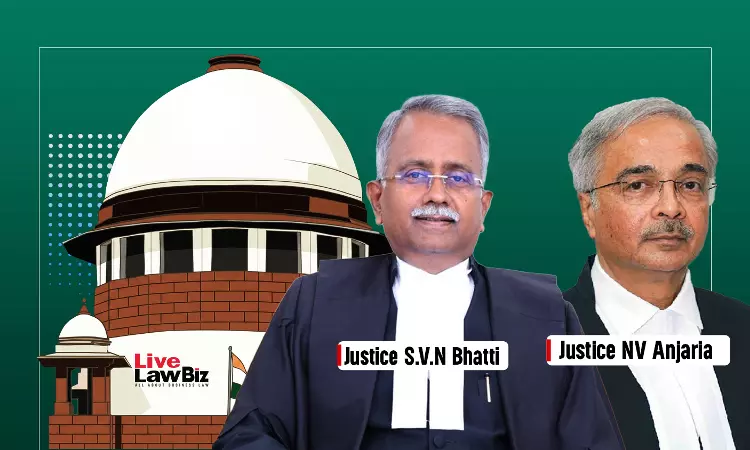
The Supreme Court on Thursday held that jewellery trade exhibitions where visitors are required to pay an entry fee attract entertainment duty under the Bombay Entertainments Duty Act, 1923, even if they are organised exclusively for business purposes.
A bench of Justice S.V.N. Bhatti and Justice N.V. Anjaria held that an exhibition cannot be excluded from the definition of "entertainment" merely because it facilitates business transactions between traders, manufacturers, and buyers.
The Court observed that Section 2(a) of the Act expressly includes exhibitions to which persons are admitted on payment. The commercial nature of an exhibition does not take it outside the scope of the provision.
"The entry is on payment, and upon entry, even if it is a business-to-business transaction, the same cannot be taken away from the definition of 'entertainment' under the Act, 1923," the Court held.
The case arose from a dispute between the Gem and Jewellery Export Promotion Council and the Maharashtra authorities over the levy of entertainment duty on the India International Jewellery Show (IIJS) and IIJS Signature exhibitions held in Mumbai.
The Council, established under the aegis of the Ministry of Commerce, Government of India, organises these exhibitions to promote the export of gems and jewellery. They provide a platform for Indian exporters, other jewellers and international buyers to conduct business.
The Maharashtra authorities demanded entertainment duty on the exhibitions on the ground that visitors were admitted on payment of registration fees.
The Council paid the duty under protest and challenged the demand, arguing that the exhibitions were purely business-to-business events and did not involve entertainment or amusement.
The authorities, however, held that the exhibitions were covered under Section 2(a) of the Act. The appellate authority reduced the duty assessed for the 2011 exhibition to ₹45,40,125 after deleting the levy and penalty relating to 919 exhibitor passes.
The Bombay High Court subsequently dismissed the Council's challenge, holding that the paid exhibitions fell within the definition of entertainment under the Act. The Council then approached the Supreme Court.
Before the Supreme Court, the Council argued that the exhibitions were not open to the general public. Visitors were allowed entry only after submitting their business credentials and completing a registration process.
It submitted that the exhibitions were intended to promote trade and did not provide amusement, recreation or entertainment.
The State, on the other hand, argued that the statutory definition expressly included exhibitions where persons were admitted on payment. The business purpose of the event, therefore, did not exclude it from entertainment duty.
The Supreme Court examined Section 2(a), which uses the word "includes" while defining entertainment. The provision specifically covers exhibitions, performances, amusements, games and sports to which persons are admitted on payment.
The Court held that the requirement of payment for admission was the deciding factor in determining whether an exhibition fell within the statutory definition.
It also rejected the Council's reliance on the registration and screening process for visitors. The Court observed that such requirements could serve purposes including security and could not be used to avoid the statutory levy.
"The requirement of filling up the form for entry can be for more than one purpose, including security reasons, and cannot be taken advantage of to wriggle out of an otherwise plain and simple reading of “entertainment” in Section 2(a) of the Act, 1923," the court observed.
The court also considered its earlier decision in Geeta Enterprises & Ors. v. State of U.P. & Ors., which discussed the meaning of entertainment and the interpretation of an inclusive statutory definition.
Applying these principles, the Court held that the IIJS and IIJS Signature exhibitions fell within Section 2(a) of the Act and attracted duty under Section 3.
Agreeing with the Bombay High Court, the top court dismissed the appeal.
For Appellant: Advocate Aman Raj Gandhi
For Respondents: Advocate Bharat Bagla