
Himachal Pradesh High Court Quashes Electricity Duty On Self-Generated Electricity Used For Captive Consumption
Mehak Dhiman
13 Aug 2026 2:44 PM IST
The Himachal Pradesh High Court has quashed Section 3(1)(xi) of the Himachal Pradesh Electricity (Duty) Act, 2009, to the extent that it prescribed electricity duty on electricity generated by consumers through diesel generating sets or any other mode for captive or standby use.
The court held that the charging provision under Section 3 of the 2009 Act does not cover electricity generated by a consumer from its own source for its own consumption.
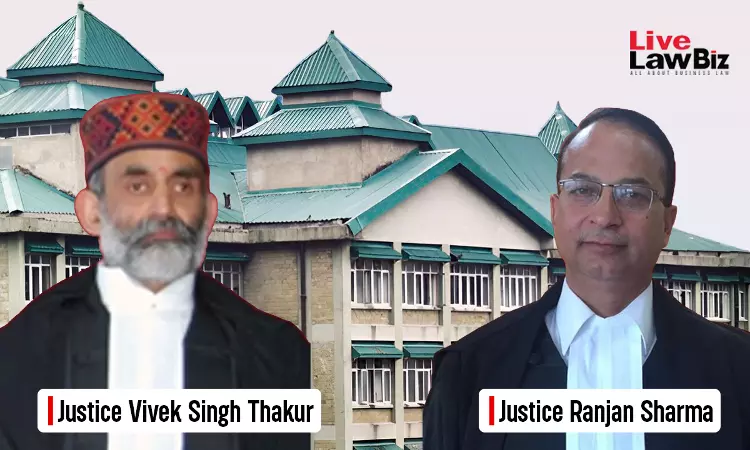
The Division Bench of Justice Vivek Singh Thakur and Justice Ranjan Sharma allowed the petition filed by Ruchira Papers Ltd. It held that electricity duty cannot be imposed on a consumer generating electricity for its own consumption when the charging provision does not cover such a situation.
"Accordingly, clause (xi) in the manner prescribing for levy of duty under Section 3 (1) in case of electrical energy generated by diesel generating sets or any mode for own consumption by the consumer, is not sustainable and accordingly quashed. Rest provision shall remain in force as it is," the court held.
Ruchira Papers had challenged Section 3(1)(xi) of the 2009 Act insofar as it permitted electricity duty on electricity generated through diesel generating sets for captive or standby consumption. It also challenged the September 1, 2023 notification increasing the duty on such electricity from 30 paise per unit to 45 paise per unit.
The company argued that the charging provision under Section 3 did not extend to electricity generated by a consumer itself and consumed by it. It contended that the provision covered electricity generated from any source and consumed by the Board, a licensee, electricity trader or a generating company, or electricity supplied by those entities to a consumer.
The petitioner therefore argued that a consumer generating electricity through its own diesel generator did not fall within either category. The levy, it contended, was consequently beyond the charging provision contained in Section 3 of the 2009 Act.
The State and Himachal Pradesh State Electricity Board defended the levy. They argued that the State had legislative competence under Entry 53 of List II of the Seventh Schedule to impose taxes on the consumption or sale of electricity.
The respondents also contended that the levy was justified as an environmental and regulatory measure. They said it was intended to discourage the use of polluting diesel generating sets and encourage cleaner energy sources.
The High Court, however, distinguished between the State's legislative competence and the scope of the charging provision under Section 3. It held that the existence of legislative competence did not by itself permit the levy where the charging provision did not cover the situation.
The bench noted that Section 3 has two essential components. First, electricity generated from any source must be consumed by the Board, a licensee, electricity trader or generating company. Second, it must be supplied by the Board, licensee, trader or generating company to a consumer.
The court held that electricity generated by a consumer through its own diesel generating set for captive or standby use does not satisfy either condition. The consumer is neither consuming electricity generated by the specified entities nor receiving electricity supplied by them.
"In the present case levy of duty is on consumption but not on generation and further as already referred supra charging portion of Section 3 of 2009 Act does not levy such duty upon a consumer producing energy from any mode including diesel generating sets for his own consumption and, therefore, levy of duty in such a situation on consumption is beyond the scope of Section 3 of 2009 Act," the Court observed.
The bench also considered the constitutional scheme governing taxation of electricity. It noted that Entry 53 of List II empowers the State to levy taxes on the consumption or sale of electricity.
The court further noted that Entry 38 of List III, which deals with electricity, does not itself confer a power to impose a tax or duty. It held that, under the constitutional scheme considered by the Court, Entry 97 of List I confers power on Parliament to tax the generation of electricity.
However, the Court expressly clarified that it was not disputing the State's competence to levy tax or duty on generation of electricity from any source, including diesel generating sets. It said the difficulty was the absence of a charging provision in Section 3 authorising such levy on a consumer other than the Board, licensee, electricity trader, or generating company.
The court also distinguished Supreme Court decisions relied upon by the State, including Jiyajeerao Cotton Mills Ltd. v. State of Madhya Pradesh and Swaroop Vegetables Products v. State of Uttar Pradesh. It noted that the statutes considered in those cases contained charging provisions that expressly covered electricity consumed from the producer's own source of generation.
In contrast, the Court found that Section 3 of the Himachal Pradesh Act contained no provision imposing electricity duty on a consumer consuming electricity generated from its own source. The duty could be imposed on a consumer where electricity was supplied to it by the Board, licensee, electricity trader, or generating company.
The Court therefore held that the State could not impose electricity duty on Ruchira Papers for electricity generated through its diesel generating sets for its own consumption under the existing charging provision. The absence of such a provision meant that the levy could not be sustained under Section 3.
Accordingly, the High Court held that the portion of clause (xi) prescribing electricity duty on electrical energy generated by diesel generating sets or by any mode for its own consumption by a consumer was unsustainable. It quashed that portion of the provision while directing that the remaining provisions would remain in force.
The petition was consequently allowed.
For Petitioner: Advocate Manik Sethi; Advocate Shabnam
For Respondent: Senior Advocate Sunita Sharma, with Advocate Saurav Upadhyay, vice Advocate Dhananjay Sharma, for respondent No. 1; Advocate General Anup Rattan, with Deputy Advocate General Swati Draik and Assistant Advocate General Shalabh Thakur, for respondent No. 2.