
Trademark Applications Filed For 'Cockroach Janta Party' As Satirical Movement Goes Viral
Riya Rathore
21 May 2026 5:38 PM IST
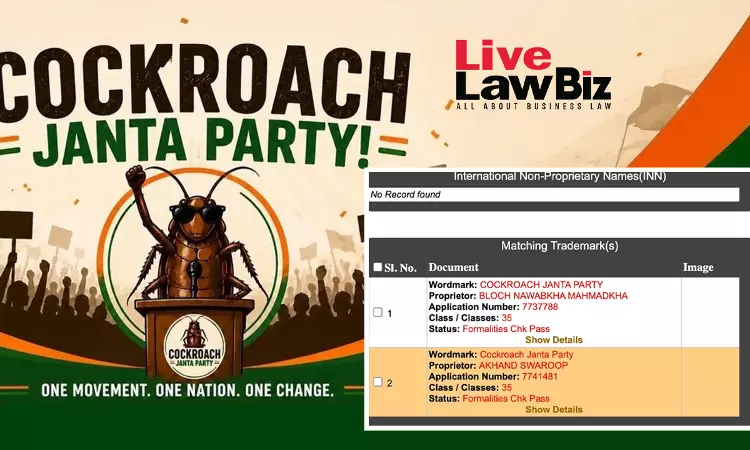
Two trademark applications have been filed for “Cockroach Janta Party,” the satirical political movement born out of viral remarks by the Chief Justice of India, before the Indian trademark registry. However, the applications were not filed by Abhijeet Dipke, the former social media strategist who launched the movement.
The Cockroach Janta Party was launched on May 16 as a direct satirical response to remarks made a day earlier in the Supreme Court.
The controversy traces back to May 15, 2026, when a bench of CJI Surya Kant and Justice Joymalya Bagchi was hearing an application by an advocate seeking senior designation. During the hearing, the CJI made remarks that quickly went viral.
“There are youngsters like cockroaches, who don't get any employment and don't have any place in profession. Some of them become media, some of them become social media, some of them become RTI activists, some of them become other activists, and they start attacking everyone,” the CJI orally remarked.
He also said he was considering ordering a CBI investigation into the genuineness of law degrees held by some Delhi lawyers, adding that the Bar Council of India was “absolutely in collusion” with fraudulent practitioners.
Within 48 hours of its launch, the movement claimed to have a party structure, a five-point manifesto, an election symbol, and over 25,000 registered members. It has since claimed to have crossed 14 million Instagram followers, surpassing both the BJP and Congress on the platform.
Application No. 7737788 was filed in the name of Bloch Nawabkha Mahmadkha, while Application No. 7741481 was filed in the name of Akhand Swaroop. The filings are under trademark classes covering business and legal services and are currently at the “Formalities Check Pass” stage.
The Cockroach Janta Party is not a formally registered political party. It presents itself as a satirical movement and public pressure campaign, occupying a space somewhere between political parody and protest.