
NCLT Kochi Rejects Insolvency Plea Against BPL, Finds It Was Attempt To Recover Arbitral Award Dues
Shilpa Soman
8 July 2026 1:09 PM IST
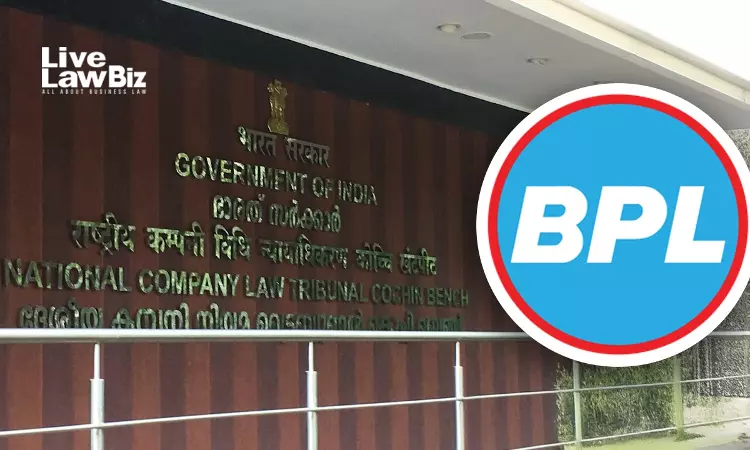
The National Company Law Tribunal (NCLT) at Kochi has recently dismissed an insolvency plea against consumer electronics company BPL Limited.
It held that the Insolvency and Bankruptcy Code (IBC) cannot be invoked as an additional or parallel mechanism to recover the balance amount under an arbitral award after a creditor has already pursued execution proceedings.
The tribunal observed, "the present proceedings are essentially an attempt to recover the balance amount claimed under the Award after having pursued arbitration, appellate proceedings and execution remedies for several years. Such use of the insolvency process is not in consonance with the object and scheme of the Code."
A coram of Judicial Member Vinay Goel and Technical Member Ravichandran Ramasamy passed the order on a petition filed by Morgan Securities and Credits Private Limited.
The financial creditor sought initiation of the Corporate Insolvency Resolution Process (CIRP) against BPL over a claim of more than ₹1,323 crore arising from bill discounting facilities extended to BPL Display Devices Limited in 2002 and 2003, for which BPL Limited had assumed joint and several liability.
Morgan Securities contended that BPL Display Devices Limited had availed itself of the bill discounting facilities, with BPL Limited assuming joint and several liability.
After the alleged default in 2007, it invoked arbitration and secured an award, which the Supreme Court upheld in 2025. The financial creditor maintained that substantial dues remained unpaid despite payments made under the Supreme Court's directions.
BPL opposed the petition, arguing that the claim was barred by limitation and that the insolvency proceedings were an attempt to recover money despite pending execution proceedings. It also contended that the underlying transaction did not qualify as a financial debt under the IBC.
The tribunal rejected that objection. It held that receivables discounted on a recourse basis constitute a financial debt. It also clarified that the debt did not lose that character merely because it had been adjudicated through arbitration.
The tribunal further held that the mere pendency of a review petition before the Supreme Court, without any interim stay, did not affect the maintainability of the insolvency petition.
However, while examining limitation, the tribunal found that the financial creditor had taken inconsistent positions. It relied on the arbitral award as giving rise to a fresh cause of action. At the same time, it sought exclusion of the period spent in arbitration under the Limitation Act.
"A person cannot be allowed to take inconsistent pleas. Individual separate pleas under section 14 of the Limitation Act and individual exclusive reliance upon finalisation of the cause of action on account of Arbitral proceedings are permissible but simultaneously reliance upon both aspects are not permissible.", the tribunal noted.
The tribunal noted that Morgan Securities had consciously invoked arbitration after the alleged default. It defended the award through appellate proceedings and later initiated execution proceedings to enforce it.
Rejecting its reliance on Section 14 of the Limitation Act, the tribunal held,
"The arbitration proceedings were not proceedings before a forum lacking jurisdiction. On the contrary, the proceedings resulted in a binding adjudication, which the Petitioner now seeks to rely upon as the very foundation of the present application. The simultaneous invocation of Section 14 of the Limitation Act and reliance upon the Arbitral Award as furnishing a fresh cause of action are, in the facts of the present case, antithetical to each other."
On the issue of acknowledgment of debt, the tribunal held that payments made pursuant to court directions could not be treated as an acknowledgment under the Limitation Act because they lacked voluntariness.
"The payment made pursuant to the Court's directions cannot be considered as an acknowledgment of debt under Section 18 of the Limitation Act, as the said deposits lack voluntariness.", the tribunal observed.
The tribunal further held that Morgan Securities had consciously chosen to pursue execution proceedings to enforce the arbitral award. Having elected that remedy and obtained substantial recoveries, it could not subsequently invoke the IBC as an additional recovery mechanism.
"The conduct of the Petitioner unmistakably demonstrates that the primary objective was the enforcement and recovery of the adjudicated claim. Having selected to pursue execution and having actively availed the recovery machinery of the Civil Court, the Petitioner cannot now seek to invoke the insolvency jurisdiction as an additional or parallel mechanism for recovery of the balance amount claimed under the Award.", the tribunal observed.
The tribunal observed that the creditor had already recovered substantial amounts pursuant to the Supreme Court's directions. It was also continuing to pursue execution proceedings. According to the tribunal, the remaining dispute substantially related to the balance claim, including interest.
"The cumulative effect of the facts noticed above leads this Adjudicating Authority to the conclusion that the present proceedings bear the characteristics of an attempt to enforce and recover amounts under an adjudicated Award rather than a genuine invocation of the insolvency resolution process contemplated under the Code." the tribunal added.
The tribunal accordingly dismissed the insolvency petition.
For Petitioner: Senior Advocate Santhosh Mathew, Advocates Niraj Chamyal and Akhil Suresh
For Respondent: Senior Advocate K.G Raghavan, Advocates Cyriac Tom and Arjun K Perikal