
State Cannot Defer MSME Payments Once Work Is Completed; Funds Shortage No Defence: J&K&L High Court
LiveLaw Network
17 April 2026 9:37 AM IST
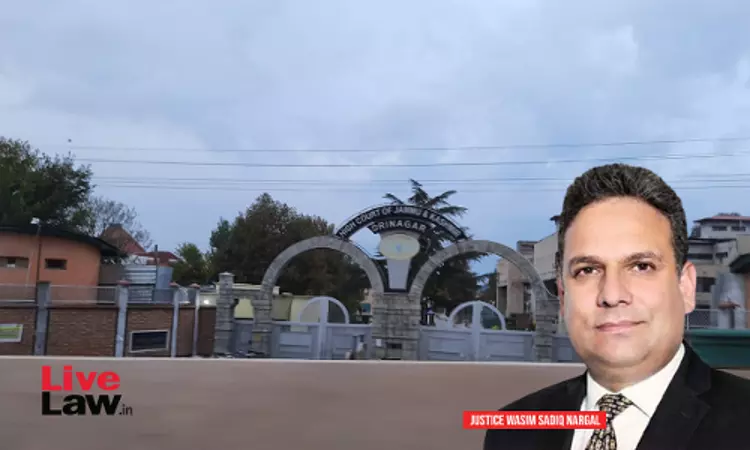
The Jammu & Kashmir and Ladakh High Court has recently held that under the Micro, Small and Medium Enterprises framework, once execution of work is admitted, the State and its instrumentalities cannot defer their obligation to make payment on the plea of paucity of funds or administrative approval.
A bench of Justice Wasim Sadiq Nargal observed, “Once the execution of work is admitted, the obligation to make payment stands crystallized and cannot be deferred on the plea of paucity of funds or want of administrative approval.”
The court further underscored the statutory protection available to small enterprises, observing, “In cases involving Micro and Small Enterprises, the statutory framework further mandates timely payment and provides for enhanced liability in case of delay. The object of such provisions is to ensure that small units are not subjected to financial hardship on account of delayed payments by State entities.”
The court was hearing a writ petition filed by Lumber India Corporation, a registered small-scale unit, seeking release of Rs 47.47 lakh for construction works, including a tourist hut at Cheshma Shahi, executed for the Jammu & Kashmir Tourism Development Corporation through the Jammu and Kashmir Small Scale Industrial Development Corporation (SICOP). The work was completed in 2015, and Rs 34.80 lakh was released, but the balance remained unpaid.
The petitioner argued that the dues were not in dispute and that the continued non-payment ran contrary to statutory obligations under the MSMED Act, apart from violating Article 14. On the other hand, the respondents, including the Tourism Department and SICOP, maintained that there was no direct contractual relationship with the petitioner.
They also said SICOP functioned only as a facilitating agency, with payments contingent on funds being released by the indenting department.
The court was not persuaded by this line of defence. It noted that once the work had been carried out and accepted, the liability to pay stood crystallised. Internal arrangements between different State entities, it held, could not be used to defeat a legitimate claim.
“It is well settled that where the claim arises out of admitted and undisputed liability, and the State or its instrumentalities withhold payment arbitrarily, the writ jurisdiction under Article 226 of the Constitution can be invoked.”
On delayed payments, the court observed, “Where payment is wrongfully withheld, the aggrieved party is entitled to compensation by way of interest. The grant of interest in such cases is not merely discretionary but is founded upon principles of equity, justice and good conscience.”
Allowing the petition, the court directed the respondents to consider release of the admitted Rs 47.47 lakh within four weeks, failing which the petitioner would be entitled to interest at 6% per annum from the date the amount became due.
For Petitioner: Senior Advocate Mr. M.Y. Bhat with Advocate Mr. Hamza Prince
For Respondents: Deputy AG Mr. Hakeem Aman Ali, GA Mr. Waseem Gul