
Delhi High Court Holds Crocodile International Logo Infringes Not Just Lacoste's Trademark But Also Its Copyright
Riya Rathore
11 March 2026 10:31 AM IST
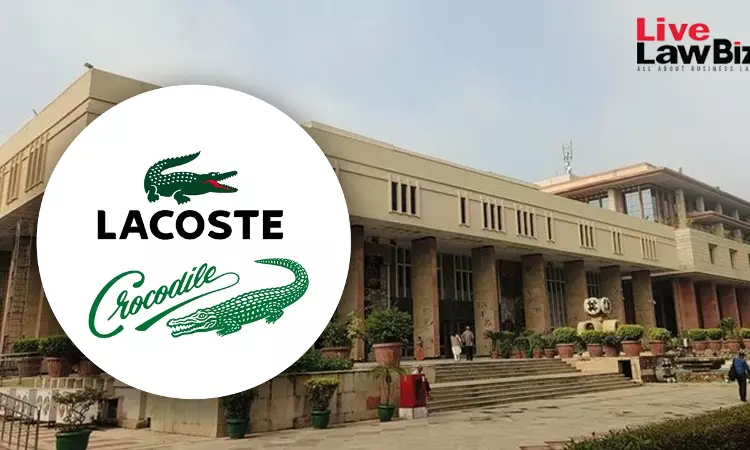
The Delhi High Court on Monday modified a single judge ruling in a long-running trademark dispute between Lacoste and Singapore based Crocodile International, holding that the latter's crocodile device infringed both the French fashion house's trademark and its copyright in the iconic saurian emblem.
A Division Bench of Justice C. Hari Shankar and Justice Om Prakash Shukla, in a judgment pronounced on March 9, 2026, partly allowed cross appeals by the parties and modified the August 14, 2024 ruling of the single judge, which had limited the finding of infringement to trademark alone.
“We respectfully disagree with the finding of the learned Single Judge… Given the substantial similarity between the marks, the existence of other ways to depict a fierce crocodile, and the reasonable likelihood that the defendants had access to Lacoste's mark, we conclude that independent creation cannot be established. The marks are conceptually identical, and hence, the issue of copyright infringement is decided in favour of Lacoste (plaintiffs) and against Crocodile International (defendants),” the court observed.
While affirming the decree of permanent injunction restraining Crocodile International from using the impugned device mark in India, the bench set aside the award of legal costs in favour of Lacoste, noting that the French company had taken over a decade to examine its witnesses during trial.
The dispute centred on Crocodile International's use of a standalone saurian device mark, a crocodile facing left, which Lacoste argued was deceptively and confusingly similar to its own registered crocodile device mark facing right.
Lacoste asserted that it held prior trademark registrations in India dating back to 1983 and had built substantial global and domestic goodwill in the mark.
Crocodile International, however, argued that its founder Dr Tan Hian Tsing had adopted the crocodile mark in 1947 and that its use in India was protected under a 1983 coexistence agreement between the parties and a subsequent 1985 communication that allegedly extended the arrangement.
The bench noted that both marks depicted crocodiles in similar horizontal postures with curved tails, scales and open jaws.
It held that the difference in direction between the marks carried little weight and would likely go unnoticed by an average consumer with imperfect recollection.
“Given that both marks share stark visual and conceptual similarities, they are likely to cause confusion among consumers. Thus, the use of the unregistered impugned mark amounts to infringement under Section 29 of the Trade Marks Act,” the court held.
On the issue of copyright, the single judge had earlier held that Crocodile International's device did not infringe Lacoste's copyright, applying the doctrine of merger on the reasoning that there were limited ways to depict a fierce crocodile.
The Division Bench disagreed, holding that the depiction of the crocodile in the impugned mark was a matter of creative choice rather than necessity.
“The mark's specific posture and visual characteristics are peculiar and not generic. The other marks in use by Crocodile International demonstrate that the defendants could have chosen a different representation of a crocodile,” the court said.
The bench further noted that Crocodile International had knowledge of Lacoste's mark since at least 1980, when disputes between the parties first arose, and therefore could not claim independent creation.
The court also examined the contractual defence based on the 1983 coexistence agreement.
Crocodile International argued that the agreement permitted both brands to coexist in India.
Rejecting the argument, the bench held that the agreement explicitly applied only to five territories, Taiwan, Singapore, Indonesia, Malaysia and Brunei, and did not extend to India.
It observed that “neither the 1983 Agreement, the 1985 letter, nor the documentary evidence on record establishes that Lacoste granted either explicit or implicit permission to Crocodile International for the use of the impugned mark in India.”
However, the court upheld the rejection of Lacoste's passing off claim, holding that the remedy required proof of established goodwill in India at the time Crocodile International entered the market in 1998.
The bench noted that Lacoste failed to produce admissible evidence demonstrating reputation in India specifically for that period.
The court also rejected Crocodile International's argument that Lacoste had acquiesced to the use of the mark by waiting three years to file the suit, holding that there was no evidence of any positive act indicating waiver of rights.
Nevertheless, the bench criticised the prolonged trial, observing that Lacoste took nearly eleven years to examine its own witnesses.
Accordingly, the court confirmed that Crocodile International was liable for both trademark and copyright infringement and upheld the decree of permanent injunction along with a direction for rendition of accounts to determine profits earned from the sale of infringing goods.
However, it held that Crocodile International should not be saddled with Lacoste's litigation costs in view of the delay attributable to the plaintiffs during trial.
For Crocodile International: Advocates Saif Khan, Shobhit Agarwal, Prajjwal Kushwaha and Shayal Anand
For Lacoste: Senior Advocate Chander M Lall with Advocates Nancy Roy and Prakriti Varshney