
Copyright Registration Not Mandatory To Initiate Criminal Proceedings For Infringement: Rajasthan High Court
Riya Rathore
8 Sept 2026 4:22 PM IST
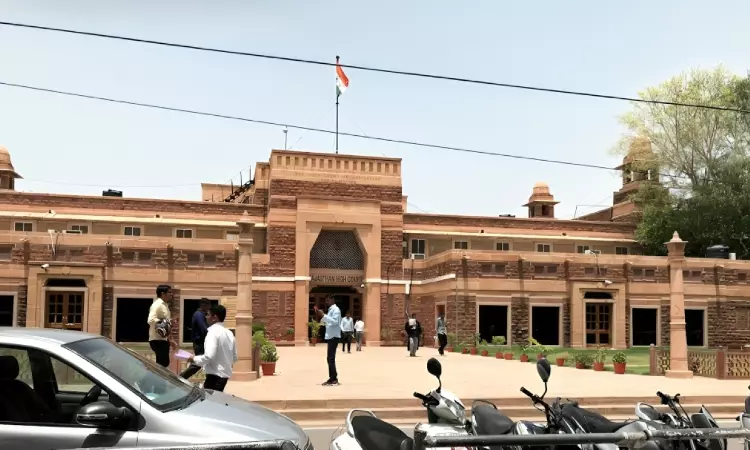
The Rajasthan High Court has held that copyright registration is not mandatory for instituting criminal proceedings alleging copyright infringement. A party can claim rights over a title without registration, subject to establishing those rights through evidence.
Justice Ashok Kumar Jain, in an order dated August 17, 2026, made the observation while refusing to quash a 2012 case concerning alleged infringement of copyright and trademark rights over Dandi Salt and Dandi Namak.
The Court observed, “It is not mandatory that a party must possess registration under the Copyright Act to claim any right on said title. Therefore, this is not a case relating to a civil nature, rather dispute regarding infringement is actionable both under civil law and criminal law. The Copyright Act and the Trademark Act provides for penal provisions and criminal action.”
The case concerned Mumbai-based businessman Sanjay Bhatt, who sought quashing of the proceedings under Section 482 Cr.P.C. He argued that the complainant did not have trademark registration and relied on earlier proceedings concerning Dandi Salt and Dandi Namak.
The case was initiated on May 6, 2012, by Rakesh, a representative of Indo Brine Industries. He alleged unauthorised sale of Dandi Salt with an imitation trademark, along with infringement of copyright and trademark rights.
Bhatt was arrested on March 5, 2016, during the investigation. He argued that the dispute was essentially civil in nature and that the complainant could not maintain the criminal proceedings without registration of the relevant intellectual-property rights.
The complainant opposed the plea. It submitted that intellectual-property rights are based on use and not merely registration, and that the ownership dispute involved questions of fact requiring evidence.
Justice Jain separately explained the position on copyright registration. He held that “registration of copyright is not mandatory, rather it is voluntary” and that protection arises automatically upon creation of an original work. Registration provides prima facie evidence of ownership and strengthens enforcement in infringement proceedings.
The Court examined the earlier orders relied upon by Bhatt. A Copyright Board order dated March 25, 2011, had allowed an application for expunging registration on a technical ground.
An Intellectual Property Appellate Board order dated November 23, 2011, concerned pending petitions and directed early hearing. The High Court noted that no final order conclusively determining the parties' rights had been produced.
Justice Jain held that the material placed by Bhatt was insufficient to conclude that the complainant had no locus to initiate criminal proceedings. Whether the complainant could establish rights over the marks was a matter to be determined through evidence.
The Court also considered the police report. It recorded that the investigation against Bhatt had been concluded and a chargesheet had been drawn against him. However, because an interim order was operating in his favour, the chargesheet was filed only against co-accused Ramswaroop Agarwal and not against Bhatt.
The High Court relied on the principles governing quashing under Section 482 Cr.P.C. It noted that disputed questions of fact and appreciation of evidence cannot ordinarily be decided in such proceedings.
The court held that the dispute concerning ownership of Dandi Salt and Dandi Namak was a factual dispute. It could not be conclusively decided at the stage of considering Bhatt's plea to quash the proceedings.
It further held that infringement is actionable under both civil and criminal law. The Copyright Act and the Trade Marks Act contain penal provisions providing for criminal action.
The Court consequently found that the grounds relied upon by Bhatt for quashing the proceedings were not satisfied.
The petition was dismissed under Section 482 Cr.P.C. The interim order operating in Bhatt's favour was also vacated.
For Petitioner: Advocate P.L. Hissaria
For Respondents: Advocates Vijay Singh Yadav, Onkar Singh Rajpurohit, Sandeep Pathak with Arnav Singh & Aditya Vyas