
Tax Department Cannot Sustain Reassessment On Other Grounds If Original Reason Fails: Supreme Court
Rajnandini Dutta
12 Oct 2026 8:25 PM IST
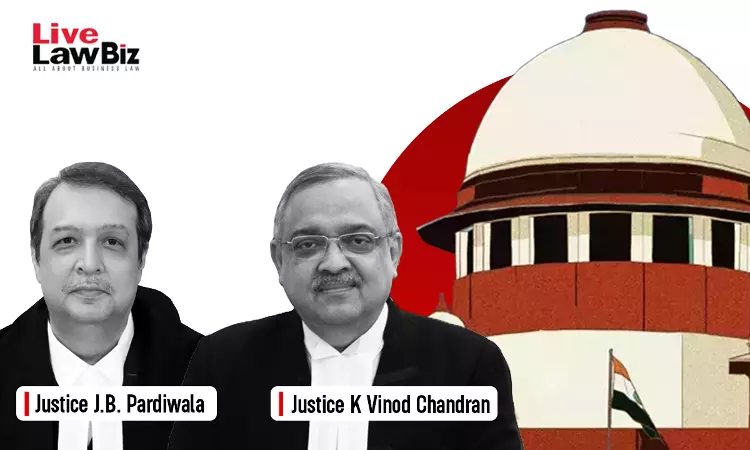
The Supreme Court has recently ruled that the Income Tax Department cannot sustain reassessment proceedings on other grounds when the original reason for reopening the assessment is untenable.
The court declared reassessment proceedings against LG Electronics India Pvt. Ltd. for Assessment Years 2006-07 to 2008-09 unenforceable. The case concerned the company's alleged failure to deduct Tax Deducted at Source (TDS) on payments to its Korean parent company and associated enterprises.
A Bench of Justice J.B. Pardiwala and Justice K. Vinod Chandran observed that the Income Tax Appellate Tribunal (ITAT), in proceedings under Section 201 of the Income Tax Act, 1961, had held that LG Electronics India was not required to deduct TDS on payments to LG Electronics Korea. The tribunal found no tax liability on the relevant income in the hands of the Korean company.
The court held, “If the ground on which reassessment is found to be initiated is untenable, then there is no question of any other ground coming forth in the reassessment proceedings being utilized for the purpose of determining escapement of income.”
The dispute arose from reassessment notices for Assessment Years 2006-07, 2007-08 and 2008-09. The Income Tax Department alleged that LG Electronics Korea and its associated enterprises operated through a Permanent Establishment (PE) in India. It claimed that LG Electronics India was therefore required to deduct TDS on remittances to these entities.
The Department sought to disallow the related expenses under Section 40(a)(i) of the Act for failure to deduct TDS. It issued reassessment notices under Sections 147 and 148.
LG Electronics challenged the notices before the Allahabad High Court, arguing that the reassessment was time-barred and amounted to a mere change of opinion. The company also relied on the Double Taxation Avoidance Agreement between India and Korea. The High Court declined to interfere with the notices, prompting the company to approach the Supreme Court.
Senior Advocate Deepak Chopra, appearing for LG Electronics, submitted that the reassessment proceedings had already been carried out. He pointed out that an appellate order under Section 250 of the Act had been communicated with two blank pages enclosed and no written decision. He argued that the company would be left without an effective remedy unless the reassessment notice was interfered with.
Additional Solicitor General Raghavendra P. Shankar, appearing for the Revenue, submitted that the ITAT had already ruled in favour of LG Electronics in parallel proceedings under Section 201. He argued that the company could produce the tribunal's order before the Assessing Officer or in an appeal to seek deletion of the disallowance.
The court relied on the ITAT's finding that LG Electronics India was not liable to deduct TDS under Section 195 or be treated as an assessee-in-default under Section 201.
It held that the related disallowance could not survive and rejected the Revenue's argument that reassessment could continue on other grounds. The Assessing Officer must close the proceedings after the company produces the court's decision and the ITAT order.
For Appellant (LG Electronics India Pvt. Ltd.): Senior Advocate Deepak Chopra, Advocates Ankul Goyal and Tanvi Aggarwal, and Advocate-on-Record Harpreet Singh Ajmani
For Respondents (Income Tax Department): Additional Solicitor General Raghavendra P. Shankar, Advocate-on-Record Sudarshan Lamba, and Advocates Karan Lahiri, Shashank Bajpai, Sarthak Karol and Navanjay Mahapatra.