
Electricity Subsidy Linked To Power Charges Is Revenue Receipt: Supreme Court
Rajnandini Dutta
7 Oct 2026 9:52 PM IST
The Supreme Court has held that the “purpose test” is the governing test for deciding whether a subsidy is a capital or revenue receipt, and that the purpose must be determined from the scheme as a whole rather than from one broad policy objective.
“The “purpose test” cannot be applied by isolating one general object clause while disregarding the operative provisions of the scheme. The scheme must be read as a whole, and when so read, the general object of industrial development is implemented through a specific subsidy on power charges, calculated with reference to actual energy charges and available only for a defined period after production commences. It is this immediate and operative purpose of the financial assistance that determines its character in the hands of the assessee,” the court observed.
The question before the court was therefore whether the Pondicherry subsidy was intended to support Mepco Industries' capital investment or to meet an operating expense. The court found that the subsidy was linked to the actual electricity charges incurred during manufacturing and therefore treated it as a revenue receipt.
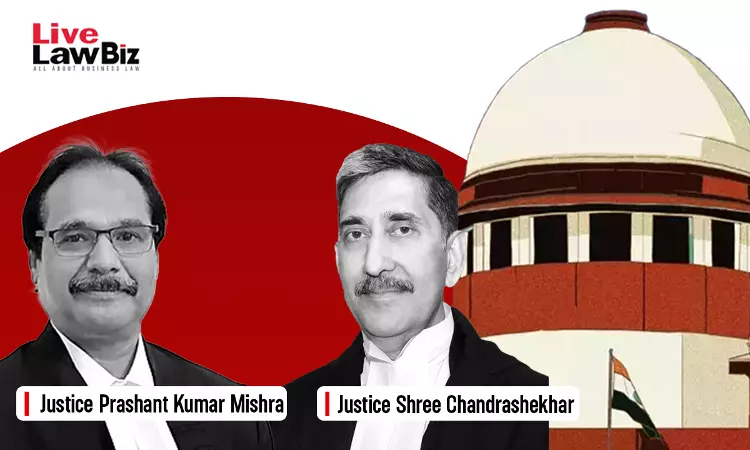
A Bench of Justice Prashant Kumar Mishra and Justice Shree Chandrashekhara pronounced the judgment.
The ruling came in an appeal filed by Mepco Industries Ltd., which had claimed an electricity subsidy of ₹16.20 lakh received from the Government of Pondicherry for Assessment Year 1997-98 as a capital receipt. A Bench of Justice Prashant Kumar Mishra and Justice Shree Chandrashekhar dismissed the appeal.
The subsidy was granted under the Government of Pondicherry's Power Subsidy Scheme, which had been in operation since November 1975. The scheme provided a subsidy on power charges for a specified period after an industrial unit commenced production.
Under the applicable pattern, the subsidy was 33⅓% of power charges for the first three years, 20% for the fourth year and 10% for the fifth year, subject to the applicable ceiling.
Mepco Industries had treated the ₹16,20,745 subsidy as a capital receipt in its return. The Assessing Officer treated it as a revenue receipt and included the amount in its taxable income. The Commissioner of Income Tax (Appeals), Income Tax Appellate Tribunal and Madras High Court upheld that view.
The court noted that the subsidy was calculated with reference to power charges. Its effect was to reduce the cost of power consumed by Mepco Industries and thereby assist the profitability of its business.
The court examined the “purpose test” with reference to its earlier decisions in Sahney Steel & Press Works Ltd. v. Commissioner of Income Tax and CIT v. Ponni Sugars and Chemicals Ltd. It noted that the character of a subsidy has to be determined by the purpose for which it is given. The timing, source and form of the subsidy are not decisive.
Where the object is to enable an assessee to run its business more profitably, the receipt is on revenue account. Where the assistance is intended to help set up a new unit or substantially expand an existing unit, it is on capital account, the court reiterated.
The court also clarified that Sahney Steel does not lay down that every subsidy linked to production or electricity consumption is invariably a revenue receipt. The character of the particular assistance must be determined in light of the scheme under which it is granted.
Applying that test, the Bench found that the Pondicherry scheme tied the subsidy directly to electricity consumed in the manufacturing process. Industrial consumers had to establish the electricity consumed for manufacturing and the electricity charges paid, with the subsidy quantified on that basis.
The court observed that the subsidy was not an independent grant based on the capital invested in the industrial undertaking. Instead, its amount moved directly with the electricity charges incurred during production.
Mepco Industries had argued that the broader object of the scheme was to foster industrial growth and encourage the establishment of industries in a backward area. The court, however, held that this broader objective could not be viewed in isolation.
An industrial incentive can have the broad economic objective of promoting industrialisation, employment or development of a backward region while the particular assistance provided under the scheme may still be intended to meet an operational cost of an industry that has already commenced production, the court observed.
In Mepco Industries' case, the subsidy was calculated as a specified percentage of actual energy charges and was available for a limited period beginning with production. Its immediate and direct effect was to reduce the electricity cost incurred in manufacturing.
The scheme did not require the subsidy to be used for acquiring plant or machinery, constructing the factory, repaying a capital borrowing or creating any other capital asset. The record also did not show that the amount received by Mepco Industries was earmarked for any such capital purpose.
The Bench distinguished CIT v. Chaphalkar Brothers, where an entertainment duty exemption was held to be capital in nature because the scheme was designed to encourage the construction of highly capital-intensive multiplexes. In Mepco Industries' case, the subsidy was a quantified concession against electricity charges incurred after production had commenced.
The court also held that the subsidy did not lose its revenue character merely because the reduction in electricity expenditure could leave more funds available to Mepco Industries for its business. What mattered was whether the government intended to contribute towards the undertaking's capital structure or capital assets.
The court found no such feature in the scheme. Instead, the subsidy reduced a part of the expense incurred by Mepco Industries in the ordinary course of its manufacturing operations.
The top court therefore agreed with the Assessing Officer, Commissioner of Income Tax (Appeals) and Income Tax Appellate Tribunal that the subsidy was a revenue receipt. It also upheld the Madras High Court's decision affirming that conclusion.
The appeal was accordingly dismissed.
For Assessee: Advocate Tushar Jarwal, AOR Radha Rangaswamy, Advocate Ranjeeta Rohatgi, Advocate Shrika Gautam.
For Revenue: Additional Solicitor General N Venkataraman, Senior Advocate Arijit Prasad, AOR Sudarshan Lamba, Advocate V Chandrashekhara Bharathi, Advocate Gaurav Arya, Advocate Gargi Khanna, Advocate Rashmi Malhotra, Advocate Bhuvan Kapoor.