
Can Delay Beyond Prescribed Time Limit In Service Tax Appeals Be Condoned Under Limitation Act? Supreme Court To Examine
Rajnandini Dutta
17 April 2026 5:59 PM IST
The Supreme Court has agreed to examine whether delay in filing a service tax appeal beyond the 2-month deadline and the additional 1-month extension allowed under the law can be excused under Section 5 of the Limitation Act.
Section 5 of the Limitation Act allows courts to accept delayed filings if sufficient cause for the delay is shown.
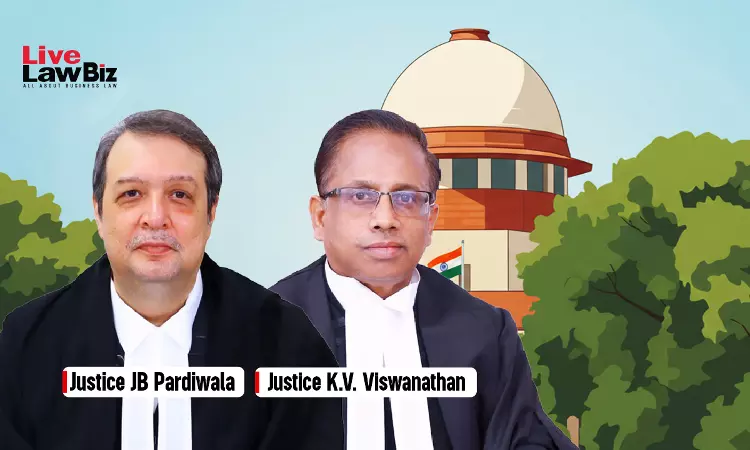
A Bench of Justice J.B. Pardiwala and Justice K.V. Viswanathan issued notice on April 13, 2026 while hearing a petition filed by assessee Morthala Sidda Reddy, challenging a Telangana High Court judgment that had refused to interfere with dismissal of his delayed appeal in a service tax matter.
Recording the issue, the Supreme Court observed, “The short point that falls for our consideration is whether for the purpose of condoning delay insofar as Section 85(3) A of the Finance Act. 1994 is concerned, whether Section 5 of the Limitation Act would apply or not.”
The case arises from service tax proceedings against the petitioner, a civil contractor who carried out government works between 2015 and 2017. Based on income tax data, the department issued a show cause notice in December 2020 and passed an order in February 2022 confirming a service tax demand of about Rs 72.20 lakh after the petitioner did not participate in the proceedings.
The petitioner filed a statutory appeal in 2025 along with the required pre-deposit. However, the Commissioner (Appeals) rejected it on the ground that it was filed with a delay of more than two and a half years, beyond the period that can legally be condoned under the statute.
The Telangana High Court upheld this decision, noting that the delay was inordinate and not sufficiently explained.
In the plea filed before the apex court, the petitioner has contended that the proceedings were initiated “solely on the basis of turnover figures reflected in Income Tax returns, without verification of work orders, valuation, exemptions, or the service component of composite contracts.”
It has further been stated that “notices of personal hearing issued thereafter were admittedly returned unserved, yet an ex-parte Order-in-Original dated 25.02.2022 was passed mechanically, confirming the entire demand without affording any effective opportunity of hearing.”
Explaining the delay, the plea states that the petitioner's consultant “fell critically ill due to multiple organ failure, remained bedridden for a prolonged period, and ultimately passed away on 01.10.2024, taking with him all records, correspondence, and working papers relating to the Petitioner's case.”
Recording the limited issue, the Court issued notice to the Union of India, returnable in four weeks, and permitted dasti service along with liberty to serve the standing counsel for the Union.
For Petitioner: Senior Advocate K. Parameshwar, Advocate Tadimalla Bhasker Gowtham, Advocate M. Parameswara Reddy, Advocate M. Chandrakanth Reddy, Advocate Prasad Hegde, Advocate N. Sai Kaushal, Advocate Veda Singh, Advocate Aditi Garg, Advocate Vallari Km, Advocate Godavari V Durga Prasad, Advocate Shambhavi Shiva, Advocate-on-Record Sandeep Singh