
Director Of Public Company Cannot Be Made Liable For Tax Dues Due To Substantial Shareholding: Gujarat High Court
Arvind Kumar Tiwari
7 Oct 2026 4:59 PM IST
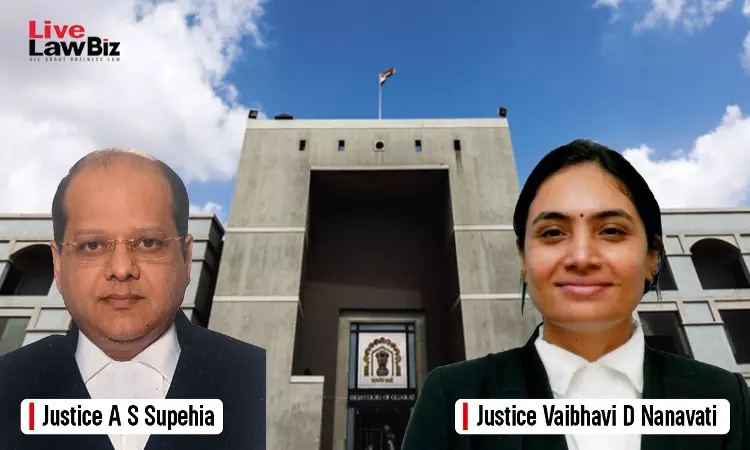
The Gujarat High Court has held that a public limited company cannot be treated as a private company merely because one of its directors holds a substantial number of shares. Thus, a director cannot be held personally liable for the company's unpaid tax merely because the director holds substantial shares in the company.
The case concerned Section 179 of the Income Tax Act. The provision allows the Income Tax Department, in certain circumstances, to recover a private company's unpaid tax from its directors when the dues cannot be recovered from the company.
A Division Bench of Justice A.S. Supehia and Justice Vaibhavi D. Nanavati observed:
“In our considered opinion, the status of public limited company cannot be doubted and held to be a private limited company by mere holding of substantial numbers of equity shares by a director.”
The Bench further observed:
“We are of the opinion, that while fixing the liability of directors under the provisions of section 179 of the IT Act, the authority cannot venture into the examine the status of the company on the basis of definition of private company under the Companies Act, without examining or ignoring that the company in question was registered as public limited company.”
The ruling came on a petition filed by Ajay Surendra Patel challenging an order dated March 31, 2016, passed against him under Section 179 of the Income Tax Act.
Patel was appointed as a director of Hirak Biotech Limited on March 20, 2005, and resigned on September 5, 2005. The company had been incorporated as a public limited company on January 25, 2005.
For assessment year 2006-07, an additional tax liability of about ₹2.40 crore was raised against the company. As the company failed to discharge the tax dues, the Income Tax Department initiated proceedings against Patel under Section 179.
The department argued that Patel had held a substantial shareholding in the company and that the corporate veil should be lifted. It relied on the fact that Patel had subscribed to 29.5 lakh out of the company's 30 lakh shares, amounting to about 98.33% of the shareholding during the relevant period.
The department also contended that the company was effectively a “one-man show” and should be treated as a private company for invoking Section 179.
The high court rejected this reasoning.
It held that the statutory status of a company as a public limited company cannot be altered merely because a director holds a substantial or majority shareholding. The fact that the company was not listed or that its shares were not offered to the public also could not, by itself, change its status.
The Bench observed that the classification of a company depends on its constitutional documents and statutory status under the Companies Act, and not merely on the concentration of its shareholding.
The court also held that the corporate veil could not be lifted in the present case merely to invoke Section 179. It distinguished the earlier decision in Pravinbhai M. Kheni, relied upon by the department.
The Bench noted that the earlier case involved circumstances warranting such an exercise, including allegations that the company was being used as a conduit and that its assets and funds were being dealt with by its directors. In Patel's case, however, there was no material showing that the company's income had been siphoned off or used by him to acquire properties.
The court also examined Patel's role in the company. In his reply dated July 24, 2015, Patel had stated that during his five-month tenure as director, he had not operated the company's bank accounts, filed its income tax returns, managed its affairs, authorised financial or tax documents, signed company contracts or signed cheques.
He had also produced an affidavit in support of his stand.
The court noted that Patel held 30% of the company's shares during financial year 2006-07. It also noted that he was no longer a director when the assessment was completed on December 29, 2008, and the tax demand of about ₹2.40 crore was raised.
The Bench held that Section 179 requires a finding that the non-recovery of the company's tax dues was attributable to the director's gross negligence, misfeasance or breach of duty.
The court observed that the department was required to examine whether Patel had siphoned off funds or defrauded the revenue. It also had to determine whether the non-recovery of the tax dues was attributable to his gross negligence, misfeasance or breach of duty.
However, the impugned order did not record such findings.
The court also found a violation of natural justice in the department's reliance on a statement made by another director, Pratik P. Shah, on May 1, 2013. The statement alleged that the company was involved in providing accommodation entries through bogus share capital and share premium.
Patel, however, had not been called upon to respond to this allegation in the show-cause notice.
The assessment order dated December 29, 2008, also did not contain any allegation that the unexplained share capital or cash credit represented accommodation entries.
The court further noted that Shah subsequently filed an affidavit dated July 23, 2015, which did not refer to accommodation entries. The department discarded the affidavit as Shah did not appear before the authorities.
The Bench noted that the department had relied on Shah's earlier statement while failing to properly consider his subsequent affidavit.
Finding that the requirements for invoking Section 179 had not been established, the high court quashed and set aside the March 31, 2016 order passed against Patel.
The writ petition was accordingly allowed. There was no order as to costs.
For Petitioner: S.N. Soparkar, Senior Advocate with Jaimin R. Dave and Manvi A. Damle
For Respondent: Dev D. Patel