
Sitting Judge Moves Allahabad HC Against Denial of Exemption On Statutory Allowances Under New Income Tax Regime
Mehak Dhiman
20 July 2026 1:02 PM IST
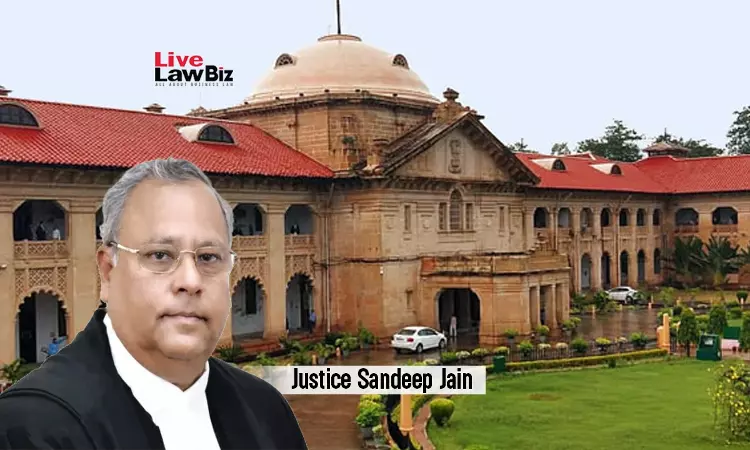
The court called for instructions from the State on the plea, observing that the interim relief sought was in the nature of final relief.
A sitting judge of the Allahabad High Court, Justice Sandeep Jain, has approached the High Court challenging the denial of exemption of statutory allowances from his total income under the new tax regime.
The plea was taken up on Monday before a bench of Justice Saumitra Dayal Singh and Justice Swarupama Chaturvedi, which called for instructions from the state on the petition.
At the outset of the hearing, the bench asked the State's counsel whether there was any objection to it hearing the petition. After the state expressed no objection, the court called for instructions. It observed that the matter could not be heard ex-parte without calling for instructions. The court further observed that the interim relief sought was "in the nature of final relief."
The matter has been directed to be listed as a fresh case on July 28.
Justice Jain has challenged the denial of exemption of statutory allowances prescribed under Section 22D of the High Court Judges (Salaries and Conditions of Service) Act, 1954, from his total income after opting for the new tax regime. Section 22D of the High Court Judges (Salaries and Conditions of Service) Act, 1954, exempts from income tax the value of a High Court judge's official residence, conveyance facilities, sumptuary allowance, and leave travel concession.
He has also challenged the CBDT Office Memorandum dated September 12, 2025, which clarifies that such exemptions are unavailable under the new tax regime. According to the petition, the denial of the statutory benefit is arbitrary and unlawful.
According to the petition, the dispute arose when Justice Jain attempted to file his Income Tax Return (ITR-2) for the financial year 2025-26 under the new tax regime.
The income tax portal allegedly did not permit him to claim exemption of ₹9.85 lakh towards statutory judicial allowances, indicating that the benefit was available only under the old tax regime.
Justice Jain thereafter made representations to the Central Board of Direct Taxes (CBDT) and the Union Finance Minister.
In response, he only received a communication referring to the CBDT Office Memorandum dated September 12, 2025.
The memorandum states that taxpayers opting for the new tax regime cannot claim such exemptions because the regime already provides liberal tax slabs, lower tax rates, and higher rebates.
Granting the exemption in addition would amount to extending a double benefit, it states.
In his plea, Justice Jain has also contended that the High Court Judges (Salaries and Conditions of Service) Act, 1954, is special legislation containing a non-obstante clause. He has argued that the statutory exemptions granted under the Act override the general provisions of the Income Tax Act. He has further contended that executive instructions or office memoranda cannot curtail benefits expressly conferred by Parliament.
The petition further states that the service conditions of High Court judges cannot be altered to their disadvantage through executive action. It contends that the impugned Office Memorandum unlawfully interferes with statutory protections available to judges under the 1954 Act.
Justice Jain has sought the quashing of the CBDT Office Memorandum and a direction permitting him to file his income tax return under the new tax regime while claiming an exemption of ₹9.85 lakh under Section 22D of the 1954 Act.
Alternatively, he has sought permission to file his return under the old tax regime, with liberty to claim a refund if he ultimately succeeds in the case.