
Mere Payment By Indian Resident To Non-Resident Not Income Accruing In India: Delhi High Court
Kapil Dhyani
16 Sept 2026 7:41 PM IST
Holding so, the court directed the Revenue to refund about ₹783 crore in TDS to Teva Israel, along with applicable interest, within two months
The Delhi High Court has held that merely because a payment is made by an Indian resident to a non-resident, the payment cannot by itself be treated as income accruing or arising in India.
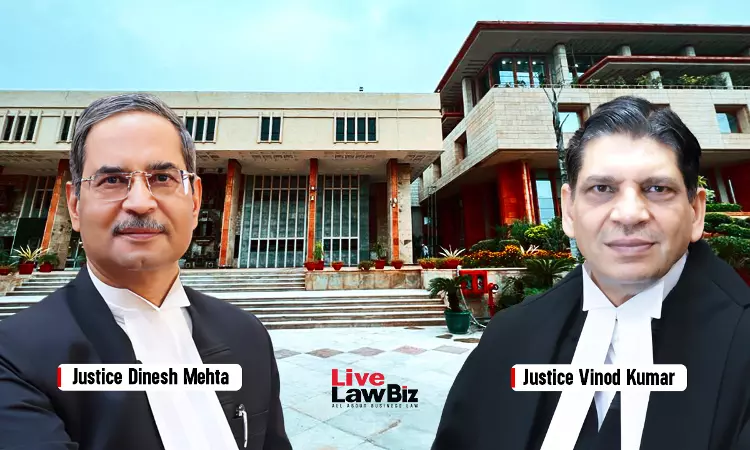
The Division Bench of Justices Dinesh Mehta and Vinod Kumar made the observation while allowing a batch of petitions concerning the taxability of payments made by Ranbaxy Laboratories to Teva Pharmaceuticals Industries Israel and the validity of reassessment proceedings initiated against Teva Pharmaceuticals USA.
The dispute arose from agreements between entities of the Ranbaxy and Teva groups concerning the commercial exploitation of Atorvastatin, the generic version of Pfizer's cholesterol-lowering drug Lipitor, in the United States.
Ranbaxy India, through its US subsidiary Ranbaxy USA, and Teva USA had entered into an agreement in the US in December 2010 concerning the commercialisation of the drug. Under the arrangement, Teva would manufacture the drug and share a portion of its profits with Ranbaxy if Ranbaxy was unable to obtain the requisite US FDA approval.
The Court noted that the contractual rights, the non-compete obligation, and the ANDA in question were situated in the United States, while the sale of the product was also in and from the US.
Subsequently, pursuant to an assignment agreement dated March 22, 2013, Ranbaxy India made a payment of approximately ₹1,851 crore directly to Teva Israel. The amount did not pass through the US.
The Revenue contended that the payment actually represented income belonging to Teva USA and had been diverted to Teva Israel through an assignment of income. It also questioned the legality of the arrangement and alleged that it had been structured to obtain tax benefits.
The Court framed the central question as whether the situs or residence of the payer in India, “without anything further,” is sufficient to constitute income of a non-resident as income accruing or arising in India under Section 5(2)(b) of the Income Tax Act.
Answering the question in the negative, the Court observed that Section 5(2)(b) covers income accruing or arising in India, while Section 9 specifies circumstances in which income is deemed to accrue or arise in India.
The Court held that the fact that Ranbaxy India, an Indian resident, ultimately made and accounted for the payment in India “does not and cannot singularly determine” the place where income accrued or arose to Teva Israel.
“Mere payment by an Indian resident to a non-resident ipso facto does not constitute an income accruing or arising in India,” it observed.
The Court added that the transaction did not fall within the specific deeming provisions under Sections 5(2)(b) or 9 and, consequently, the jurisdictional foundation for issuing the Section 148 notices collapsed.
It further observed that even if Teva USA had assigned the income to Teva Israel to obtain a tax benefit in Israel, that circumstance could not, by itself, confer jurisdiction on Indian tax authorities.
The Court also rejected the Revenue's reliance on observations of the US Attorney General made during anti-trust proceedings to contend that the underlying agreement was illegal.
It noted that Ranbaxy and Teva had paid a fine of USD 150,000 each without admitting guilt and had undertaken not to adhere to the anti-compete clauses in respect of other generic drugs.
It concluded that the Assessing Officer's attempt to initiate proceedings under Section 148 was “without jurisdiction” and impermissibly extra-territorial.
Accordingly, it quashed the Section 148 notices for AYs 2012-13 and 2013-14 directed the Revenue to refund approximately ₹783 crore, along with applicable interest, within two months.
For Petitioners: Senior Advocate Harish N. Salve; Senior Advocate Sachit Jolly; Advocate Anuradha Dutt; Advocate Sherry Goyal; Advocate Viyushti Rawat; Advocate Devansh Jain; Advocate Raghav Dutt; Advocate Sarthak Abrol; Advocate Abhyudaya Shankar Bajpai.
For Respondents: Special Counsel Himanshu S. Sinha; Advocate Yash Varmani; Advocate Utkarsh Mittal; Advocate Ishita Sharma; Advocate Kshitiz Saxena; Senior Standing Counsel Sunil Agarwal; Junior Standing Counsel Monica Benjamin; Junior Standing Counsel Gibran Naushad; Advocate Adeeb Ahmad; Advocate Harshita Sharma; Advocate Laiba Arif; Senior Standing Counsel Vipul Agrawal; Junior Standing Counsel Sakshi Shairwal; Junior Standing Counsel Akshat Singh; Advocate Harshita Kotru; Advocate Gaoraang Ranjan; Advocate Sachin Singh.