
Assessing Officer Cannot Revisit DSIR-Approved R&D Expenses For Tax Deduction: Karnataka High Court
Mehak Dhiman
6 Nov 2026 3:43 PM IST
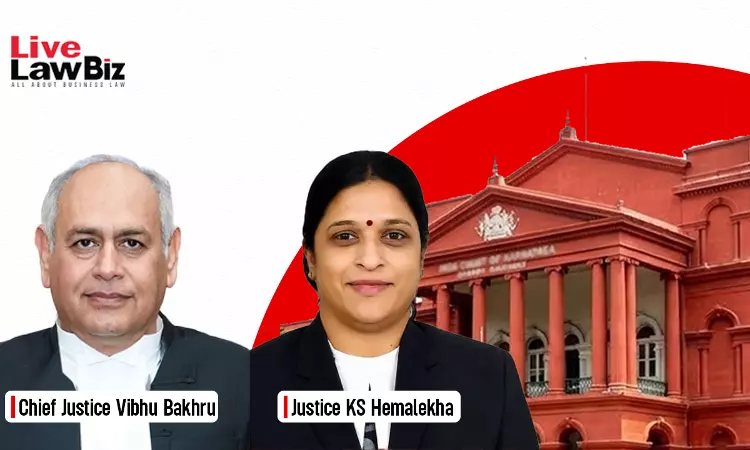
The Karnataka High Court on 2 November held that an Assessing Officer cannot independently examine the merits of research and development (R&D) expenditure approved by the Department of Scientific and Industrial Research (DSIR), and must restrict scrutiny to verifying whether the approved expenditure was actually incurred.
A Bench of Chief Justice Vibhu Bakhru and Justice K.S. Hemalekha dismissed the Revenue's appeal against a Single Judge's order setting aside the disallowance of R&D expenditure claimed by the Tejas Networks Limited for Assessment Year 2009-10. It held:
“...The AO cannot review or revisit the approval granted. However, if any question arises as to whether, and if so, to what extent, any activity constitutes or constituted, or any asset is or was being used for, scientific research, the Central Board of Direct Taxes [the Board] is required, in terms of Section 35(3) of the Act, to refer the question to the Central Government, if such question relates to any activity under Clauses (ii) and (iii) of Section 35(1) of the Act, and to the 'prescribed authority' if such question relates to any activity other than the activities specified under Clauses (ii) and (iii) of Section 35(1) of the Act.”
The dispute arose after the taxpayer claimed a weighted deduction under Section 35(2AB) of the Income Tax Act, 1961, for expenditure incurred on its in-house R&D activities. The DSIR had recognised the taxpayer's R&D units and scrutinised the expenditure before approving eligible expenditure of approximately Rs. 46.01 crore through Form 3CL dated 10 April 2013.
However, the Assessing Officer disallowed a substantial portion of the deduction on the ground that expenditure relating to product development, incomplete projects, know-how and capital work-in-progress did not qualify for the benefit under Section 35(2AB). The Dispute Resolution Panel upheld the disallowance.
The Court held that once the prescribed authority had examined and approved the expenditure, the Assessing Officer could not independently reassess its eligibility. The Assessing Officer's scrutiny was limited to examining supporting documents and audited accounts to verify whether the approved expenditure had actually been incurred.
It further clarified that if a question arose as to whether a particular activity constituted scientific research, the Assessing Officer could not decide the issue independently. Instead, the mechanism under Section 35(3) required the Central Board of Direct Taxes (CBDT) to refer the question to the appropriate authority, depending on the nature of the activity.
Moreover, the Bench rejected the Revenue's contention that expenditure resulting in the creation of intellectual property, proprietary rights or know-how would automatically fall outside the scope of Section 35(2AB). It said:
“...the assumption that capital expenditure other than land and building is excluded is not sustainable on a plain reading of Section 35(2AB) of the Act.”
The judges explained that the exclusion under Section 43(4)(ii) of the Act, concerning the acquisition of rights in or arising out of scientific research, applies to expenditure incurred to acquire existing rights arising from research undertaken by another person. It does not cover expenditure incurred by a taxpayer on its own in-house research merely because the research results in the development of technology or know-how. They held:
“...The expenditure on scientific research is to be understood as expenditure incurred by an Assessee on scientific research and not for acquisition of rights arising out of scientific research. The exclusion under Section43(4)(ii) of the Act covers expenditure for acquisition of those rights without the Assessee undertaking any scientific research.”
Lastly, the Division Bench stated that obtaining know-how and technological advancements was one of the objectives of scientific research. Accepting the Revenue's interpretation would defeat the legislative object behind granting the deduction.
On the question of maintainability, it held that the availability of an alternative remedy does not oust the High Court's jurisdiction under Article 226 of the Constitution.
Accordingly, the High Court dismissed the Revenue's appeal and upheld the order setting aside the disallowance of the R&D deduction.
For Appellant: Advocate E.I. Sanmathi
For Respondent: Advocates S. Annamalai and V. Chandrashekar