
Income Tax Reassessment Cannot Be Reopened On Mere Change Of Opinion: Supreme Court
Rajnandini Dutta
28 Oct 2026 5:34 PM IST
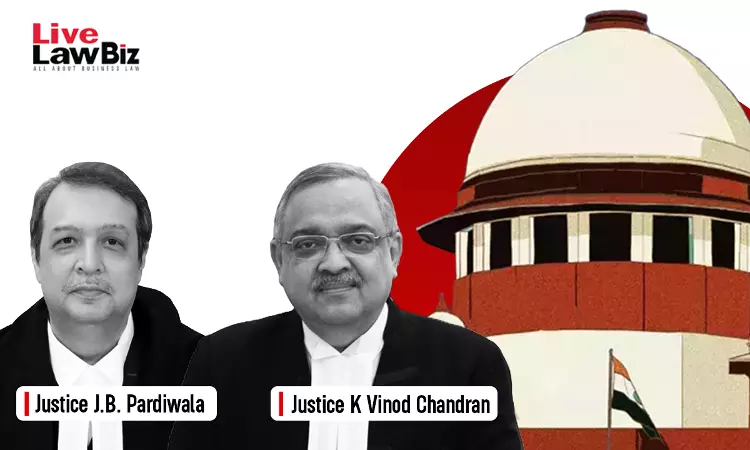
The Supreme Court on Wednesday held that a mere change of opinion cannot justify reopening an income tax assessment, reiterating that an assessing officer has the power to reassess but not review an earlier decision.
It can, however, reopen an assessment when there is tangible material suggesting that income has escaped assessment.
A bench of Justice J.B. Pardiwala and Justice K. Vinod Chandran made these observations while dismissing appeals filed by Chetan Sabharwal and his brother Nitin Sabharwal against reassessment notices issued by the Income Tax Department for the assessment years 2008-09 and 2009-10.
“The expression 'reason to believe' in Section 147 of the Act means cause or justification. The AO must have tangible material having a rational connection or a live link with the formation of the belief that income has escaped assessment, and need not have finally ascertained the fact by legal evidence or conclusion. At the stage of the notice, the only question is whether there was relevant material on which a reasonable person could have formed the requisite belief, and the sufficiency of the reasons is not a justiciable issue. Further, a mere 'change of opinion' cannot be a reason to reopen, as the AO has the power to reassess and not the power to review. A change of opinion presupposes a conscious application of mind and the formation of an opinion in the original assessment, which the court must verify, either expressly or by necessary implication, before interfering with the reopening", the court ruled
The case arose from the sale of shares in Pawan Impex Pvt Ltd and SVIIT Software Pvt Ltd. Chetan and Nitin, along with two other shareholders, entered into agreements to sell the shares for ₹195 crore and ₹60 crore, respectively. The brothers used the sale proceeds to purchase residential property in Delhi and claimed tax benefits under Section 54F of the Income Tax Act.
After the original assessments, the Income Tax Department's Investigation Unit in Noida reported that the shares appeared to have been overvalued when compared with the cost of the companies' land and buildings. The assessing officer subsequently issued notices under Section 148 to reopen the assessments.
The brothers challenged the notices, contending, among other things, that the department was seeking to reopen assessments on a mere change of opinion.
The top court rejected this contention, distinguishing between the two brothers' assessments. Nitin's returns had been accepted through intimations under Section 143(1) of the Act, without scrutiny. As no opinion had been formed during an assessment, the question of a change of opinion did not arise in his case.
Chetan's assessments, on the other hand, had been completed under Section 143(3). However, the court found that the original assessment orders did not expressly or by necessary implication reflect an opinion on the specific issues that formed the basis for reopening.
These included the valuation of the shares against the cost of the companies' land and buildings, the investment of the sale proceeds in a property on Sikandara Road in Delhi, the adjustment of capital gains to future years and the claim for exemption under Section 54F.
The court observed that a change of opinion presupposes that the assessing officer had consciously applied their mind to an issue and formed an opinion during the original assessment. In the absence of such an opinion on the specific matters underlying the reassessment, the department was not barred from reopening the assessments on the basis of new material.
The court also summarised five principles governing the application of the change-of-opinion test under Section 147 of the Act.
First, a mere change of opinion cannot justify reopening an assessment because the assessing officer has the power to reassess, not review. The restriction acts as an in-built check against abuse of power. After April 1, 1989, reopening requires tangible material with a live link to the belief that income has escaped assessment.
Second, a change of opinion presupposes that the assessing officer formed an opinion during the original assessment and subsequently changed it. This requires conscious application of mind during the original proceedings.
Third, courts must verify whether the original assessment expressly or by necessary implication reflects an opinion on the issue forming the basis of the alleged escapement of income.
Fourth, where an assessment order is non-speaking, cryptic or perfunctory, it may be difficult to attribute an opinion to the assessing officer. Where there is a perceptible lack of inquiry into the specific issue, the plea that reopening amounts to a change of opinion is legally untenable.
Fifth, where no opinion was formed during the original assessment, the department may reopen the case upon discovering facts suggesting that income has escaped assessment. However, if the issue was already considered in the original proceedings, the assessing officer cannot reopen the assessment merely to take a different view on the same facts.
The top court ultimately held that the reassessment notices were based on tangible material in the form of the Investigation Unit's report, which had a rational connection and a live link with the belief that income had escaped assessment. It found no case of change of opinion and dismissed the appeals, upholding the notices.
For Appellants: Senior Advocate Mukul Rohatgi appeared
For Respondent: Senior Advocate Nisha Bagchi and Additional Solicitor General K.M. Nataraj.