
Bona Fide Delay Justifies Tax Benefit, “Genuine Hardship” Must Be Liberally Applied: Gujarat High Court
Mehak Dhiman
26 March 2026 4:32 PM IST
The Gujarat High Court on 16 March, held that a bona fide delay of 53 days in filing Form 10-IC cannot deprive an eligible taxpayer of concessional tax benefits. The expression “genuine hardship” under the Income Tax Act must be given a liberal, justice-oriented interpretation. Form 10-IC is a declaration filed by a company to opt for the concessional corporate tax rate under Section 115BAA of the Income Tax Act.
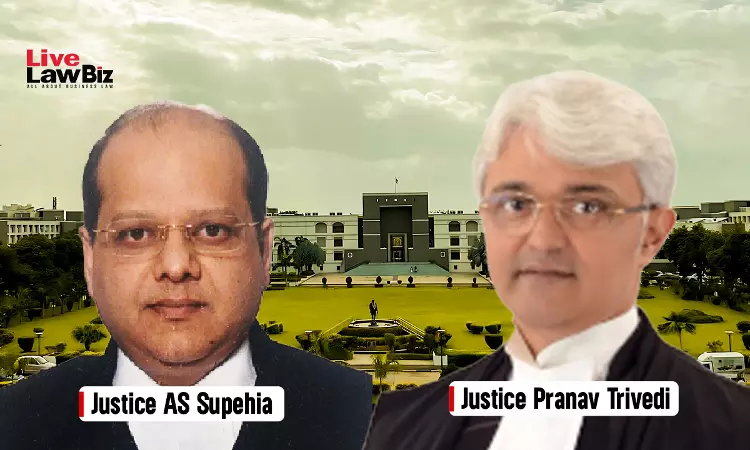
A Bench comprising Justice A.S. Supehia and Justice Pranav Trivedi allowed Herald Global Ventures Private Limited to avail benefits under Section 115BAA of the Income Tax Act. The judges held:
"……if the delay in question is not condoned, the petitioner will have to pay substantial tax calculated as per 'normal rate of tax' despite the fact that the petitioner is otherwise eligible for claiming benefit under section 115BAA of the Act i.e. 'tax rate being 22%'. This will result into 'financial hardship' to the petitioner which is a 'genuine hardship'. Thus, by condoning delay, the genuine hardship caused to the petitioner could have been avoided."
Herald Global Ventures, a startup recognised by the Department for Promotion of Industry and Internal Trade, initially applied for tax benefits under Section 80-IAC. Its certification by the Inter-Ministerial Board was rejected in October 2022 due to shareholding concerns.
Following this, the company sought professional advice and opted to avail the concessional tax regime under Section 115BAA. It paid self-assessment tax in December 2022 and filed its return with Form 10-IC on 30 December 2022, resulting in a delay of 53 days beyond the due date of 7 November 2022.
The return was processed without granting the concessional tax benefit, leading to an additional tax demand of over Rs. 50 lakh. Subsequently, the company applied for condonation of delay under Section 119(2)(b), which was rejected on the ground that no “genuine hardship” was made out. It then approached the High Court.
The Division Bench observed that the delay occurred due to bona fide reasons, including the petitioner's initial pursuit of Section 80-IAC benefits and subsequent shift to Section 115BAA after its certification was rejected. The Court noted that the company acted diligently, and there was no element of mala fide or intentional delay.
The Bench emphasised that the delay arose from bona fide reasons. It found that the company had acted diligently by paying taxes and filing the return, and there was no element of mala fide or deliberate delay. It stated:
"The respondent was supposed to consider the impact of refusing to condone the delay in filing Form 10-IC. The refusal to condone the delay has resulted into denial of claiming the benefit under section 115BAA of the Act, despite the petitioner being found eligible."
Relying on the Supreme Court's interpretation of “genuine hardship” in B.M. Malani vs. Commissioner of Income Tax [2008] 306 ITR 196, the Court held that the expression must be construed liberally to advance substantial justice. It noted that tax authorities have wide discretionary powers under Section 119(2)(b), which must be exercised judiciously to avoid undue hardship. It held:
"The efforts made by the petitioner and the delay of 53 days cannot be either said to be concocted or illogical. Hence, we are of the opinion that the expression 'genuine hardship' used under Section 119(2)(b) of the Act is required to be construed liberally in case of the petitioner."
The Bench further stated:
"The necessary efforts coupled with the fact that the petitioner's action was bonafide and his hardships which it will face are required to be examined at the relevant point of time, when the cause arose, and the remedial action cannot be left on the happening of the subsequent event of claiming the deduction."
Accordingly, the High Court allowed the petitioner to avail the concessional tax regime, directing authorities to accept Form 10-IC for the relevant assessment year.
For Appellant: Senior Advocate Tushar Hemani with Advocate Parimalsinh Parmar
For Respondent: Advocate, Maunil G Yajnik