
INCOME TAX
ITAT Chennai Cancels Rs 1.5 Lakh Penalty For Delayed Audit Filing, Cites Reasonable Cause
The Chennai Bench of the Income Tax Appellate Tribunal (ITAT) on 2 February deleted a penalty of Rs. 1,50,000 imposed on a jewelry export company for delayed filing of its audit report under Section 44AB of the Income-tax Act, 1961. A Bench of Judicial Member Abhy T. Varkey and Accountant Member S.R. Raghunatha, observed that penalty provisions could not to be mechanically invoked and that the assessee was prevented by “reasonable cause.” They held: “Penalty provisions being quasi-criminal...
ITAT Chennai Rules Cash Deposits Can Be Set Off Against Earlier Advances, Deletes ₹20 Lakh Addition
The Chennai Bench of the Income Tax Appellate Tribunal (ITAT) on 2 February deleted an addition of Rs. 20 lakh on a taxpayer out of the total Rs. 39.95 lakh made towards unexplained cash deposits and bank credits, observing that earlier bank deposits or cash advances can be set off against the said deposits.The matter was heard by Judicial Member Manu Kumar Giri and Accountant Member S.R. Raghunatha. The Bench noted that cash deposits of Rs. 20,00,000 in UCO Bank, made by Dhanabalan Selvamuthu...

Delhi High Court Directs Nil TDS For GoDaddy, Says Domain Registration Fees Not Taxable Under India-US DTAA
The Delhi High Court has held that domain name registration fees received by GoDaddy is not chargeable to income tax in India, in terms of the India-USA Double Taxation Avoidance Agreement.A division bench of Justices Dinesh Mehta and Vinod Kumar also criticised the Income Tax Department for refusing to grant a nil withholding tax certificate under Section 197 of the Income Tax Act, 1961, despite binding judicial precedent.“We record our displeasure about the casual rather callous manner, in...
Organising Ramkatha, Bhagwat Katha Not 'Wholly Religious', 80G Approval Cannot Be Denied To Charitable Trust: ITAT Ahmedabad
The Income Tax Appellate Tribunal at Ahmedabad has recently held that a charitable trust cannot be denied approval under Section 80G of the Income Tax Act merely because one of its objects provides for organising Ramkatha, Bhagwat Katha, and similar programmes for raising funds. A coram of Judicial Member Sanjay Garg and Accountant Member Narendra Prasad Sinha observed that object of the trust “cannot be said to be wholly or substantially religious in nature,” and that organising Ramkatha and...
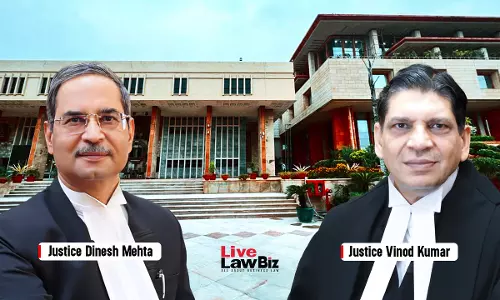
Delhi High Court Dismisses Revenue Appeals Against ITAT Order In Mahagun TDS Dispute Over NOIDA Lease Rent
The Delhi High Court has dismissed three appeals filed by the Income Tax Department challenging orders of the Income Tax Appellate Tribunal (ITAT) that had granted relief to Mahagun developers in a long-running dispute over deduction of tax at source (TDS) on lease rent payments made to the NOIDA Authority.A Division Bench of Justices Dinesh Mehta and Justice Vinod Kumar rejected the appeals after noting that the controversy was squarely covered by its earlier ruling in Rajesh Projects (India)...
Supreme Court To Examine If Delay In Filing ITR Can Be Condoned Under Section 119(2)(b) Of Income Tax Act
The Supreme Court is to examine whether a delay in filing a return of income can be condoned under Section 119(2)(b) of the Income Tax Act, 1961. A Bench of Justice J.B. Pardiwala and Justice K.V. Viswanathan issued notice in a Special Leave Petition filed by Sirez Limited challenging the judgment dated December 8, 2025, of the Delhi High Court. “The short point that falls for our consideration is whether delay in filing the Return of income can be condoned under Section 119(2)(b) of the Act,...

Gujarat High Court Sets Aside TDS Order For Failure To Apply 'Make Available' Test Under India–Singapore DTAA
The Gujarat High Court has recently set aside a tax deduction at source order against Solvay Specialities India, holding that the Income Tax Department failed to apply the mandatory “make available” test under the India–Singapore tax treaty. Under this test, tax authorities are required to first determine whether the foreign service provider actually passed on any technical knowledge, skill, or know-how in a way that allows the Indian company to use it independently in the future. Without...

Supreme Court Dismisses Plea Seeking Checks To Prevent TDS Defaults On Property Purchases Above ₹50 Lakh
The Supreme Court on Wednesday dismissed a plea seeking directions to introduce safeguards so that property buyers are not unknowingly penalised for failing to deduct tax at source (TDS) while purchasing property worth more than Rs 50 lakhs. A bench of Justice Vikram Nath and Justice Sandeep Mehta heard the matter and dismissed the petition after brief submissions. The petition concerned Section 194IA of the Income Tax Act, 1961. The provision requires a buyer of immovable property (other than...
Delhi High Court Quashes Transfer Pricing Order After TPO Failed To Share Agreements Relied Upon
The Delhi High Court has recently has held that a Transfer Pricing Officer (TPO) is bound to furnish copies of agreements relied upon for benchmarking before finalising a transfer pricing adjustment.A division bench of Justices Dinesh Mehta and Vinod Kumar observed, “It is the settled position of law that any authority is bound to provide copies of the relied upon documents.”The court was dealing with a writ petition challenging a transfer pricing order, whereby the TPO relied on third-party...
PIL In Supreme Court Challenges Income Tax Law Allowing Search Of Digital Devices, Cloud Data
A public interest litigation has been filed before the Supreme Court challenging the constitutionality of provisions in the Income Tax Act, 2025 that empower tax authorities to conduct searches of “computer systems” and “virtual digital space”, including personal electronic devices, cloud servers, emails and private communications. The plea, filed under Article 32 of the Constitution by entrepreneur Vishwaprasad Alva, assails Section 247 of the Income Tax Act, 2025, as well as the corresponding...
ITAT Mumbai Sets Aside ₹1.14 Crore Transfer Pricing Adjustment For Lack Of Proper FAR Analysis
The Mumbai Bench of the Income Tax Appellate Tribunal (ITAT) on 6 January set aside a transfer pricing adjustment of Rs. 1.14 crore against Corporate Worldwide Stay LLP, after finding that the revenue authorities had proceeded on assumptions about the firm's functions and risks without a proper FAR analysis.The bench, comprising Judicial Member Anikesh Banerjee and Accountant Member Vikram Singh Yadav remitted to the assessing officer and transfer pricing officer for fresh adjudication.The...

CBDT Issues Draft Income Tax Rules 2026 Navigator Mapping Existing Rules To New Framework
With the Income Tax Act, 2025 set to come into force on 1 April 2026, the Central Board of Direct Taxes (CBDT) has released the Draft Income Tax Rules, 2026 for public consultation. To assist stakeholders in navigating the transition, the CBDT has also published an official navigator that maps each of the 333 draft rules to their corresponding provisions under the existing Income Tax Rules, 1962, which currently comprise 511 rules. In addition to revising and consolidating existing draft...