
INCOME TAX
Expenditure Made On Ice Boxes Are Capital Expenditure: ITAT Upholds Disallowance Against Hindustan Coca-Cola Beverages
The Delhi Bench of the Income Tax Appellate Tribunal (ITAT) has held that the expenditure made on ice chests or ice boxes was made for acquiring or bringing into existence an asset for the enduring benefit of the business and was of the nature of capital expenditure.The two-member bench of Anubhav Sharma (Judicial Member) and N.K. Billaiya (Accountant Member) has observed that if the expenditure is made for acquiring or bringing into existence an asset or advertisement for the enduring benefit...
ITAT Quashes Penalty Notice Which Was Silent On Specification Of Charges
The Delhi Bench of the Income Tax Appellate Tribunal (ITAT) has quashed the penalty notice, which was silent on the specification of charges.The bench of Astha Chandra (a judicial member) and Shamim Yahya (an accountant member) has observed that no specification of charge in the penalty notice leads to the same becoming void, and the penalty on that count is to be deleted.The penalty under Section 271(1)(c) of the Income-tax Act, 1961, was levied upon the assessee on account of additions for...

S. 80-IB Of Income Tax Act - Assessee Not Entitled To Deduction Under On Profit Derived From DEPB And Duty Drawback Schemes: Supreme Court
The Supreme Court has ruled that the assessee is not entitled to deduction under Section 80- IB of the Income Tax Act, 1961 on the amount received / profit derived from the Duty Entitlement Pass Book Scheme (DEPB) and the Duty Drawback Schemes.The bench of Justices M.R. Shah and B.V. Nagarathna held that the profit from DEPB and the Duty Drawback claims cannot be said to be an income “derived from” the industrial undertaking. The court added that even otherwise, such an income is chargeable to...
Income Tax Exemption On The Voluntarily Payment Made By The Employer To The Employee Out Of Appreciation: ITAT
The Pune Bench of the Income Tax Appellate Tribunal (ITAT) has held that the payment has been made voluntarily by them out of appreciation for the employee and thus falls outside the rigours of Section 17(3)(iii) of the Income Tax Act.The two-member bench of R.S. Syal (Vice President) and Partha Sarathi Chaudhury (Judicial Member) has observed that the department could not produce any documents or evidence on record to show that the payment received from the employer was coupled with some legal...
Income Tax Act | For A Company To Be A "Resident" In India, Domicile Or Registration Irrelevant; Test Is Where De Facto Control Lies : Supreme Court
The Supreme Court has ruled that under the Income Tax Act, 1961, the domicile or the registration of the company is not at all relevant, and the determinate test is the place where, the sole right to manage the company and the control of the company lies. The place where the “head and seat” and the “directing power” of the affairs of the company and the control and management is shown, must not merely be theoretical control and power, i.e., not de jure control and power. Rather, in order to hold...
Mere Delay In Remittance Of TDS Doesn’t Attract Penalty Under S 271C Income Tax Act: Supreme Court
The Supreme Court has ruled that no penalty is leviable under Section 271C of the Income Tax Act, 1961 on mere delay in remittance of the tax deducted at source (TDS) after the same has been deducted by the assessee.The bench of Justices M.R. Shah and C.T. Ravikumar observed that the relevant words used in Section 271C(1)(a) are “fails to deduct”, and the same does not speak about belated remittance of the TDS. The words “fails to deduct” occurring in Section 271C(1)(a) cannot be...
Non-Compete Fee Related To Profession Is Made Taxable Only w.e.f. AY 2017-18: ITAT
The Delhi Bench of the Income Tax Appellate Tribunal (ITAT) has held that a non-compete fee related to a profession is made taxable only with effect from AY 2017–18, and the non-compete fee in relation to a profession for periods prior to AY 2017–18 would be treated as a capital receipt.The bench of Astha Chandra (Judicial Member) and Shamim Yahya (Accountant Member) has decided in favor of the Assessee-doctor holding that the department has erred in looking beyond the service agreement entered...
In Absence Of Proper Show Cause Notice To The Assessee, There Is No Merit In Levy Of Penalty: ITAT
The Delhi Bench of the Income Tax Appellate Tribunal has held that where the initiation of penalty is one limb and the levy of penalty is another limb, then in the absence of proper show cause notice to the assessee, there is no merit in the levy of penalty.The bench of Anil Chaturvedi (Accountant Member) and Yogesh Kumar Us (Judicial Member) has relied on the decision of the Bombay High Court in the case of CIT vs. Samson Perinchery and has held that where the initiation of penalty is one limb...
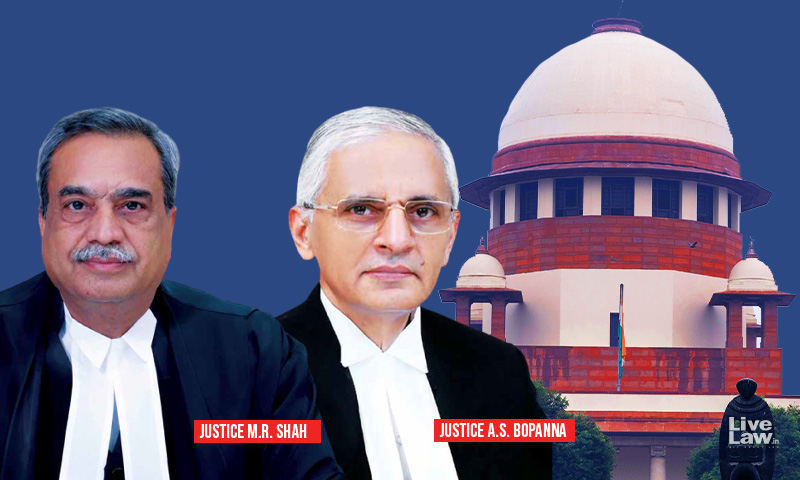
Section 263 Income Tax Act | Erroneous Order Of Assessing Officer Causing Prejudice To Revenue Is Revisable By CIT : Supreme Court
The Supreme Court has held that the Commissioner of Income Tax can exercise revision powers under Section 263 of the Income Tax Act over the orders of the Assessing Officer which cause prejudice to the interest of the revenue.The Top Court set aside the Bombay High Court’s order where the High Court had ruled that the amount paid by the assessee to its shareholders in lieu of settlement of litigation in pursuance of an arbitral award, was deductible from the sale proceeds of the property...
ITAT Allows Section 54F Deduction Though Capital Gain Scheme Account Was Not Opened
The Chennai Bench of the Income Tax Appellate Tribunal (ITAT) has allowed the deduction under section 54F though the capital gain scheme account was not opened.The two-member bench of V. Durga Rao (Judicial Member) and G. Manjunatha (Accountant Member) has observed that even though the assessee has not invested the sale proceeds in Capital Gain Account Scheme, but complied with the conditions under section 54F(1) by purchasing an independent house by executing a sale agreement.Under Section 54F...
Income Tax Act - Date Of Panchnama Last Drawn Starting Point Of Limitation For Completing Block Assessment Proceedings: Supreme Court
The Supreme Court has held that the date on which the Panchnama was last drawn is the starting point of the two-year limitation for completing the block assessment proceedings under the Income Tax Act 1961.The division bench of Justice M.R. Shah and Justice C.T. Ravikumar has upheld the order of the Delhi High Court in which it was held that the date of the Panchnama last drawn would be the relevant date for considering the period of limitation of two years and not the last date of...
Tax Cases Weekly Round-Up: 19 March To 25 March 2023
Supreme Court Only Retail Sale Can Claim Assessment Benefits Under Section 4A Of Central Excise Act : Supreme Court Case Title: Commissioner Of Central Excise & Service Versus M/S. A.R. Polymers Pvt. Ltd. Etc. Citation: 2023 LiveLaw (SC) 223 The Supreme Court has held that mere affixation of MRP does not make goods eligible for central excise duty exemption, and what is required along with the affixation is a mandate of law that directs the seller to affix such MRP. Delhi...