
Small Operational Creditors Are 'Significantly Disenfranchised': Supreme Court Urges Review Of IBC Framework
Shilpa Soman
18 July 2026 3:48 PM IST
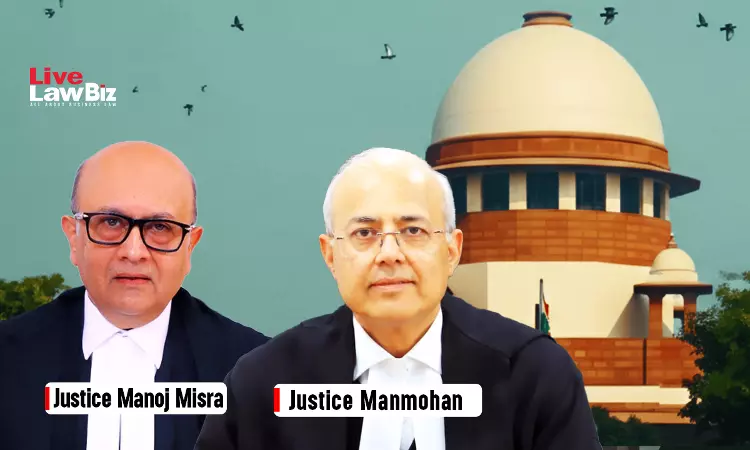
The Supreme Court on Friday observed that small operational creditors, including MSMEs and statutory local bodies, remain "significantly disenfranchised" under the Insolvency and Bankruptcy Code (IBC) by being placed at the bottom of the repayment waterfall.
Observing that the issue falls within the legislative domain, the court urged the Law Commission of India and the legislature to examine whether a fairer repayment mechanism could be devised without compromising the efficiency and commercial certainty of the insolvency resolution process.
A bench of Justice Manoj Misra and Justice Manmohan, while deciding appeals arising from the Bhushan Steel insolvency, observed:
"While the distinction between financial creditors and operational creditors has been upheld in Swiss Ribbons Private Limited and Anr. v. Union of India & Ors., 2019 (4) SCC 17, as resting on an 'intelligible differentia', this Court is nevertheless of the view that the Code does not adequately account for the position of small operational creditors, including MSMEs and statutory local bodies, who stand significantly disenfranchised under the present framework by being placed at the bottom of the repayment waterfall."
The bench, therefore, urged, "Most such entities are ill-equipped to absorb even a minor financial setback and are therefore often compelled to adopt an aggressive and disruptive stance, as the facts of the present matters demonstrate. Since this issue lies within the legislative domain and perhaps merits consideration by the Law Commission of India and the Legislature, to explore whether a fairer and more proportionate repayment mechanism can be devised, one that preserves the efficiency and commercial certainty of the resolution process while also mitigating the disproportionate hardship presently faced by vulnerable operational creditors."
The observations came while allowing appeals filed by Tata Steel, the successful resolution applicant for Bhushan Steel Limited. The appeals challenged Bombay High Court orders permitting a recovery suit filed by operational creditor Varsha to continue despite approval of the company's resolution plan. The bench also considered a similar issue arising from arbitration proceedings initiated by Masyc Projects Private Limited.
Before the commencement of the Corporate Insolvency Resolution Process (CIRP), Varsha had filed a recovery suit against Bhushan Steel seeking around ₹38.89 lakh. Masyc had also initiated arbitration proceedings to recover its dues.
After the insolvency process commenced, both companies submitted claims as operational creditors. The Resolution Professional initially admitted the disputed claims at a notional value of ₹1 each.
Tata Steel argued that the approved resolution plan expressly barred continuation of legal proceedings relating to pre-resolution claims. It contended that once the plan was approved, all claims stood frozen and became binding on every stakeholder.
Allowing unresolved proceedings to continue, it argued, would defeat the "clean slate" principle underlying the insolvency framework.
Varsha and Masyc contended that the resolution plan preserved disputed claims that were pending adjudication. According to them, the civil suit and arbitration proceedings could continue until those claims were finally determined.
Rejecting those submissions, the bench reiterated that claims not forming part of an approved resolution plan cannot survive.
"Claims not incorporated in the Resolution Plan stand extinguished, withdrawn or abated, consistent with the legislative intent of enabling the Resolution Applicant to commence on a 'clean slate', free from unforeseen liabilities.", the court ruled.
The bench held that the final list of operational creditors and the approved resolution plan had attained finality. It also found no merit in the allegation that the resolution plan had been procured through fraud or manipulation.
Addressing the ₹1 valuation, the bench held that deletion of Note 3 from the interim list of creditors and its replacement with Note 2 in the final list fundamentally altered the status of the disputed claims. According to the bench, they ceased to be notional claims awaiting adjudication and instead became quantified claims of ₹1 with apparent finality. It therefore rejected the contention that assigning a value of ₹1 was intended to keep the claims alive pending litigation.
Reading the resolution plan as a whole, the bench concluded that it did not preserve pending disputed claims. Instead, it extinguished legal proceedings relating to the period before approval of the plan, except to the extent of payments contemplated under the Operational Creditors Settlement Amount.
The judgment noted that Tata Steel had provided an Operational Creditors Settlement Amount of ₹1,200 crore under the resolution plan. Of this, ₹1,000 crore was earmarked for essential and critical operational creditors, while ₹200 crore was allocated to operational creditors other than employees, workmen, and related parties.
The bench held that the ₹200 crore was available only for claims that had crystallised and were approved by the Committee of Creditors by March 20, 2018.
Explaining why unresolved claims could not remain pending indefinitely, the bench held:
"…no Resolution Plan can succeed if uncertain or unquantified claims are permitted to linger and resurface against the Successful Resolution Applicant years after approval. Such a situation would be akin to a hydra-headed recurrence and is antithetical to the 'clean slate' principle."
The bench ultimately concluded that civil suits and arbitration proceedings relating to pre-resolution claims that had not culminated in determinable and quantifiable claims before approval of the resolution plan could not continue thereafter.
"Consequently, upon a harmonious reading of the Resolution Plan, this Court is of the opinion that all legal proceedings, including arbitration and civil suits which had not culminated in determinable, quantifiable claims by the date of approval of the Resolution Plan by the NCLT stand abated, extinguished, waived or withdrawn.", the court ruled.
Before parting with the matter, the bench noted that many small operational creditors lack the financial capacity to absorb even modest losses. It observed that this often forces them to adopt an aggressive and disruptive stance during insolvency proceedings.
Allowing the appeals, the bench set aside the Bombay High Court's orders as well as the trial court's order refusing to dismiss the recovery suit.
It dismissed Varsha's recovery suit and the arbitration proceedings initiated by Masyc, holding that both stood extinguished upon approval of the resolution plan.
For Petitioner: Advocate Kunal Chatterji
For Respondent: Advocate Garvesh Kabra
For Intervenor: Advocate Manjeet Chawla