
Committee Of Creditors Cannot Withdraw Resolution Plan After It Is Placed Before NCLT: Supreme Court
Shilpa Soman
26 Oct 2026 8:29 PM IST
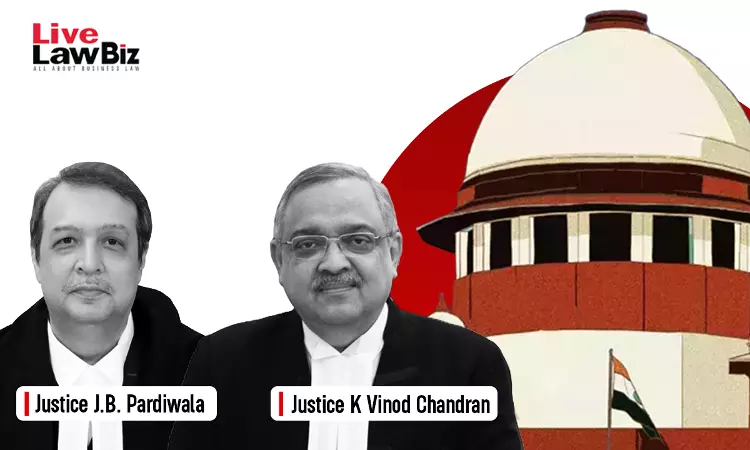
The Supreme Court on Monday held that the Committee of Creditors (CoC) cannot withdraw its approval of a resolution plan once it has been placed before the National Company Law Tribunal (NCLT) for approval under the Insolvency and Bankruptcy Code, 2016.
The court examined Section 12A of the IBC, which provides for withdrawal of a corporate insolvency resolution process (CIRP) application with the requisite approval of the CoC, alongside Sections 30 and 31, which govern the approval of resolution plans.
“Read together, we are of the opinion that the withdrawal of an application can only be till the CoC approves the plan and after it is placed before the Adjudicating Authority, there can be no withdrawal either of the application or the approved Resolution Plan,” a bench of Justices J.B. Pardiwala and K. Vinod Chandran observed.
The court declined to interfere with the National Company Law Appellate Tribunal's (NCLAT) decision that the CoC had no jurisdiction to withdraw its approval of the resolution plan.
The dispute arose after the CoC unanimously sought to withdraw a resolution plan providing for a resolution amount of ₹172.55 crore. It argued that the corporate debtor's financial position had improved considerably while the resolution professional managed its affairs, giving the successful resolution applicant (SRA) a windfall because it would have to bring in substantially less money than originally envisaged.
The CoC pointed out that the corporate debtor's opening balance had risen from ₹30 crore to ₹165 crore. It argued that implementing the plan would allow the SRA to acquire the business by bringing in substantially less money than originally envisaged, and that creditors could benefit from a fresh resolution process.
The corporate debtor's holding company, which belonged to its erstwhile promoters, separately sought to end the CIRP through a one-time settlement with creditors. The SRA opposed the requests, maintaining that the CoC-approved resolution plan was binding and could not be withdrawn.
The NCLT had initially allowed the application seeking withdrawal of the resolution plan. The NCLAT overturned that decision, holding that the CoC had no jurisdiction to withdraw its approval. It restored the application seeking approval of the resolution plan and directed the NCLT to consider it alongside the holding company's request to end the CIRP.
The CoC members then approached the Supreme Court.
The court relied on its earlier ruling in Ebix Singapore (P) Limited v. Committee of Creditors of Educomp Solutions Limited, which held that a resolution plan is binding between the CoC and the SRA once approved by the CoC. Applying that principle, the court held that the CoC could not withdraw the plan after it had been placed before the NCLT.
The bench also considered the Supreme Court's ruling in Kalyani Transco v. Bhushan Power & Steel Ltd., which recognised that the CoC retains an interest in a resolution plan until it is implemented.
However, the court clarified that the CoC's continued existence does not give it the power to withdraw a plan that has already been submitted to the NCLT.
“The finding that the CoC continues to exist till the Resolution Plan is implemented, does not detract from the essential binding nature of a Resolution Plan, approved by the CoC,” the court observed.
While declining to interfere with the NCLAT's decision, the Supreme Court directed the NCLT to consider both the application seeking approval of the resolution plan and the holding company's request to end the CIRP.
The tribunal must examine whether the resolution plan satisfies Section 30(2) of the IBC, including by assessing the corporate debtor's current financial position and cash balance against the terms of the plan.
The court clarified that improved profitability alone would not justify refusing approval if the resolution plan meets the requirements of Section 30(2) of the IBC.
“The improved profitability alone cannot be a reason to refuse approval if the Resolution Plan meets the requirements under sub-section (2) of Section 30,” the court observed.
The court clarified that, apart from its finding that the resolution plan was binding on the CoC and the SRA, its other observations were preliminary and should not determine the NCLT's final decision.
It requested the tribunal to consider both applications together and decide them as expeditiously as possible, keeping in mind the delay that had already occurred.
The appeal was disposed of.
For Petitioners: Advocate K.V Mohan
For Respondents: Advocates Hasan Murtaza, Shagufa Salim and Devashish Tiwari