
NCLT, NCLAT Staff Recruitment System 'Completely Hijacked' By MCA: Supreme Court
Kirit Singhania
29 Oct 2026 12:44 PM IST
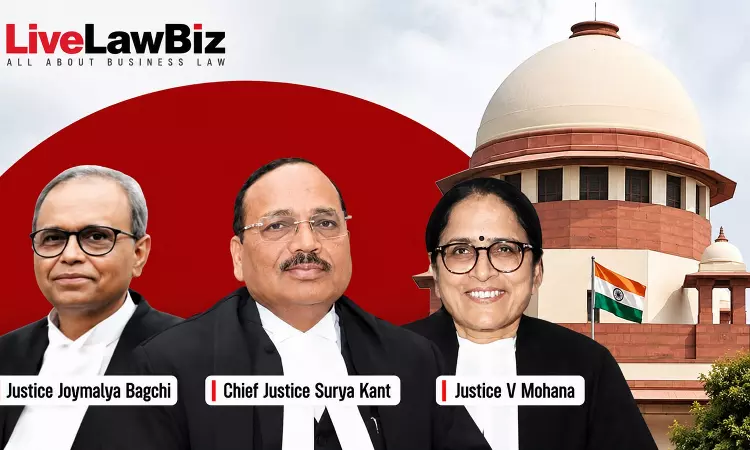
The Supreme Court on Thursday criticised the Ministry of Corporate Affairs' control over the recruitment system of the National Company Law Tribunal (NCLT) and the National Company Law Appellate Tribunal (NCLAT).
Chief Justice of India Surya Kant observed that the system had been “completely hijacked” by the Ministry.
The Court suggested that the Presidents of both tribunals be given greater autonomy over administrative staff appointments and recruitment. It proposed bringing experienced government personnel on deputation as an interim measure. The tribunals could undertake regular recruitment in phases, with assistance from the Union Public Service Commission (UPSC) or the Staff Selection Commission (SSC).
A Bench of Chief Justice Surya Kant and Justices Joymalya Bagchi and V. Mohana made the observations while hearing a writ petition concerning contractual employees at the NCLT. The Court issued notice in the matter.
During the hearing, CJI Surya Kant stressed the need for the tribunal Presidents to have greater control over their institutions.
“Complete autonomy must be with both Presidents of NCLT and NCLAT,” he said.
Suggesting an interim arrangement to address staffing requirements, the CJI said:
“Bring people on deputation, experienced persons from government departments. Meanwhile, they should undertake their own recruitment in a phased manner. They should take the assistance of UPSC or the Staff Selection Commission.”
The CJI also expressed concern over the Ministry of Corporate Affairs' control over the tribunals.
“This system, we are compelled to observe is completely hijacked by Ministry of Corporate Affairs. That is the problem. That is impinging on the autonomy of the institution. That is what you need to look into,” he observed.
He further remarked, “The Ministry wants to have complete grip over the institution. That is most unfortunate.”
Senior Advocate Meenakshi Arora, appearing for the contractual employees, submitted that those who had worked for a considerable period should not be removed abruptly. She argued that the employees should not be displaced before the Court decided how the issue should be addressed.
The CJI, however, responded, “Nothing is happening overnight.”
Arora submitted that the existing contract had been awarded to an independent private company. According to her instructions, the existing staff would likely be required to leave on November 1 or 2. Appointments would then be made by the new company.
The CJI questioned the legal basis for the employees' continued engagement.
“I would ask myself this question: those who have been working there for some time, what is their right under the law to continue? Those who have already been discharged, are they entitled to any compensation?” he asked.
Arora submitted that the employees had worked for six years and had acquired certain rights despite being employed on a contractual basis. She added that contractual employees appointed through the Ministry were not entitled to house rent allowance or dearness allowance because they were not treated as full-time employees.
The CJI responded, “We are not approving system.”
When Arora argued that employees would ordinarily be considered for regularisation after serving for a considerable period, the CJI questioned how regularisation could be granted without a competitive recruitment process.
“How can there be regularisation? You were not recruited through a competitive process. Nobody competed alongside you,” he said.
Arora countered that the NCLT recruitment rules and the relevant advertisement provided for regularisation. She argued that removing the employees collectively would be arbitrary.
The CJI also referred to an incident in Mumbai involving contractual employees who allegedly took away an original report, leading to the registration of FIRs. He expressed concern over the conduct of some contractual personnel and its impact on tribunal functioning.
Senior Advocate Shikhil Suri supported the need for regular appointments. He agreed with the CJI's observations on institutional autonomy and submitted that regular recruitment should be undertaken.
Senior Advocate Sanjiv Sen submitted that, despite the existing shortcomings, the NCLT under its current President had approved resolution plans worth more than ₹11,000 crore.
Advocate Arundhati Katju submitted that the Union should provide a category-wise breakdown of pendency in its status report.
The CJI observed that pendency fluctuated and suggested examining matters under the Companies Act that were not being taken up effectively.
When Katju pointed out that insolvency proceedings under the Insolvency and Bankruptcy Code (IBC) were receiving precedence over company matters, the CJI responded:
“We are aware of this. Bifurcated data should be provided.”
The Court issued notice in the petition. The CJI clarified that the notice was being issued “only for the larger public interest.”